Before you can build an effective mental health program, you have to understand what your people are actually going through. Skipping this step and jumping straight to a solution is a classic mistake. It’s how companies end up with generic, one-size-fits-all programs that barely get used and don’t touch the real issues causing stress and burnout.
Laying the Groundwork for a Mentally Healthy Workplace
The first real move is a proper needs assessment. This isn’t about ticking a box; it’s about digging in to genuinely understand your team’s wellbeing. The whole point is to find the specific stressors in your unique environment. Is it the workload? A particular management style? Maybe it’s just friction in the company culture. Getting this diagnosis right means whatever you build next will be a targeted solution, not just another superficial perk.
Let’s be clear: mental health struggles are common. A study published by the World Health Organization found that an estimated 12 billion working days are lost globally each year to depression and anxiety. And while 81% of workplaces say they’ve ramped up their focus on mental health since the pandemic, there’s a disconnect. A full one-third of employees still report feeling unsupported.
Moving Beyond Generic Surveys
A really solid assessment pulls from a few different places to get the full picture. If you just rely on an anonymous survey, you’re going to miss a ton of important context. A multi-pronged approach gives you much richer, more actionable information to work with.
Think of it as a three-part investigation: listen to what people say privately, observe what they discuss openly, and look at the hard data.
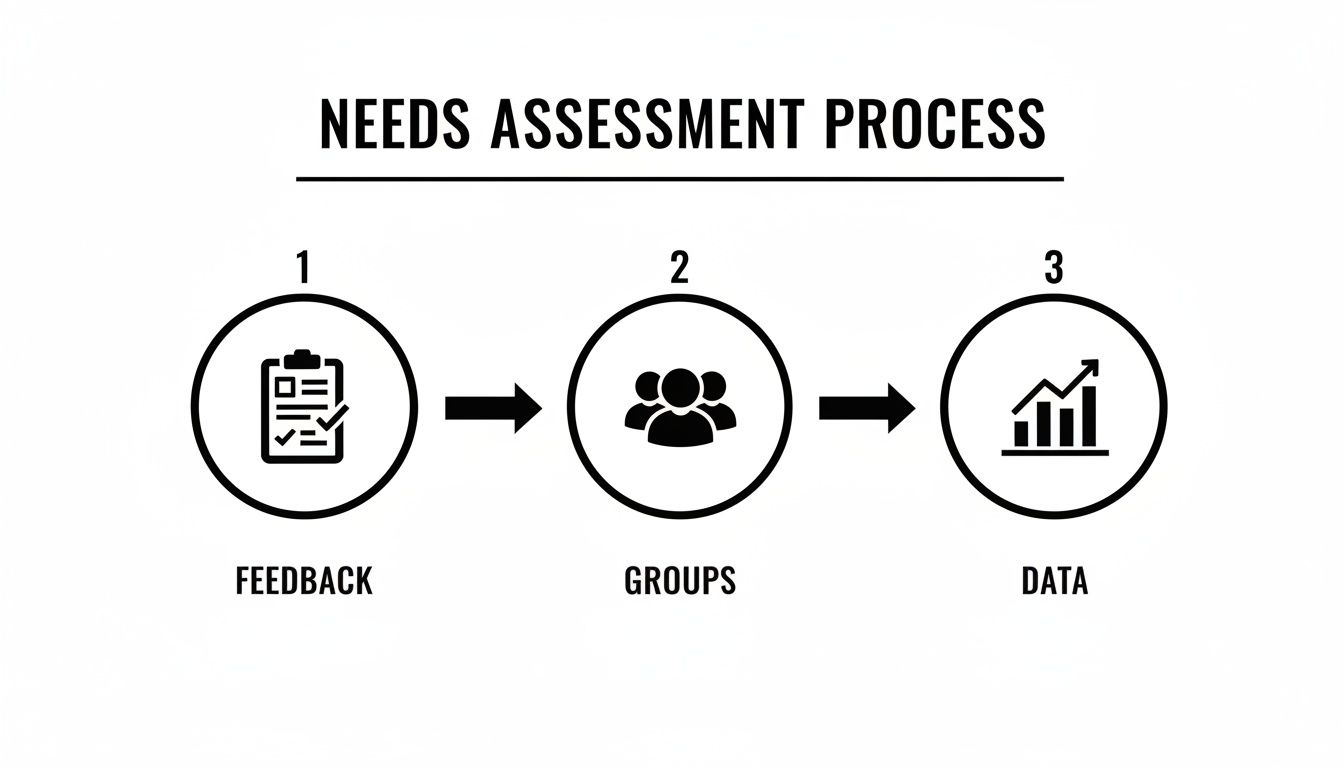
When you combine confidential feedback with direct conversations and objective metrics, you stop guessing and start making evidence-based decisions.
Combining Qualitative and Quantitative Data
A great place to start is with confidential employee surveys. But they have to be well-designed. Ask specific, pointed questions about workload, work-life balance, psychological safety, and whether people feel they have the resources they need. Action Step: Use a platform like SurveyMonkey or Google Forms to create an anonymous survey. Include a clear statement at the top guaranteeing confidentiality and outlining exactly how the data will be used to improve workplace conditions.
Next, run some candid focus groups. These are small, voluntary discussions that help you uncover the “why” behind the survey numbers. For instance, your survey might show crazy-high stress in the marketing department. But a focus group could reveal the problem isn’t the work itself, but a new manager’s inconsistent communication style. These conversations bring systemic issues to the surface that pure data can’t.
Finally, you need to look at the organizational data you already have. Start connecting the dots by looking at trends in:
- Absenteeism & Presenteeism: Are sick days spiking on certain teams? Are people logged on but clearly checked out?
- Turnover Rates: If one department has a revolving door of talent, that’s a massive red flag for a toxic micro-culture or unbearable pressure.
- EAP Utilization: If you have an Employee Assistance Program but nobody is using it, that’s a problem. It could point to a lack of awareness, stigma, or a service that just doesn’t meet your team’s needs.
This table provides a simple framework for structuring your data collection across these key areas.
Key Areas for Your Mental Health Needs Assessment
| Assessment Area | Data Collection Method | Key Questions to Ask |
|---|---|---|
| Workload & Stress | Anonymous Surveys, Focus Groups | “On a scale of 1-10, how manageable is your current workload?” “What is the single biggest source of stress in your role?” |
| Psychological Safety | Confidential Surveys, One-on-One Interviews | “Do you feel comfortable voicing a dissenting opinion in team meetings?” “Do you believe mistakes are treated as learning opportunities?” |
| Leadership Support | 360-Degree Feedback, Focus Groups | “Does your manager regularly check in on your well-being?” “Do you feel your manager advocates for you and your team?” |
| Resource Awareness | Surveys, EAP Usage Data | “Are you aware of the mental health resources available to you?” “What prevents you from using our current support programs?” |
| Organizational Culture | Absenteeism & Turnover Data, Focus Groups | “What are the biggest cultural challenges in your department?” “Why do you think people choose to leave our company?” |
By gathering and analyzing this information, you get a clear, detailed map of where the real pain points are in your organization.
Tying these different data streams together gives you a clear map of your company’s mental health landscape. That clarity is what allows you to build a program that actually solves problems, which in turn drives higher engagement and a much better return on your investment.
This proactive work is the foundation for cultivating mental wellness in business and creating a place where people can truly thrive. It sets the stage for introducing solutions with real impact, and you can learn more about the benefits of these programs in our other guides. The research is clear: programs designed to meet specific, identified needs deliver far better results for both people and the bottom line.
Moving Beyond the Old-School EAP
Once you’ve got a handle on what your team actually needs, you can start building a program that truly hits the mark. Let’s be honest: the days of just having a traditional Employee Assistance Program (EAP) and calling it a day are long gone. While an EAP can have its place, it’s often a reactive, underused resource that feels completely disconnected from the daily grind.
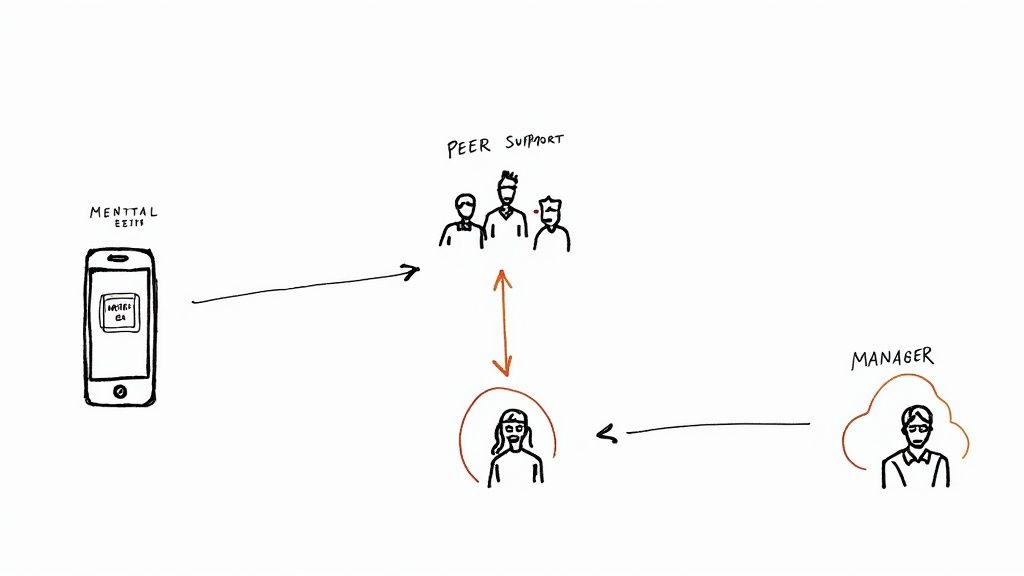
A mental health program that really works is less of a single benefit and more of a supportive ecosystem. The idea is to build a multi-layered system that meets people wherever they are, offering different entry points and kinds of support. This is key because not everyone needs—or wants—formal therapy.
Weaving Together a Diverse Support Network
A modern program mixes different kinds of support to fit various needs and comfort levels. Research from the American Journal of Health Promotion confirms that offering a variety of proven mental health interventions can significantly reduce the burden of mental health conditions. By blending proactive, preventative, and responsive tools, you build a much more resilient and genuinely supportive culture.
Think about integrating a few of these core pieces:
- Digital Mental Health Platforms: Apps and online tools give people on-demand access to things like guided meditations, Cognitive Behavioral Therapy (CBT) exercises, and mood trackers. They’re private and flexible, which often makes them the perfect first step for someone who’s hesitant to ask for help.
- Specialized Workshops: Forget generic “stress management.” Offer practical sessions on topics that came up in your needs assessment, like financial wellness, navigating tough conversations, or specific mindfulness techniques. You’re giving employees tangible skills they can use right away.
- Peer Support Groups: Setting up structured, confidential spaces for employees to connect over shared experiences can be incredibly powerful. It chips away at stigma and builds a real sense of community, reminding people they aren’t going through their struggles alone.
- Manager Coaching: Your leaders are your first line of support. Train them in empathetic communication, how to spot the early signs of burnout, and how to guide their team members toward the right resources without overstepping.
This layered approach ensures there are no gaps in your support system. If you want to see how other companies are putting these ideas into practice, you can explore these workplace wellness program examples.
What a Blended Program Looks Like in the Real World
Let’s make this concrete. Imagine a tech startup seeing high burnout rates among its engineers who are constantly on tight deadlines.
Instead of just handing them an 800 number, they could roll out a blended program:
- Proactive Tools: They might offer a company-wide subscription to a mindfulness app like Headspace or Calm for daily stress regulation.
- Skill-Building: Then, they could bring in a facilitator for workshops on managing cognitive load and preventing burnout, teaching practical, job-specific techniques.
- Direct Support: For those who need more personalized help, they might partner with a service like BetterUp for one-on-one professional coaching.
This strategy tackles the problem from all sides—daily prevention, practical skill development, and intensive, personalized support.
Or take the construction industry, which unfortunately has one of the highest suicide rates of any profession. A construction firm could combine on-site “mental health toolbox talks” to make these conversations normal with access to a digital therapy app that guarantees anonymity. This mix respects the industry’s tough-it-out culture while providing modern, accessible care.
A study in the Journal of Occupational and Environmental Medicine found that multicomponent programs—those combining education, stress management training, and EAP promotion—were more effective at improving employee well-being than single-component initiatives.
Why One Size Will Never Fit All
The best workplace mental health programs are flexible. They have to be. An employee’s needs change over time. Someone might start by using a self-guided digital journey to manage mild anxiety, later attend a workshop on financial stress, and eventually need one-on-one therapy during a major life event.
Your program needs to provide a clear pathway for that kind of progression. Action Step: Create a simple, one-page document for all employees that visually maps out the available resources. Categorize them by need (e.g., “For Immediate Support,” “For Proactive Wellness,” “For Manager Support”) with clear instructions on how to access each one. This makes navigation easy and empowers employees to find the right help quickly.
How to Get Leadership on Board and Engage Your People
Let’s be honest: even the most brilliant workplace mental health program is dead on arrival without real support from the top. If leadership isn’t bought in, your initiative is just a nice suggestion, not a core business priority. Getting everyone from the C-suite to team leads on board means building a rock-solid business case that frames this as a strategic investment, not just another expense.
The secret is to speak their language. Executives respond to numbers that affect the bottom line. So, instead of focusing only on well-being, you need to translate your program’s goals into tangible business outcomes they can’t ignore.
Crafting a Compelling Business Case
To really grab their attention, you have to connect the dots between mental health and the KPIs they track daily. It’s about shifting the conversation from cost to return on investment.
Frame your argument around these key areas:
- Reclaiming Lost Productivity: A workforce struggling with mental health isn’t performing at its peak. It’s that simple. One study in the Journal of Occupational and Environmental Medicine found that employees with depression cost companies an estimated 44 million lost workdays annually. Your program is a direct strategy to get that productivity back.
- Keeping Your Best People: High turnover is a budget killer. When you can show that a supportive environment makes people want to stay, you’ve got a powerful argument. People don’t just leave jobs; they leave cultures that don’t support them.
- Slashing Absenteeism: Draw a straight line from high rates of unscheduled absences to burnout and stress. Proactive mental health support isn’t just a perk; it’s a way to keep your teams present, engaged, and moving projects forward.
The narrative you’re building is simple: investing in our people’s mental health directly strengthens our financial health. It’s not just the right thing to do; it’s the smart thing to do.
Action Step: Build a one-slide executive summary for your presentation. Use data from your needs assessment (e.g., “Our current turnover in the X department is costing us $Y annually”) and connect it directly to your proposed solution (e.g., “A targeted manager training program is projected to reduce this by 15%”).
Finding and Empowering Your Internal Champions
Getting that executive sign-off is a huge win, but it’s just the beginning. For a mental health program to actually stick and shift the culture, you need passionate advocates at every level of the company. These are your internal champions.
Think about it: a program announced from on high can feel corporate and impersonal. But a recommendation from a trusted teammate? That feels real. These champions are the respected peers who can normalize conversations about mental health and encourage their colleagues to actually use the resources you’re providing.
One group you absolutely cannot overlook is your middle managers. Research consistently shows they’re the first to spot when an employee is struggling. When you train them and empower them to offer support, they become the most powerful champions you have.
Here’s how to activate these key players:
- Identify Natural Advocates: Look for managers and individual contributors who are already known for their empathy and are respected by their teams. They don’t need to be experts, just people who genuinely care.
- Give Them the Right Tools: Equip your champions with the training and language to talk about the program confidently. This means knowing what resources are available and, just as importantly, how to guide a colleague toward help without overstepping.
- Give Them a Seat at the Table: Involve these champions in the program’s evolution. Ask for their feedback. Feature their stories in internal newsletters. When others see their peers are bought in, it builds momentum and trust.
By creating this network of internal advocates, you weave your workplace mental health programs into the very fabric of your company. It’s a combination of top-down support and bottom-up enthusiasm that creates a solid foundation for real, lasting change. For more ideas on building this kind of supportive framework, check out our guide to employee stress management programs.
Rolling Out Your Program and Training Your Managers
How you introduce your new mental health resources is just as important as the resources themselves. A single company-wide email just won’t cut it. Your launch strategy sets the tone for engagement and trust, and a thoughtful, strategic rollout can be the difference between a program that thrives and one that gets ignored.
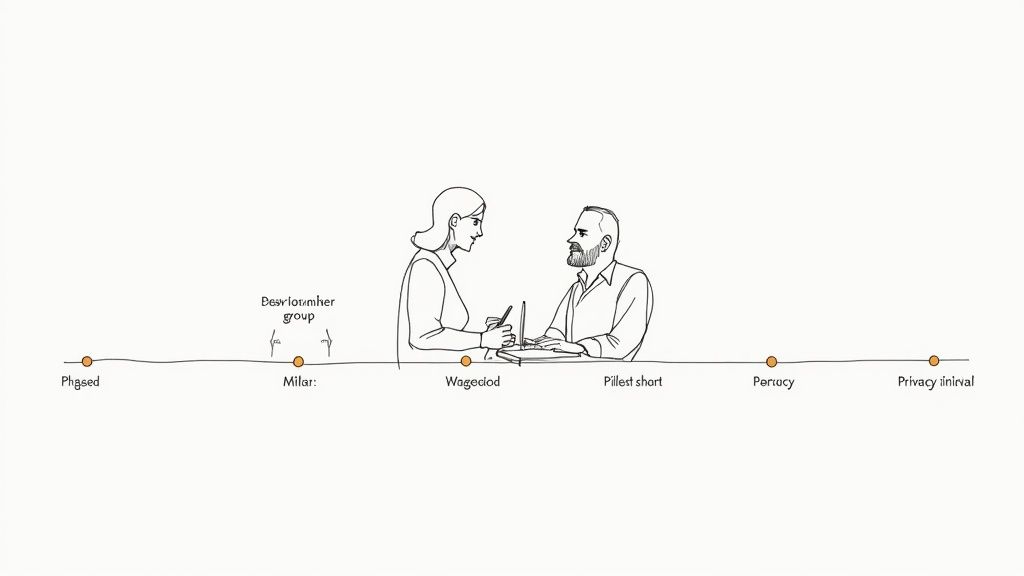
From my experience, a phased implementation works best. Rushing a full-scale launch often leads to unforeseen glitches and a poor first impression that’s hard to recover from.
Instead, start with a pilot group. This small, representative team—maybe a single department or a cross-functional group—can test-drive the program and give you honest, invaluable feedback. Their real-world experience will help you iron out any kinks, refine your communication, and build a stronger case before you go company-wide.
Transforming Managers into Your First Line of Support
While leadership buy-in gets the engine started, your managers are the ones steering the ship day-to-day. They’re on the front lines and are often the first to notice when a team member is struggling. The problem is, few are naturally equipped to handle these delicate conversations.
Without the right training, managers might overstep and give unqualified advice, or—more likely—they’ll avoid the conversation entirely out of fear of saying the wrong thing.
This is why manager training isn’t just a nice-to-have; it’s the most critical piece of your rollout. A study in The Lancet Psychiatry found that manager training can lead to a significant reduction in work-related sickness absence among employees. The goal is to give them the skills and confidence to be a competent and compassionate first point of contact.
Effective training moves beyond theory. It needs to focus on practical, real-world skills. For example, offering something specific like Mental Health 1st Aid Training can equip them with tangible skills for recognizing and responding to challenges. This empowers leaders to act as a crucial bridge to professional help, not a roadblock.
Essential Training Modules for Your Leaders
Build your training curriculum around clear, actionable modules that give managers a playbook for supportive conversations. Don’t drown them in clinical information; focus on what they can and should do within their role.
Here are the key modules I always recommend:
- Spotting Early Warning Signs: Teach managers to recognize the subtle shifts in behavior that can signal distress. This could be increased absenteeism, missed deadlines, social withdrawal, or uncharacteristic irritability.
- Initiating a Supportive Conversation: Give them simple, non-judgmental conversation starters. Action Step: Provide managers with a script of simple, approved phrases like, “I’ve noticed you’ve been quiet in meetings lately. How are things going?” or “You don’t seem like yourself recently. I just want to check in and see if you need any support.”
- Guiding to Resources, Not Diagnosing: This is the most important boundary to establish. Managers are not therapists. Their role is to listen empathetically and guide employees to the official resources you’re providing, whether it’s an EAP, a digital therapy app, or HR.
- Modeling Healthy Behaviors: Encourage managers to be open about their own well-being. When a leader takes a mental health day or talks about using a mindfulness app, it sends a powerful signal to their team that it’s okay to prioritize their own mental health.
For teams in high-pressure environments, you might also look into specialized programs like stress management training for employees, which offer practical tools for building resilience.
A well-trained manager becomes a gateway to support, not a barrier. They learn to create psychological safety, making it okay for employees to ask for help before a challenge becomes a crisis. This proactive support is the heart of an effective mental health strategy.
Recent data shows that since the pandemic, 81% of workplaces have sharpened their focus on mental health. Yet, one in three workers still want more from their employers—a gap that skilled managers are perfectly positioned to fill.
Proving Your Program’s Value: How to Measure What Really Matters
Let’s be honest: to get long-term buy-in and a real budget, you have to prove your mental health program is actually working. This isn’t just about counting how many people logged into an app. It’s about building a compelling case that connects your efforts directly to the health of the business.
Think of it as storytelling with data. You’ll learn to track meaningful shifts in things like employee engagement, turnover rates, and team morale. When you can draw a straight line from your program to these critical business outcomes, you’re not just asking for investment—you’re demonstrating undeniable ROI.
Choosing Metrics That Genuinely Tell a Story
The whole point here is to show a clear cause-and-effect relationship. We’ve all seen companies launch programs, yet a global survey reveals burnout is still sky-high. That’s a classic sign of a disconnect between activity and impact, and it’s exactly what a smart measurement framework helps you avoid.
A great way to start is by looking at a mix of leading and lagging indicators.
- Leading Indicators: These are your early warning signs and signals of progress. Think program participation rates, how many managers completed their training, or the feedback scores from a recent workshop. They tell you if you’re on the right track.
- Lagging Indicators: These are the results that show up over time. They’re the heavy hitters: things like voluntary turnover rates, absenteeism trends, and changes in short-term disability claims. This is where you see the long-term payoff.
By tracking both, you get the full picture. You can see that people are engaging with the program and that their engagement is actually moving the needle on key business metrics.
It’s worth noting that one study found mental health conditions are a huge driver of workers’ comp claims. In fact, they often result in four to five times more lost time than physical injuries. Suddenly, measuring a reduction in those claims becomes a very powerful way to frame your program’s financial impact.
Connecting the Dots to Business Outcomes
Once you have your KPIs, the real art is presenting them in a way that gets leadership’s attention. That means tying everything back to productivity, retention, and, ultimately, the bottom line. I’ve found that creating a simple dashboard is one of the most effective ways to visually track your program’s progress against the company’s biggest goals.
Here’s a look at how you can structure your measurement, moving from simple program activity all a way to real business impact.
Sample KPIs for Workplace Mental Health Programs
Tracking the right metrics is how you turn good intentions into a data-backed strategy. The table below outlines a few examples, moving from leading indicators (like engagement) to lagging indicators (like turnover) that leadership really cares about.
| KPI Category | Specific Metric | How to Measure |
|---|---|---|
| Program Engagement | Utilization of Digital Tools | Track active users and frequency of use through platform analytics. |
| Skill Development | Manager Confidence Scores | Use pre- and post-training surveys asking managers to rate their confidence in handling mental health conversations. |
| Behavioral Change | Absenteeism Rates | Analyze HR data to track unscheduled absences, especially on high-stress teams, before and after program launch. |
| Sentiment & Culture | Psychological Safety Scores | Include specific questions about feeling safe to speak up or admit mistakes in your annual employee engagement survey. |
| Business Impact | Voluntary Turnover | Monitor quarterly and annual turnover rates, cross-referencing with data from exit interviews to identify trends. |
This kind of structured approach takes something that can feel abstract, like “well-being,” and translates it into the concrete, data-driven language that business leaders understand and respect.
Don’t Forget the Human Element: The Power of Stories
Numbers alone can feel cold. They tell you what happened, but they rarely tell you why it mattered. This is where qualitative data—the stories—comes in to add depth and a human touch to your reporting.
Action Step: During your next round of employee surveys, include an optional open-ended question: “Can you share a specific example of how our company’s focus on well-being has impacted your work experience?” Collect these anonymous testimonials to share with leadership.
- Anonymous Testimonials: Give people a safe way to share quotes about how the program helped them.
- Focus Groups: Host informal discussions to explore how the program has changed team dynamics or communication.
- Manager Check-ins: Simply ask managers during one-on-ones if they’ve noticed a shift in their team’s resilience or openness.
Imagine presenting your turnover data and then sharing this from a manager: “Since the training, I’ve had two people on my team come to me for support. Before, I would have completely fumbled that conversation. Now, I actually know how to listen and point them to the right resources.” That single story brings your data to life. It’s no surprise that the U.S. Department of Labor highlights active listening as a core pillar of a mentally healthy workplace—these are the real-world skills that change everything.
Common Questions About Workplace Mental Health
As more and more companies start to connect the dots between employee well-being and a healthy bottom line, good questions start popping up. It’s one thing to want a supportive workplace; it’s another to figure out the nuts and bolts of making it happen.
Let’s walk through some of the most common hurdles employers face. We’ll cover the tricky stuff—like legal duties and employee privacy—and get practical about budgeting and making sure your remote teams feel just as supported as everyone else. The goal here is to give you the confidence to move forward.
How Do We Handle Employee Privacy and Legal Compliance?
This is, without a doubt, one of the biggest and most important questions. Getting this right is everything. If your team doesn’t feel their information is confidential, they simply won’t use the resources you’ve worked so hard to provide. Trust is the foundation of any successful program.
When you’re vetting a third-party partner—whether it’s a digital therapy app or a traditional EAP provider—you need to get forensic with their data privacy policies. They should only ever provide you with aggregated, anonymous data. Your contract must spell out in no uncertain terms that individual usage is completely confidential and firewalled from the company.
Legally, you have a duty of care. That means taking reasonable steps to protect your people from psychological harm at work, not just physical injury. In the U.S., you’ll see agencies like OSHA increasingly talking about mental health as a core part of workplace safety. Your role isn’t to be a therapist; it’s to create a supportive environment and make sure professional resources are easily accessible.
What’s a Realistic Budget for a Small Business?
You don’t need a Fortune 500 budget to make a real difference. In fact, some of the most effective initiatives cost very little. The secret is to start smart and focus on high-impact actions that build a strong foundation.
Here are a few places to start, even on a shoestring budget:
- Train Your Managers: This is your best bang for your buck. Giving managers the tools to communicate with empathy and confidently point employees toward help has a massive ripple effect.
- Curate Free Resources: You don’t have to create everything from scratch. Point your team to incredible, free resources from trusted organizations like the National Alliance on Mental Illness (NAMI) or the Mental Health Foundation.
- Encourage Peer Support: Employee-led support groups are a powerful and low-cost way to build community and chip away at stigma. You just need to provide the space and encouragement.
- Rethink Your Policies: Formalizing flexible work hours or solidifying remote work options can dramatically lower stress levels at no direct cost to the company.
A study in the Journal of Occupational Health Psychology found that even small, targeted programs focusing on stress reduction can lead to significant improvements in well-being and productivity. The ROI isn’t about flashy perks; it’s about fewer sick days and a more engaged team.
As you grow, you can then scale up to more comprehensive programs, like bringing in specialists for workshops or investing in a subscription-based mental health platform.
How Do We Adapt for a Remote or Hybrid Team?
Supporting a distributed workforce requires a whole new level of intention. You can’t rely on those casual “how are you really doing?” conversations by the coffee machine. You have to actively build that support into your virtual culture.
Isolation is a real challenge for remote employees. A study published in Cyberpsychology, Behavior, and Social Networking found that feelings of isolation were significantly associated with lower job satisfaction and higher stress among remote workers. This means proactive check-ins and easy-to-access digital tools are non-negotiable.
Here’s how you can adjust your strategy:
- Go Digital-First: Make sure every single resource, from your therapy app to workshop sign-ups, is a click away. No barriers.
- Train for Virtual Leadership: Your managers need to learn how to lead with empathy through a screen. That means training them to spot signs of burnout on a video call and knowing how to create psychological safety in a virtual meeting.
- Champion Asynchronous Work: Fight the “always on” culture. Set clear expectations around response times for emails and Slack messages to help your team disconnect without guilt.
- Schedule Human Connection: Be deliberate about creating non-work touchpoints. Virtual coffee chats, team-building games, or a simple “no-work-talk” call can go a long way in combating loneliness and keeping your team tight-knit.
By putting accessible digital tools and empathetic leadership at the center of your strategy, you can build a genuinely supportive culture that has nothing to do with where your people log in from.
At 9D Breathwork, we believe that true well-being comes from addressing challenges at their root. Our unique approach combines deep breathwork with immersive sound and targeted guidance to help individuals and teams release stress, overcome burnout, and build profound resilience from the inside out. Discover how our programs can support your organization by visiting 9dbreathwork.com.