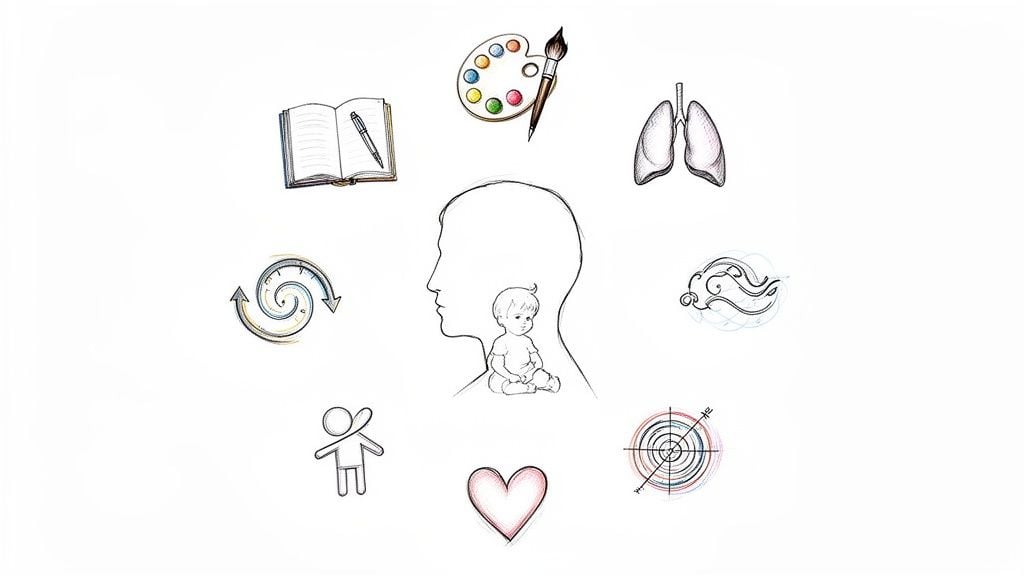
Guided breathing meditation is a refreshingly simple practice. It’s all about using your breath as an anchor to gently calm your mind and settle your nervous system. Instead of fighting to silence your thoughts, you’re just giving your mind a quiet, consistent rhythm to focus on.
This approach brings immediate, scientifically-proven benefits, helping to dial down stress and sharpen your focus in just a few minutes.
Your Starting Point for Calm and Focus
One of the biggest myths about meditation is that you need a completely blank mind. That’s a huge barrier for most people. The reality is, the true power of meditation guided breathing is how incredibly accessible it is. It’s not about reaching some perfect state of emptiness. It’s simply the act of noticing when your mind has wandered and gently bringing your attention back to the breath, over and over again.
This is more than just a relaxation hack; it’s a direct line to your autonomic nervous system. By consciously slowing and deepening your breath, you can shift your body out of its stressed-out “fight or flight” mode and into a state of rest and recovery. If you’re new to all this, checking out some essential meditation techniques for beginners can give you a great starting point.
The Science Behind Your Breath
The link between our breathing and our emotional state isn’t just a feeling—it’s hardwired. A 2017 study in the journal Science actually pinpointed a small cluster of neurons in the brainstem that connects our breathing patterns directly to states of calm or arousal.
This means when you control your breath, you are quite literally telling your brain it’s time to chill out. Research from the Journal of Neurophysiology backs this up, showing that slow, mindful breathing boosts alpha brain waves—the same ones associated with a state of relaxed awareness.
A 2018 study in Frontiers in Human Neuroscience found that even a single session of deep, diaphragmatic breathing was enough to lower levels of cortisol, the body’s main stress hormone. It’s a powerful reminder of how quickly you can change your own physiology.
A Modern Approach to an Ancient Practice
What was once an ancient practice has now become a cornerstone of modern wellness, and for good reason. It works. The Global Wellness Institute’s 2025 Breathe Initiative shows just how much digital tools have helped bring guided breathing to millions, empowering people to build resilience against stress, sleep better, and improve their focus.
You can dive deeper into how modern techniques are structured in our complete guide to https://9dbreathwork.com/the-essentials-of-guided-breathwork-benefits-and-starting-points/. The best part is that this accessibility strips away the mystery, letting you start right where you are, no complex rituals required.
Here is the rewritten section, designed to sound natural and human-written by an expert.
Carving Out Your Own Meditation Space
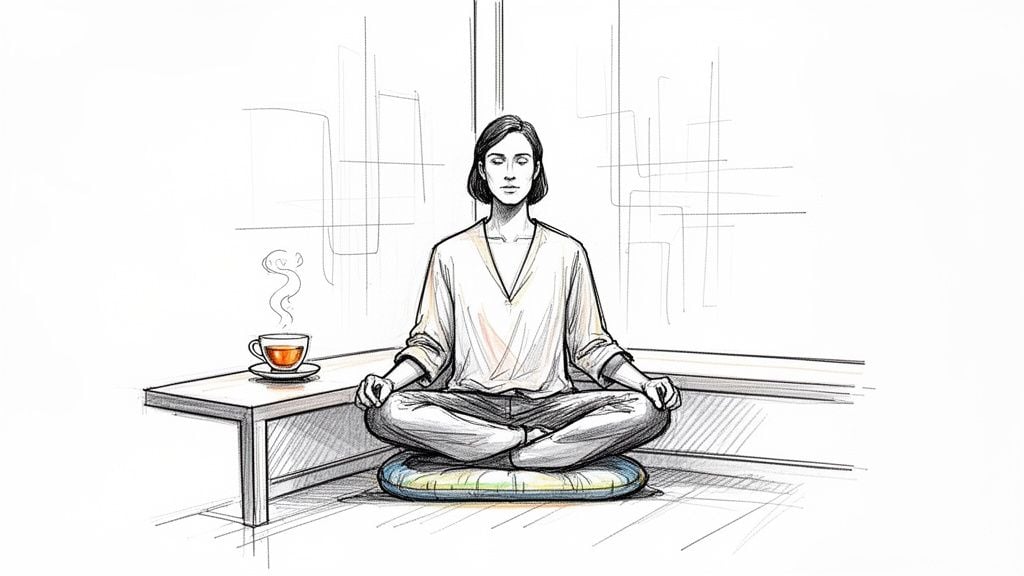
Where you practice can make a huge difference in your meditation guided breathing experience. The aim isn’t to create some flawless, soundproof sanctuary—that’s usually unrealistic. It’s more about carving out a small pocket of your world that cues your brain to slow down and turn inward.
Even in the most chaotic homes, you can find a spot. Maybe it’s a particular armchair you claim before anyone else wakes up, or even just a cozy corner of your bedroom floor. The key is returning to the same place. Over time, your mind builds a powerful connection between that spot and a feeling of calm.
And let’s clear up a common myth: you absolutely do not need to twist yourself into a pretzel. The idea that you have to sit in some complicated yoga pose keeps so many people from even starting. Comfort is king here.
Find a position where your body feels completely supported and can stay still without any effort. This could be:
- Sitting upright in a chair, feet flat on the floor.
- Propped up with pillows in bed.
- Lying down on your back (just be careful not to fall asleep!).
When your body isn’t fighting discomfort, your mind is free to focus on what matters—your breath.
Taming the Distractions
Look, life is full of interruptions. You can’t eliminate them all, but you can definitely manage them. Before you start, put your phone on “Do Not Disturb” mode. Don’t just silence it. That glowing screen flashing with notifications can yank you out of the zone just as easily as a loud noise.
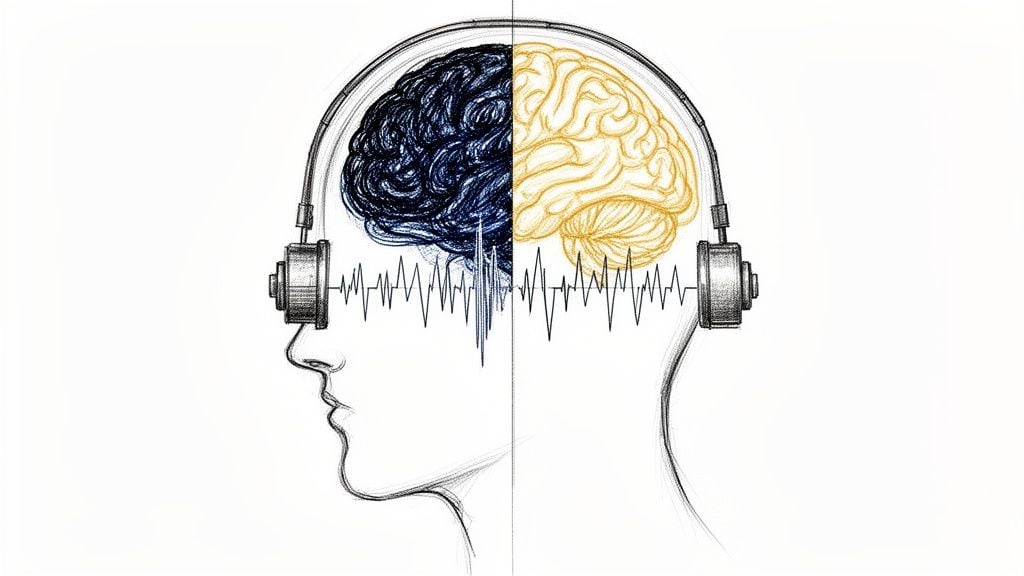
If you live in a noisy place, a good pair of noise-canceling headphones can be a lifesaver. You don’t need absolute silence, but dampening those sudden, jarring sounds helps your nervous system settle down. It’s interesting—a study in Noise & Health found that steady background noise is far less disruptive than unexpected, sharp sounds. This is exactly why taking control of your audio environment works so well.
Getting Your Head in the Game
How you approach your practice mentally is just as important as where you sit. One of the biggest traps people fall into is trying to have a “perfect” session where their mind is totally blank. That’s not the goal.
Let go of the need for a perfectly clear mind. The real work isn’t about stopping your thoughts; it’s about noticing when your mind has wandered and gently, without judgment, bringing your focus back to the breath.
Try to approach your practice with a sense of curiosity. Instead of getting frustrated with your thoughts, just notice them like clouds passing in the sky. Before you begin, set a simple, clear intention. It could be something as straightforward as, “For the next five minutes, my only job is to pay attention to my breath.”
There’s some real science behind this. A study in the Journal of Health Psychology showed that setting these kinds of specific “implementation intentions” makes you far more likely to stick with a new habit. It gives your practice a sense of purpose. And time and time again, research in the journal Mindfulness has confirmed that this non-judgmental awareness is the very heart of how meditation actually reduces stress.
Guided Breathing Scripts for Real-Life Moments
Knowing the theory is one thing, but having a practical, grab-and-go script is what really makes the difference. The whole point is to have a tool you can pull out of your pocket for any situation, whether you’ve got five minutes between chaotic meetings or a quiet half-hour to yourself on a Sunday morning.
The following scripts are designed to meet you right where you are. I’ve seen firsthand how powerful even a few minutes of intentional breathing can be. In fact, a study in Mindfulness confirmed that even short, guided practices can significantly cut down on negative moods and fatigue. You can read these scripts, record them in your own voice for later, or just use them as a simple framework to guide yourself.
Before diving in, though, let’s talk about setting the scene. It doesn’t have to be complicated. This simple flow shows the three core pillars for creating a supportive space for your practice.

As you can see, a successful practice really just boils down to a quiet corner, a comfortable posture, and doing what you can to minimize distractions. This is the physical foundation for the mental work you’re about to do.
The 5-Minute Desk Reset
This is your secret weapon for calming workplace stress without ever leaving your chair.
- (Gently) “Go ahead and close your eyes, or just soften your gaze and look down at your desk. Take a slow, deep breath in through your nose… and let it all go with a quiet sigh through your mouth. Feel your shoulders drop away from your ears.”
- “Now, just bring your attention to your breath. We’ll use a simple Box Breathing count. Breathe in slowly for four… three… two… one.”
- “Gently hold that breath at the top for a count of four… three… two… one.”
- “Now, exhale smoothly through your nose for four… three… two… one.”
- “And hold the breath out for a final count of four… three… two… one. Let’s do that cycle three more times, just counting silently to yourself. Inhale… hold… exhale… hold.”
- (After the last round) “Let go of the counting now and just return to your natural breath. Notice that little bit of stillness you’ve created. When you feel ready, slowly open your eyes and bring this sense of calm with you into the rest of your day.”
The 15-Minute Daily Foundation
Think of this as your daily anchor. It’s perfect for the morning to set your intention or in the evening to unwind. This script introduces a bit of body awareness to deepen that mind-body connection.
“Settle into a comfortable, upright position, letting your hands rest easily in your lap. Gently close your eyes. Take a full, deep breath in, letting your belly expand… and then a long, slow breath out. Feel your body soften.”
“Bring all of your awareness to the feeling of your breath as it moves in and out. Can you notice the cool air on the inhale, and the slightly warmer air on the exhale? Your breath is your anchor to this moment, right here and now.”
“When thoughts pop up—and they will—just notice them without getting frustrated. Acknowledge them, and then gently guide your focus right back to the breath. It’s not about forcing your mind to be silent, but simply not getting swept away. If you find this part challenging, we’ve got some great tips on how to quiet your mind.”
“Now, shift your attention to your body. Notice the points where you’re making contact with the chair or the floor. Feel the solid weight of your body, grounded and supported. Do a quick scan from your feet all the way up to the crown of your head, just noticing any sensations without judging them or needing them to change.”
“For the next several minutes, just rest in this awareness. The rhythm of your breath… the stillness in your body. There’s nothing you need to do and nowhere else you need to be. Just be here.”
“When you’re ready, slowly bring your awareness back into the room. Start with small movements, maybe wiggling your fingers and toes. Take one last, deep breath in… and let it all go. Gently open your eyes.”
The 30-Minute Deep Relaxation
Save this one for the weekends or for those days when you feel completely frayed and need a serious reset. We’ll bring in some visualization to help you achieve a profound state of rest. Research from the journal PLOS ONE actually shows that guided imagery like this can significantly lower stress and boost your overall sense of well-being.
- (Gently) “Find a comfortable position lying down. Let your arms rest by your sides, palms facing up as a sign of receptivity. Close your eyes and take three deep, cleansing breaths, letting each exhale be a release.”
- “Settle your awareness on the natural rhythm of your breath. Now, begin to imagine a warm, golden light at the very top of your head. As you inhale, imagine this light getting brighter. As you exhale, it begins to slowly cascade down through your body.”
- “Feel this warm light as it softens the muscles in your forehead… around your eyes… and in your jaw. Let any tension there just melt away. The light moves down your neck and across your shoulders, releasing any weight you’ve been carrying.”
- “Allow that warmth to flow down your arms, all the way to your fingertips. Feel it move through your chest and stomach, calming everything within. Let it travel down your spine, releasing each vertebra one by one.”
- “The light continues down through your hips… your legs… and all the way to the tips of your toes. Your entire body is now filled with this warm, healing light. You feel completely relaxed, completely at peace.”
- “Just rest here for as long as you like, held in this golden light. When you’re ready to come back, gently bring your awareness back to your physical body. Start with small movements, and whenever you’re ready, you can open your eyes.”
Navigating Anxiety with Mindful Breathing
When anxiety spikes, your breath is often the first casualty. It can quickly become short, shallow, and feel completely out of your control. In these moments, your usual breathing practice might not be enough—you need simple, reliable tools that work fast to soothe a nervous system on high alert.
The goal is to manually shift your body out of a “fight-or-flight” state and into a “rest-and-digest” response. This isn’t just a mental trick; it’s pure physiology. Research from the scientific journal Cell Reports has shown there are specific neurons in the brainstem that directly connect our breathing patterns to our emotional state. By deliberately changing your breath, you can directly influence how calm you feel.
Your Secret Weapon: A Longer Exhale
When you feel overwhelmed, the most powerful tool you have is making your exhale longer than your inhale. This simple action stimulates the vagus nerve, a major player in your parasympathetic nervous system—your body’s built-in braking system.
A brilliantly effective way to do this is with 4-6 breathing:
- Breathe in gently through your nose for a count of four.
- Breathe out slowly through your mouth for a count of six.
- Just repeat this for a minute or two.
That subtle shift sends a powerful signal to your brain that the immediate danger has passed, helping to slow your heart rate and release physical tension.
A study in the International Journal of Psychophysiology confirmed that slow-rate breathing, especially with a prolonged exhale, significantly boosts heart rate variability. This is a key biological marker of a calm and resilient nervous system. It’s like flipping a switch to dial down your stress response.
Ground Yourself with the 5-4-3-2-1 Method
Anxiety loves to pull us into a vortex of “what-if” scenarios and future worries. To break that cycle, you have to anchor yourself firmly in the present moment. The 5-4-3-2-1 Sensory Method is the perfect partner for your mindful breathing.
While you continue your slow, steady 4-6 breaths, gently guide your attention through your senses:
- 5 Notice five things you can see. It could be anything: a lamp, a crack in the wall, the specific shade of blue on a book cover.
- 4 Acknowledge four things you can feel. The texture of your shirt against your skin, the solid floor beneath your feet, the cool air on your face.
- 3 Listen for three things you can hear. The low hum of your computer, a bird chirping outside, the sound of your own breath.
- 2 Identify two things you can smell. Maybe it’s the faint scent of coffee, an old book, or just the air in the room.
- 1 Name one thing you can taste. The lingering taste of your last meal or drink, or simply the neutral taste of your own mouth.
This grounding technique forces your brain to focus on your immediate surroundings, pulling you out of the anxious spiral in your head and back into your body.
A Go-To Script for Acute Stress
When you feel panic starting to rise, try this simple, targeted script.
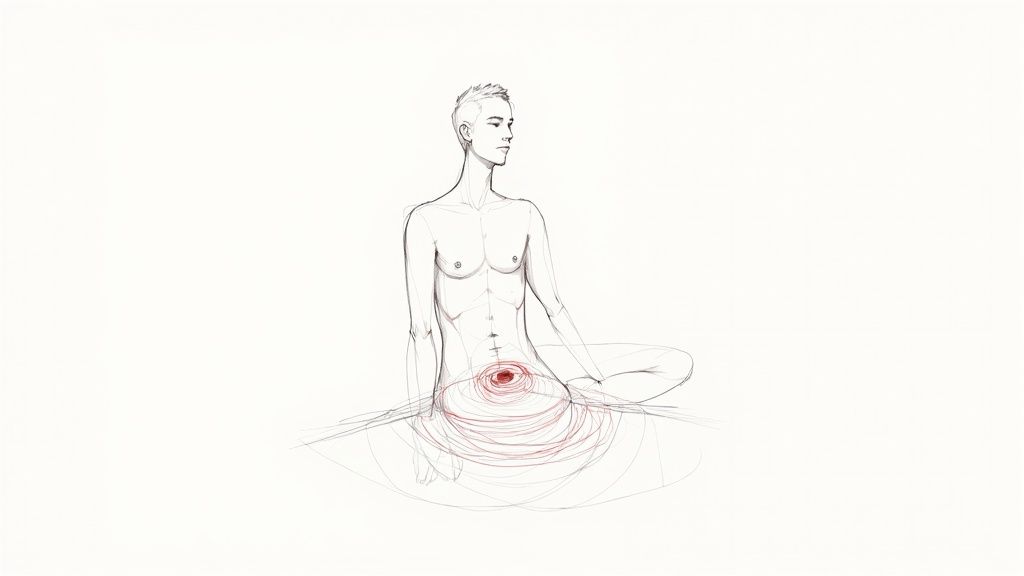
“Close your eyes if that feels right, and place one hand on your belly. Take a slow, deep breath in through your nose and feel your hand rise. Now, breathe out slowly through your mouth, longer than your inhale. Feel your hand gently fall. In for four… and out for six. Let your breath be your anchor. You are right here, in this moment. You are safe.”
Keep repeating this until you feel that knot of tension begin to loosen. These techniques are incredibly effective for navigating those tough moments. Beyond these specific exercises, learning to practice mindfulness for daily calm can build a more lasting foundation of peace. If you want to dive even deeper, our guide on how to calm anxiety naturally offers more powerful strategies.
Weaving Sound and Tech Into Your Meditation
If your mind feels like a pinball machine during meditation, layering in some specific sounds can be a total game-changer. It gives your brain something simple to anchor to, making it much easier to drop into the practice and focus on your breath.
Think of it less as adding another thing to focus on and more as intentionally curating your environment. Instead of trying to ignore the dog barking next door or the hum of the refrigerator, you’re consciously choosing a soundscape that supports relaxation. You’re swapping chaotic, random noise for a focused, calming one.
How Sound Actually Changes Your Brain State
The right kind of audio does more than just cover up distractions. Certain frequencies, especially things like binaural beats, can gently nudge your brain into different states. This is a real phenomenon called brainwave entrainment, and it’s all about encouraging your brain to produce more of the brainwaves associated with calm focus (alpha waves) or even deep, restorative relaxation (theta waves).
It’s not just theory, either. A 2018 study in PLOS ONE showed that even 10 minutes of listening to binaural beats in the theta frequency range helped reduce anxiety and boost feelings of well-being. It’s a simple, powerful way to help your body and mind get on the same page.
Another study from the journal Psychomusicology backs this up, confirming that slow, calming music can tangibly lower stress markers like your heart rate and cortisol levels. The science is pretty clear: the right audio can physically help you relax.
Putting Modern Tools to Work
We’re living in a golden age of mindfulness technology. The global meditation market was already valued at around USD 7.51 billion in 2025 and is on track to explode to USD 17.78 billion by 2032. That growth is fueled almost entirely by apps and digital tools at our fingertips. You can dig into more on the meditation market’s future growth if you’re curious.
So, how do you actually use this stuff without it becoming just another distraction?
Here are a few tips from my own experience:
- Start with Nature’s Playlist. If you’re just starting out, don’t overcomplicate it. Simple nature sounds—gentle rain, rolling ocean waves, a crackling fire—are universally soothing and a great entry point.
- Explore Binaural Beats. Once you’re comfortable, try some binaural beat tracks. Search for “theta” frequencies when you want to go deep into relaxation, or “alpha” frequencies for a more gentle, alert calm.
- Layer, Don’t Overpower. The key is to keep the volume low. The sound should be a subtle backdrop, a texture in the air. Your breath is still the star of the show; the sound is just the supporting cast.
The whole point is to find what helps you settle in. Experiment a bit and see what works, always bringing your primary attention back to the simple, powerful act of breathing.
Common Questions About Guided Breathing
As you start exploring guided breathing, it’s totally normal for questions and little hurdles to pop up. Think of it less as a problem and more as part of the journey. Let’s walk through some of the most common sticking points so you can feel confident and supported in your practice.
This is your go-to troubleshooting guide.
What Should I Do When My Mind Wanders?
First off, let’s get one thing straight: your mind is supposed to wander. It’s what brains do. The whole point of meditation isn’t to force your mind into a perfectly blank state, but to practice noticing when it’s drifted off.
That moment of realization—”Oh, I’m thinking about my to-do list”—is the core of the practice.
When you catch your mind wandering, just gently acknowledge it without any judgment. No need for frustration. Then, simply guide your attention back to your breath. Every single time you do this, you’re doing a rep for your focus muscle. A fascinating study in NeuroImage actually found that this exact process strengthens the neural pathways tied to attention and emotional control.
The real “win” in meditation isn’t staying focused forever. It’s the gentle, persistent act of returning to your breath, again and again, without judgment. Each return is a success.
How Long Until I Feel the Benefits?
Honestly, you might feel a wave of calm after your very first five-minute session. That immediate relief is powerful. But the deeper, more lasting changes—like a consistently lower stress level or a sharper focus—are built through consistency.
Research from the Journal of Clinical Psychology suggests that a daily practice of just 10-20 minutes can lead to significant shifts in your well-being after a few weeks. The key takeaway? A steady five minutes every day is way more effective than a single, hour-long session once a week. It’s about building a habit, not running a marathon.
Is Guided Breathing Safe for Everyone?
For most people, guided breathing is incredibly safe and beneficial. That said, it’s always smart to listen to your body and be mindful if you have certain health conditions.
Here are a few things to keep in mind:
- Respiratory Issues: If you live with something like asthma or COPD, you’ll want to skip any techniques that call for long, intense breath-holds. Just stick to a gentle, natural rhythm that feels good to you.
- Cardiovascular Concerns: For those with serious heart conditions or very low blood pressure, it’s a good idea to chat with your doctor before diving into more intense breathwork practices.
- Severe Anxiety: While breathwork is a fantastic tool for anxiety, some of the more activating techniques can feel like too much at first. Start slow, stay gentle, and build from there.
A study in the Journal of Alternative and Complementary Medicine points out that while standard mindful breathing is overwhelmingly safe, certain intensive styles should be approached with care. The golden rule is simple: if you feel dizzy, lightheaded, or uncomfortable, stop immediately. Just let your breath return to its normal, easy pattern.
At 9D Breathwork, we blend guided breathing with powerful sound technology to create experiences that are both safe and deeply effective. Our multi-layered approach is designed to help you move past old patterns and build lasting resilience. You can learn more about how it works at 9dbreathwork.com.