The secret to stopping intrusive thoughts isn’t to fight them head-on. It’s about fundamentally changing your relationship with them. The real goal is to see them for what they are, detach from their scary stories, and dial down your emotional reaction using a mix of smart thinking and mindfulness.
First, Let’s Understand Intrusive Thoughts
Ever been driving and had a sudden, jolting thought to yank the wheel into oncoming traffic? Or maybe a completely bizarre, unwelcome image popped into your head while you were trying to relax. These are intrusive thoughts. Think of them as mental pop-up ads—unwanted, unexpected, and often jarring precisely because they go against everything you believe and value.
Here’s the most important thing you need to grasp: you are not your thoughts. Having a weird or disturbing thought doesn’t make you a bad person. It doesn’t mean you secretly want to do what the thought suggests. It’s just your creative, and sometimes overactive, mind doing what it does—generating random noise.
What Makes a Thought “Intrusive”?
A thought crosses the line into “intrusive” when it feels totally unwanted. It feels like it comes from somewhere else, arriving without an invitation and leaving you with a wave of distress, confusion, or even shame.
These thoughts get “sticky” when we give them too much credit. We see the thought, panic, and try to shove it away. This struggle actually tells our brain, “Hey, this one is important!” which, ironically, makes it come back even stronger.
For instance, a new parent might have a fleeting, horrifying image of dropping their baby. This doesn’t mean they’re a monster. It’s a reflection of how deeply they love that child and how terrified they are of anything bad happening. The real issue isn’t the thought itself—it’s the panicked reaction to the thought. Learning to create that space between the thought and the reaction is the first big step. If you’re looking to build this kind of mental muscle, a great place to start is learning how to increase self-awareness.
An intrusive thought gets its power not from what it says, but from the importance and belief you assign to it. The aim is to become a neutral observer of your mind, not a frantic participant in its drama.
To help you get better at spotting the difference, here’s a quick comparison.
Intrusive Thought vs Intentional Thought
This table helps distinguish between a harmless intrusive thought and a thought that actually reflects your true feelings or intentions.
| Characteristic | Intrusive Thought | Intentional Thought |
|---|---|---|
| Origin | Feels sudden, random, and out of nowhere. | Arises from your values, goals, or current focus. |
| Emotion | Causes distress, anxiety, or disgust. | Feels aligned, neutral, or productive. |
| Control | Feels unwanted and hard to get rid of. | Feels like it’s “yours” and you can direct it. |
| Content | Often contradicts your true character and morals. | Is consistent with your beliefs and who you are. |
Recognizing these distinctions in the moment is a powerful way to reclaim your peace of mind.
This Is a Completely Normal Experience
If you’re dealing with this, you’re in good company. This is a nearly universal part of being human. A landmark 2014 study published in the Journal of Obsessive-Compulsive and Related Disorders found that up to 94% of people experience unwanted intrusive thoughts, with most admitting they’d had at least one in the last three months. These thoughts can be as simple as, “Did I lock the door?” or as upsetting as a violent or taboo image. It’s not a personal failing; it’s just a common quirk of how our brains work.
While incredibly common, these thoughts can sometimes become part of a clinical issue like Obsessive-Compulsive Disorder (OCD). This only happens when they are persistent, intensely distressing, and lead to repetitive, compulsive behaviors aimed at “neutralizing” them. For anyone wanting to dig deeper into the subject of anxiety, there are some fantastic resources out there, including some of the best anxiety books to support your wellbeing.
Practical CBT Strategies to Reframe Your Mindset
If you want to stop intrusive thoughts from hijacking your day, you need practical tools that change your relationship with them. Cognitive Behavioral Therapy (CBT) offers some fantastic techniques, and they’re not about fighting or suppressing your thoughts—that’s a losing battle. Instead, it’s about learning to observe them without getting swept away. This simple shift is what dials down their emotional power and puts you back in the driver’s seat.
The central idea here is something called cognitive defusion. Think of it as creating a bit of space between you and your thoughts. You learn to see them for what they are: just mental events, like clouds passing in the sky. They aren’t objective truths or commands you have to follow. So, when an intrusive thought pops up, instead of grabbing onto it and wrestling with it, you can simply acknowledge its presence and let it go.
This simple diagram captures the essence of that pause—the moment where you get to decide how to react.
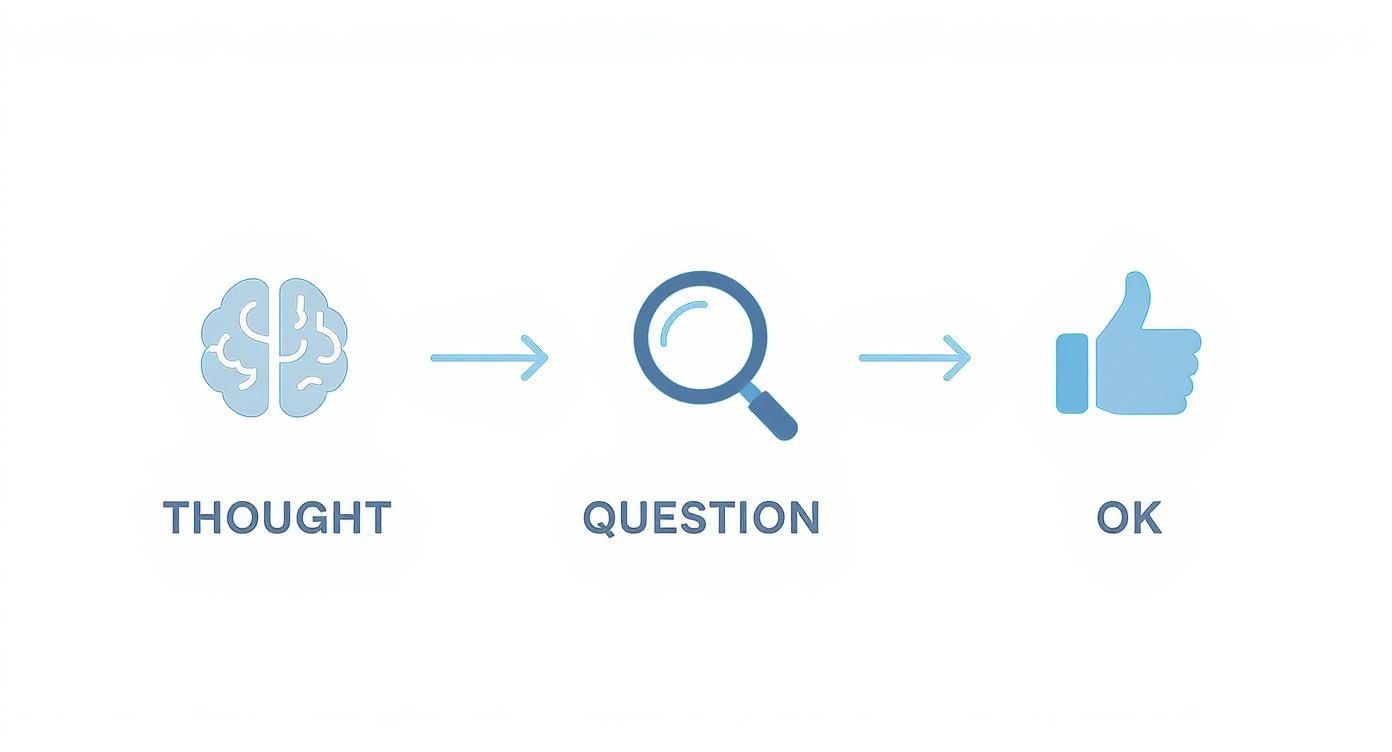
It’s a great reminder that we can stop, question a thought’s validity, and choose not to give it power over us.
Simple Defusion Exercises You Can Use Now
Practicing cognitive defusion doesn’t require a therapy session. You can start right now with a few simple, yet surprisingly powerful, mental exercises. These are designed to strip intrusive thoughts of their authority.
- The “Leaves on a Stream” Technique: This is a classic for a reason. Action: Right now, close your eyes and picture yourself sitting beside a gently flowing stream. As each thought enters your mind, place it on a leaf and watch it float away. The trick is not to push it or analyze it—just observe it as it drifts calmly out of sight. Try this for two minutes.
- Labeling Your Thoughts: When a difficult thought arises, mentally label it: “I’m having the thought that…” Action: Next time you have a thought like “I’m a terrible friend,” reframe it as, “I’m having the thought that I’m a terrible friend.” This small linguistic tweak creates a crucial separation between you (the observer) and the thought (the mental event).
By using these methods, you’re training your brain to stop getting tangled up in unwanted mental chatter. For more techniques like this, you’ll find a ton of helpful information in our guide on how to break negative thought patterns.
Create a Thought Record to Identify Triggers
Another incredibly effective CBT tool is the thought record. It’s essentially a structured way to journal. You write down the intrusive thought, what was happening when it appeared, the emotions it stirred up, and then—this is the important part—you actively challenge its truthfulness.
Getting thoughts out of your head and onto paper helps you see them more objectively. Over time, you’ll start to spot recurring patterns and can consciously practice more balanced responses.
By documenting your thoughts, you move from being a passive victim of your mind to an active investigator of its patterns. This shift in perspective is the key to lasting change.
Actionable Example: Let’s say a project manager is getting anxious about an upcoming client presentation. Here’s what their thought record might look like:
- Situation: I’m preparing the slides for the quarterly review.
- Intrusive Thought: “I’m going to blank out, forget everything, and look completely incompetent.”
- Challenge: “Okay, hold on. I’ve prepared thoroughly for this. I’ve given successful presentations many times before. Feeling nervous is just my body’s reaction to something important—it’s not a prediction of failure.”
- Balanced Response: “It’s normal to be anxious, but I am well-prepared and perfectly capable of handling this presentation professionally.”
Walking through this process makes the thought much less intimidating. If you’re new to this, check out this fantastic guide on how to start journaling for self-discovery and mental clarity for some practical tips to get you going.
Using Mindfulness to Find Calm

When an intrusive thought crashes your mental party, your first instinct is probably to shove it out the door. You fight it, argue with it, or try to bury it. But this resistance is like trying to hold a beach ball underwater—the second you let up, it rockets back to the surface with even more force.
Mindfulness gives you a completely different playbook. Instead of fighting, you learn to simply observe.
The whole point is to anchor yourself in the present moment. This creates a bit of breathing room between you and your thoughts, allowing them to drift by without pulling you into a full-blown drama. You’re not trying to achieve a silent, empty mind. The goal is to shift from being an actor in the story of your thoughts to being a calm member of the audience.
It’s not just a nice idea; science backs it up. A 2011 study published in Psychiatry Research showed that people who practiced mindfulness had less gray matter density in their amygdala—the brain’s fear center. This suggests that with regular practice, you can actually rewire your brain to be less reactive to the very thoughts that used to send you spiraling.
Cultivating Present-Moment Awareness
The heart of mindfulness is gently pulling your attention back to the here and now. It’s a simple move, but it’s powerful. It loosens the grip of those sticky thoughts that are almost always rooted in worries about the past or fears about the future.
And you don’t need a special cushion or a silent retreat. You can do this right now.
Action: Start by tuning into your senses. What do you feel? Notice the solid ground beneath your feet or the texture of the fabric on your chair. What do you hear? Listen to the sounds around you without judging them as good or bad. This simple act of pure observation yanks you out of your head and plants you firmly in your immediate reality.
Mindfulness isn’t about emptying your mind. It’s about being fully aware of what’s in your mind without letting it control you. This awareness is where your power lies.
A Practical Breathwork Exercise for Instant Calm
Your breath is your most reliable anchor. It’s always with you. When an intrusive thought sparks anxiety, your breathing almost immediately gets shallow and fast. By consciously slowing it down, you send a direct message to your nervous system: “We’re safe.” This can stop an anxious thought in its tracks.
The 4-7-8 breathing technique is a game-changer because it’s effective, quick, and subtle enough to do anywhere—even in the middle of a tense meeting.
Action: Here’s how to do it right now:
- Breathe in through your nose for a count of 4. Keep your mouth closed.
- Hold that breath for a count of 7.
- Exhale slowly through your mouth, making a whoosh sound, for a count of 8.
Just repeat this cycle three or four times. You’re essentially hitting the pause button on the feedback loop between an anxious thought and your body’s physical stress response. Research has shown that slow, deep breathing can measurably reduce the physiological symptoms of anxiety. A 2017 study in Frontiers in Psychology found that controlled, slow breathing exercises significantly reduce anxiety and improve attention, making it a perfect on-the-spot tool for your mental toolkit.
Grounding Techniques to Anchor Your Mind

When an intrusive thought sends your mind spinning, one of the best things you can do is get out of your head and into your body. This is where grounding techniques come in. They are simple, sensory-based exercises that pull your focus back to the here and now, effectively hitting the emergency brake on an anxious mind.
Think of them as a way to short-circuit the feedback loop of anxiety. These aren’t complex mental gymnastics; they’re practical actions you can use anytime, anywhere, to anchor yourself in the present moment. A study in the Journal of Behavior Therapy and Experimental Psychiatry found that sensory-focused tasks effectively reduce the distress and frequency of intrusive memories, showing that focusing on sensory input disrupts the very cognitive processes that fuel distressing thoughts.
The 5-4-3-2-1 Method: Using Your Senses as an Anchor
One of the most effective and well-known grounding exercises is the 5-4-3-2-1 method. It’s incredibly powerful because it systematically engages each of your senses, reconnecting you with the world outside your own head. Best of all, it’s discreet and can be done in just a minute or two.
Action: Try this the next time you feel overwhelmed:
- 5 – SEE: Look around you and mentally name five things you can see. Don’t just list them; notice details. “I see the subtle texture of the office wall, my blue pen, the light reflecting off my computer screen…”
- 4 – FEEL: Shift your awareness to your sense of touch. Acknowledge four things you can physically feel. This could be the solid pressure of your feet on the floor, the soft fabric of your shirt, or the smooth, cool surface of your desk.
- 3 – HEAR: Listen closely and pick out three distinct sounds. Maybe it’s the low hum of the air conditioner, the distant sound of traffic, or even the sound of your own breathing.
- 2 – SMELL: Focus on what you can smell right now. Identify two separate scents, even if they’re faint—like the aroma of coffee from the breakroom or the clean scent of soap on your hands.
- 1 – TASTE: Finally, bring your attention to one thing you can taste. This might be the lingering flavor of your last sip of water or just the neutral taste inside your mouth.
This process forces your brain to switch gears from abstract worry to concrete, sensory data. It’s a quick and powerful reset button.
Grounding isn’t about ignoring your thoughts. It’s about shifting your attention to something more powerful—your present reality. By focusing on physical sensations, you remind your nervous system that you are safe right now.
What This Looks Like in the Real World
Practical Example: Let’s say you’re in a tense family dinner. An old, sensitive topic comes up, and you feel that familiar knot of anxiety tightening in your chest. An intrusive thought about saying something awful or inappropriate flashes through your mind.
Instead of getting swept away by it, you discreetly ground yourself. You press your feet firmly into the floor (feel). You focus on the intricate pattern of the wallpaper across the room (see). You tune into the clinking of silverware on plates (hear). You take a slow, deliberate sip of water, noticing its cool temperature as it goes down (taste and feel).
Within moments, the emotional charge of the thought starts to fade. You haven’t fought the thought—you’ve simply redirected your brain’s attention, and in doing so, you’ve taken back control.
Other great options include holding a piece of ice, mindfully sipping a cup of hot tea, or even exploring simple breathing exercises to lower your heart rate. These small, intentional actions are incredibly effective at breaking the cycle of distress.
When It’s Time to Bring in a Professional
The strategies we’ve talked about are fantastic for managing those occasional, unwelcome thoughts that pop into your head. They’re your go-to toolkit for everyday mental noise. But what happens when that noise becomes a roar?
If your intrusive thoughts start to feel relentless, cause serious distress, or make you shrink your world to avoid them, that’s a clear signal it’s time to call in professional support. Think of it this way: the techniques here are like excellent first aid, but some wounds need a specialist.
When these thoughts consistently get in the way of your work, your relationships, or just your ability to feel okay, a mental health professional can offer much more targeted, evidence-based treatments.
It’s important to know that clinically, intrusive thoughts are often linked to conditions like Obsessive-Compulsive Disorder (OCD) and Post-Traumatic Stress Disorder (PTSD). In fact, around 2% of the global population deals with OCD, a condition where intrusive thoughts are a core feature. They’re not just a quirk; they are a recognized diagnostic criterion in the DSM-5-TR, which underscores how seriously they can impact a person’s life. You can dig deeper into OCD statistics and their global impact on BrainsWay.com.
Red Flags That You Need More Support
It can be tough to know when to make the call. You don’t have to be in a full-blown crisis to benefit from therapy. It might be time to reach out if you notice any of these signs:
- They’re getting louder and more frequent. The thoughts are showing up more often, and their emotional punch is getting stronger.
- You’re actively avoiding things. You find yourself dodging certain places, people, or activities just to keep the thoughts from being triggered.
- You’ve developed rituals. You’re performing specific actions—like checking things repeatedly, counting, or constantly asking for reassurance—to try to cancel out the thoughts.
- They’re tanking your mood. The thoughts are leaving you with a persistent feeling of anxiety, shame, guilt, or even depression.
If any of that sounds familiar, professional guidance can be a game-changer.
The Most Effective Therapies for Intrusive Thoughts
When you do seek help, you’ll find that there are highly effective, science-backed therapies designed specifically for this. The two heavy hitters are Exposure and Response Prevention (ERP) and Acceptance and Commitment Therapy (ACT).
Seeking therapy isn’t giving up; it’s gearing up. You’re making a strategic decision to equip yourself with the best tools available for your long-term mental well-being.
- Exposure and Response Prevention (ERP): This is the gold-standard treatment, especially for OCD. With a therapist’s guidance, you’ll gradually face the thoughts or situations that trigger your anxiety (exposure) without performing your usual compulsive safety behavior (response prevention). Over time, this process retrains your brain to understand that these thoughts aren’t genuine threats, which turns down the volume on your anxiety.
- Acceptance and Commitment Therapy (ACT): This approach takes a different angle. Instead of fighting the thoughts, ACT teaches you how to let them be there without letting them run the show. You learn to unhook from their power and focus on taking actions that align with what truly matters to you, even when your mind is being loud and difficult.
How to Find the Right Therapist for You
Taking that first step can feel like the hardest part. A great place to start is by looking through online directories for therapists who specialize in OCD, anxiety, ERP, or ACT.
When you have that first consultation call or meeting, don’t be shy about asking direct questions. You’re interviewing them for a very important job.
- What’s your experience in treating intrusive thoughts or OCD?
- Which therapeutic models do you use? (Listen for ERP, CBT, or ACT).
- What would a typical session focused on this issue look like?
Finding the right person is everything. You need someone who has the clinical chops, but just as importantly, you need someone you feel safe with and understood by.
Still Have Questions About Intrusive Thoughts?
Even with new tools in your pocket, you might still have a few questions rattling around. That’s perfectly normal. Getting straight answers can build the confidence you need to put these techniques into practice and find your footing. Let’s clear up some of the most common ones.
Is It Possible to Get Rid of Intrusive Thoughts for Good?
This is the big one, isn’t it? The honest answer is a bit of a paradox. The goal isn’t really to wipe them out completely, mostly because trying to force a thought away just makes it boomerang back harder. It’s a strange quirk of the mind called the ironic process theory—the more you tell yourself not to think about a pink elephant, the more you see a pink elephant.
The real aim is to fundamentally change your relationship with these thoughts.
It’s about learning to see them as what they are: random, powerless bits of mental static, not directives you have to follow or truths about who you are. As you get better at detaching and observing them without judgment, the emotional sting starts to fade. Over time, you’ll probably find they pop up less, and when they do, they’ll have far less power over you.
How Are Intrusive Thoughts Different from Just Plain Worrying?
It’s easy to lump them together since both feel awful, but they have a very different texture. Worrying tends to be a string of “what if” scenarios about a real-world problem you could potentially face. It often feels like you’re trying to chew on a problem to solve it, even if you’re just going in circles.
Intrusive thoughts are a whole different beast. They are often bizarre, random, and ego-dystonic—a clinical term that just means they run completely contrary to your true values and self-image.
Let’s put it in context:
- Worrying sounds like: “What if I bomb this presentation and my boss thinks I’m incompetent?”
- An intrusive thought feels like: A sudden, shocking, and unwanted violent image that comes out of nowhere and makes you think, “Where on earth did that come from?”
Getting a handle on this difference is crucial because it helps you stop taking the intrusive thoughts so seriously.
You can try to problem-solve a worry. You have to learn to observe and dismiss an intrusive thought. They require completely different approaches.
How Long Until These Techniques Actually Start to Work?
There’s no magic number here—it really depends on you and the specific technique. Grounding exercises like the 5-4-3-2-1 method can provide relief almost instantly, pulling you out of a spiral and back into the present moment within a few minutes. They’re your in-the-moment rescue tool.
Cognitive strategies like thought defusion and mindfulness, on the other hand, are more like building mental muscle. They take consistent practice, day in and day out, over weeks or even months. You’re essentially carving out new neural pathways. A study in the Journal of Consulting and Clinical Psychology found that the consistency of practice was one of the biggest factors in successfully managing anxious thoughts long-term.
The bottom line? Be patient and persistent with yourself. But if you’ve been at it for a while and feel like you’re spinning your wheels, or if the thoughts are seriously getting in the way of your life, that’s your cue to reach out to a mental health professional for more personalized guidance.
At 9D Breathwork, we guide people through powerful journeys designed to break old thought patterns and restore inner calm. By blending breathwork, sound, and vocal guidance, we help you quiet the mental chatter and build resilience from within. Explore our transformative journeys today.