Employee stress management programs aren’t just a nice-to-have anymore. They’re strategic initiatives designed to help your team handle the pressures of work, sidestep burnout, and genuinely improve their well-being. Frankly, they’ve become a core business function for any company serious about keeping top talent and maintaining productivity.
The True Cost of Ignoring Employee Stress

When you let workplace stress run unchecked, it’s more than a morale problem—it’s a silent killer of your company’s financial and operational health. I’ve seen it happen time and again. When team members are constantly overwhelmed, the ripple effects spread everywhere, showing up as missed deadlines, a nosedive in innovation, and even a spike in team conflicts.
The modern workplace has cranked up the pressure. We’re always connected, blurring the lines between our work and home lives. For remote teams, that can easily lead to isolation and communication falling apart. This creates a perfect storm for burnout, making it essential to get ahead of the problem.
The Financial Bleed of Burnout
Letting employee stress slide creates real, measurable costs that hit your bottom line. Hard. High stress is a direct line to more sick days, people working while unwell (presenteeism), and higher turnover. A study published in the Journal of Organizational Behavior found that chronic job stress is a significant predictor of voluntary turnover. This isn’t just a hunch; it’s a direct drag on your operations.
Actionable Takeaway: Start tracking absenteeism and voluntary turnover rates this quarter. This data is your baseline. Six months after implementing a stress management pilot, you can use these same metrics to demonstrate a tangible return on investment to leadership.
Here’s how it all adds up:
- More Absenteeism: Stressed-out employees call in sick more often, which throws off workflows and team momentum.
- Higher Turnover: Burnout is a top reason people quit. Replacing a good employee is expensive and time-consuming, from recruitment fees to getting the new person up to speed.
- Lost Productivity: Chronic stress messes with focus, decision-making, and creativity. That means lower-quality work and missed opportunities.
The financial hit is staggering. Work-related stress and burnout cost companies an estimated $322 billion every year in lost productivity and turnover alone. On the flip side, research shows that companies that actually prioritize employee well-being have turnover rates that are 41% lower than those that don’t. That’s a direct link between stress management and keeping your people.
A Strategic Business Imperative
Viewing employee stress management programs as just another expense is a massive mistake. It’s one of the best investments you can make in your most valuable asset: your people. A resilient, mentally healthy team is simply better equipped to tackle challenges, roll with change, and drive your business forward.
Investing in employee wellbeing is no longer optional. It’s a fundamental strategy for building a sustainable, high-performing organization that can thrive in any economic climate. A comprehensive review in the International Journal of Environmental Research and Public Health confirmed that well-designed workplace interventions can lead to significant improvements in employee mental health and productivity.
When you put effective workplace stress management strategies in place, you create a positive feedback loop. Your employees feel supported and valued, which builds loyalty and engagement. In turn, that fuels higher productivity and a stronger company culture, making you an employer people want to work for. A study from the American Journal of Health Promotion further supports this, showing that comprehensive wellness programs result in a 25% reduction in both absenteeism and healthcare costs. This isn’t just about cutting risks; it’s about building a real competitive advantage.
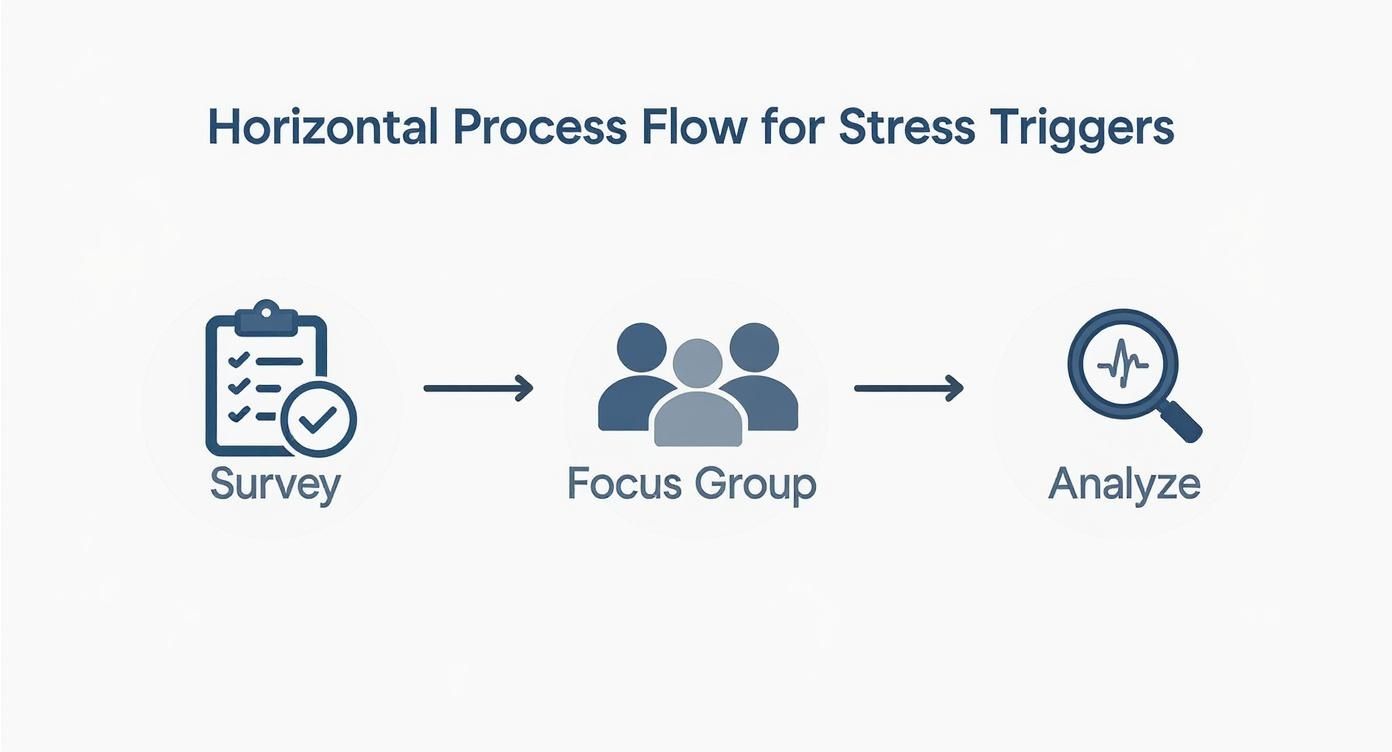
Pinpointing Your Team’s Biggest Stress Triggers
Before you even think about solutions, you have to play detective. The first step in building a stress management program that actually works is to figure out what’s really causing the pressure in your organization. Jumping straight to generic fixes like yoga classes or meditation apps is a classic mistake. It’s like putting a bandage on a broken bone.
The goal here is to stop guessing and start gathering real data. You might assume everyone is stressed about their workload, but what if the real problem is a chronic lack of feedback or unclear expectations from leadership? A proper needs assessment is your roadmap, making sure every dollar and hour you invest goes toward solving the right problems.
Going Beyond Guesswork with Anonymous Surveys
Anonymous surveys are your best friend for getting honest, unfiltered feedback. When people know their name isn’t attached to their answers, they’re far more likely to tell you the truth about sensitive topics, like issues with management or feeling completely overwhelmed.
Actionable Takeaway: Use a free tool like Google Forms or SurveyMonkey to create a 10-question anonymous survey. Ensure at least three questions are open-ended to capture qualitative feedback. Send it out and give your team a one-week deadline to respond.
To make your survey count, keep it focused and quick to complete. A good mix of question types will give you both hard numbers and personal stories.
- Rating Scales (1-5): “On a scale of 1 to 5, how manageable do you find your current workload?”
- Multiple Choice: “What’s your single biggest source of stress at work? (a) Workload, (b) Deadlines, (c) Team communication, (d) Management support.”
- Open-Ended Questions: “If you could change one thing to better support your well-being, what would it be?”
This approach gives you data you can track over time, plus the rich, personal insights that bring those numbers to life. A study in the Journal of Applied Psychology highlights that work-family conflict is a huge driver of stress and burnout. You’d likely never uncover that kind of specific insight without asking direct, confidential questions. And make sure you shout it from the rooftops: all responses are 100% anonymous. Trust is everything here.
Conducting Confidential Focus Groups
Surveys give you breadth, but focus groups give you depth. These small, confidential conversations let you dig into the themes that pop up in your survey data. They create a space where employees can share experiences and build on each other’s ideas—something a static form just can’t do.
Actionable Takeaway: Schedule two 45-minute focus groups with 5-7 volunteers from different departments. Appoint a neutral facilitator (someone from outside the team’s direct management line) and provide them with 3-4 open-ended questions based on your survey results.
For a focus group to work, you have to create a safe, structured environment. Let’s say your surveys flag “lack of recognition” as a major stressor. In a focus group, you could ask:
- “Can you describe what meaningful recognition actually looks like to you?”
- “In what ways do you feel your contributions are currently seen or acknowledged?”
- “What gets in the way of giving and receiving feedback on our team?”
These conversations uncover nuances you would absolutely miss otherwise. Research in Occupational and Environmental Medicine found that participatory interventions—where employees are actively involved in identifying problems and solutions—are significantly more effective. Spotting these triggers early is crucial before they spiral into bigger problems like the signs of workplace burnout.
The most impactful programs are built on a foundation of listening. By genuinely seeking to understand your employees’ daily realities, you transform your wellness initiative from a corporate mandate into a shared commitment to a healthier workplace.
Designing Your Stress Management Program For Impact
Alright, you’ve done the homework and gathered the data from your needs assessment. Now comes the fun part: moving beyond guesswork and actually building a program that will make a difference for your team.
A truly effective stress management program isn’t just a one-off yoga class or a subscription to a meditation app. It’s an entire ecosystem of support designed to meet people where they are. The goal is to create layers of assistance, from foundational policies that reduce systemic stress to individual tools that help people build resilience. A study in The Lancet Psychiatry found that organizational-level interventions—those that change the work environment—have a more profound and lasting impact on employee mental health than individual-focused tools alone.
When you design your program based on this kind of real-world feedback, you’re already miles ahead of companies just throwing generic “wellness” perks at their people.
Start With The Foundation: Your Policies
Before you even think about workshops or wellness challenges, take a hard look at your company policies. These are the structural supports that can either create stress or alleviate it every single day. Tweaking these sends a powerful signal that you’re serious about well-being from the top down.
Actionable Takeaway: This week, pilot a “No-Meeting Wednesday afternoon” with one department. After two weeks, survey that team to see if it reduced their stress and increased their focus. If successful, propose it as a company-wide policy.
Here are a few high-impact policy changes to consider:
- Flexible Work Arrangements: Offering flexible start/end times, compressed workweeks, or hybrid models can be a game-changer for work-life balance.
- Meeting-Free Days: This cuts down on calendar chaos and eases the pressure of looming deadlines.
- Clear “Off-Hours” Communication: Set a clear expectation that no one is required to answer emails or Slacks after their workday ends.
Offer A Mix Of Interventions
Once you’ve got supportive policies in place, you can start layering on different types of interventions. The best approach is to offer a mix of proactive, skill-building resources alongside more reactive support systems.
Employee stress management programs are becoming standard practice for a reason. As of 2025, an estimated 87% of companies will have a formal wellness program in place. This isn’t just a trend; it’s a strategic shift.
Don’t forget the power of simple, practical tools. For example, journaling is an incredibly powerful and low-cost way to help people manage difficult emotions. You could easily share resources on effective ways to process feelings through writing for anxiety and depression as part of your toolkit.
Choosing The Right Tools For Your Team
So, what specific components should you include? It really depends on your budget, company culture, and the specific needs you uncovered earlier. I always recommend a combination of on-site, virtual, and digital options to make sure you’re reaching everyone.
Comparison of Stress Management Program Components
This table can help you compare different interventions to figure out the right mix for your organization’s specific needs and resources.
| Intervention Type | Primary Goal | Best For | Implementation Effort |
|---|---|---|---|
| Skill-Building Workshops (e.g., resilience, time management) | Proactively equip employees with coping mechanisms and practical skills to manage stress before it becomes overwhelming. | Organizations wanting to invest in long-term employee development and preventative care. | Moderate to High |
| Mental Wellness Apps (e.g., meditation, CBT) | Provide immediate, on-demand access to stress-relief tools and guided exercises in a private, accessible format. | Companies with a distributed workforce or those seeking a scalable, cost-effective solution. | Low |
| Employee Assistance Program (EAP) | Offer confidential, short-term counseling and referral services for personal and work-related problems. | Any organization wanting a comprehensive, confidential safety net for employees facing serious challenges. | Moderate |
| On-Site Activities (e.g., yoga, breathwork sessions) | Create community and provide a physical break from work, promoting both mental and physical relaxation. | Companies with a strong on-site culture looking to foster connection and tangible wellness breaks. | Moderate to High |
Getting Your Program Off the Ground and Into People’s Lives
You can build the most incredible, data-backed employee stress management program, but it’s worthless if your people don’t know it exists, don’t understand it, or don’t feel safe enough to use it. A thoughtful launch isn’t just about a single company-wide email. It’s about creating a groundswell of trust and excitement that pulls people in from day one.
Get Your Leaders On Board (For Real)
Nothing kills a wellness initiative faster than lukewarm leadership. Visible, authentic support from the top is the single biggest factor in getting people to participate. A study in the Journal of Occupational Health Psychology drove this home, finding a direct link between supportive leadership and lower employee stress. When your team sees the boss taking their own well-being seriously, it gives them permission to do the same.
Actionable Takeaway: Ask one senior leader to share a personal (but professional) story in the next all-hands meeting about a time they felt overwhelmed and what strategy they used to manage it. This act of vulnerability normalizes the conversation instantly.
Here’s what active buy-in looks like:
- They Participate Openly: A VP mentions how they used the new mindfulness app to unwind after a crazy day of back-to-back calls.
- They Model Good Habits: A manager puts “focus time” blocks on their public calendar and encourages their team to do the same.
- They Champion the ‘Why’: Leadership consistently ties the program back to business goals like innovation and performance.
Build Your Crew of Wellness Champions
You can’t be everywhere at once. Wellness champions are passionate volunteers from across the business who can spread the word and build momentum more effectively than any top-down memo.
Actionable Takeaway: Identify three people who are already passionate about wellness. Formally invite them to be your “Wellness Champions” and ask them to co-host the program launch event with you.
What can they do?
- Help host a Q&A session or an intro workshop.
- Post about their positive experiences on your company’s Slack or Teams channels.
- Gather informal feedback from colleagues to help you improve the program.
Map Out Your Communication Strategy
Your communication has to be clear, consistent, and compassionate. You’re trying to build awareness while simultaneously chipping away at the stigma around asking for help. A great example comes from Microsoft, who drove huge adoption by embedding well-being tools directly into their existing platforms, meeting people where they already work.
Pro Tip: Don’t just list features; tell a story. Connect your communications back to the specific struggles you discovered during your needs assessment. Instead of, “Announcing our new EAP,” try, “Feeling stretched thin? Here’s a confidential resource to help you get back on track.”
Start Small with a Pilot Group
Before you go big, go small. Rolling the program out to a single, willing department first is a brilliant move. Research in the Journal of Applied Behavioral Science confirms that pilot programs are invaluable, as they let you learn and tweak things before a full-scale launch.
Think of a pilot as a low-risk dress rehearsal. You’ll get priceless feedback on what’s resonating and gather powerful testimonials. Those early success stories are pure gold—they become your best marketing material for the company-wide rollout.
Measuring Success and Proving ROI to Leadership
To keep your employee stress management program funded and supported, you have to talk about more than just good vibes. Leadership needs to see a clear return on investment (ROI). It’s all about connecting your efforts to tangible business results. When you can shift the conversation from “wellbeing” to “bottom-line impact,” you transform a perceived cost into a strategic advantage.
Defining Your Key Metrics
Before you can show improvement, you need to know where you’re starting. The best way to do this is by blending hard numbers (quantitative data) with real human experiences (qualitative data). First, establish a baseline by gathering data for at least a quarter before you roll out the program.
Actionable Takeaway: Create a simple dashboard tracking 3 key metrics: monthly voluntary turnover rate, average absenteeism days per employee, and self-reported stress levels (from a quarterly 1-5 scale survey question). Update it monthly and prepare a quarterly summary for leadership.
Your quantitative metrics should hit on operational efficiency and cost savings:
- Absenteeism Rates: A drop in unscheduled absences is a direct signal of better wellbeing.
- Employee Turnover: Reducing turnover, especially among top performers, delivers huge cost savings.
- Productivity Levels: A study in Applied Psychology confirmed the direct link between a healthy work-life balance and better productivity.
- Healthcare Claims: A long-term play, but effective programs can lead to fewer stress-related health claims.
Capturing the Human Element
Numbers are great, but they don’t tell the whole story. Qualitative data adds the context that makes your ROI report resonate. Pulse surveys—short, frequent check-ins—are perfect for this.
The most persuasive reports blend data with stories. A 15% reduction in absenteeism is powerful, but it becomes undeniable when paired with a quote from a manager about their team being more focused and collaborative since the program began.
Don’t forget to tap into manager feedback. Schedule regular, informal check-ins with team leads. Ask them what they’re seeing on the ground. Have they noticed shifts in team dynamics, communication, or morale? Their firsthand observations are some of the most credible evidence you can get.
Calculating and Presenting Your ROI
With your data in hand, you can put together a straightforward ROI calculation. You’re connecting what you spent on the program to the financial gains it created.
Here’s a simple framework:
- Tally Up the Total Program Cost: Include everything—vendor fees, workshop materials, and staff time.
- Calculate the Financial Gains: Put a number on the savings from reduced turnover, lower absenteeism, and productivity boosts.
- Present the ROI: Use the classic formula: (Financial Gains – Program Cost) / Program Cost x 100 = ROI %.
Demonstrating how your program impacts performance is critical. For more inspiration, you can find some excellent strategies to increase employee productivity that complement this approach. You can also strengthen your case by highlighting physiological benefits. Programs that teach employees practical skills, like how to reduce cortisol levels naturally, lead to better focus and fewer health issues—both of which directly fuel a healthier bottom line.
Common Questions About Stress Management Programs
Getting an employee stress management program off the ground can feel like navigating a minefield of questions. Let’s walk through some of the most common hurdles and give you clear, practical answers.
How Do I Secure a Budget for This?
Stop calling it a “perk” and start positioning it as a strategic investment. Show them the real costs of doing nothing. What’s your current turnover costing you? How many sick days are being taken? A University of Kansas study on work-life balance showed that proper support directly boosts morale and productivity—metrics leadership cares about.
Actionable Takeaway: Draft a one-page summary connecting the program’s cost to potential savings. Calculate the total cost of replacing just one mid-level employee. Then, show how retaining even a handful of people through this program delivers a clear positive ROI.
What if Employees Don’t Participate?
Low engagement is almost always a symptom of a few core problems: lack of awareness, stigma, or a program that misses the mark. Your communication plan is everything. Microsoft did this brilliantly by embedding wellness tools like Viva Insights right into platforms people already use daily.
Actionable Takeaway: During your launch week, host a 20-minute “lunch and learn” where a wellness champion demonstrates one of the program’s tools (like a 5-minute guided meditation from an app). This low-commitment entry point can demystify the offerings and boost initial adoption.
How Do We Handle Employee Privacy?
Privacy is non-negotiable. It’s the bedrock of trust. You have to shout it from the rooftops that all individual participation is 100% confidential. A study on workplace wellness programs confirmed that mental health initiatives thrive only when employees feel completely secure.
When vetting vendors, scrutinize their privacy policies. They should only provide you with aggregated, anonymized data. For instance, they might report that 40% of users accessed mindfulness resources, but they should never, ever tell you who those users were.
Actionable Takeaway: Create a dedicated FAQ page on your intranet that explicitly answers questions about data privacy. Be transparent about what aggregate data you will see and what will always remain 100% confidential.
How Do We Choose the Right Vendor?
The wellness market is incredibly crowded. Don’t let flashy marketing sway you. Your focus should be on finding a partner that aligns with your company’s specific goals.
Actionable Takeaway: Before booking demos, create a simple vendor scorecard. List your top 5 must-have criteria (e.g., customization, reporting quality, engagement support). Score each vendor on a 1-5 scale during their demo. This removes emotion and helps you make a data-driven decision.
Make sure you cover:
- Customization: Can they adapt their offerings to address the specific stress triggers you already identified?
- Engagement Strategy: What’s their plan to help you drive and sustain participation?
- Reporting: What kind of anonymized data will you get to prove this is working?
- Implementation Support: Are you getting a dedicated partner or just a login?
At 9D Breathwork, we provide a full-spectrum experience that addresses stress at its root by fusing ancient wisdom with modern technology. Our programs are designed to disrupt patterns and rewire well-being from the inside out. Discover how our unique approach can support your team.