Tackling burnout isn’t about just “powering through.” It’s a strategic process that involves recognizing the warning signs, creating immediate breathing room for yourself, and then building new, sustainable habits that get to the root of the problem. This is how you move from a state of constant crisis back to one of control and genuine well-being.
How to Recognize the Signs of Workplace Burnout
Before you can start to fix the problem, you need to know exactly what you’re up against. Burnout is so much more than feeling tired after a long week. It’s a state of chronic physical and emotional exhaustion that fundamentally changes how you feel about your job, quietly dismantling your passion, productivity, and sense of purpose. A study in the American Journal of Public Health found that workplace burnout is a significant predictor of serious health issues like cardiovascular disease, highlighting its severity.
And it’s a massive issue. Workplace burnout has hit staggering levels, with some studies showing that around 82% of employees are at risk. Interestingly, even remote workers aren’t immune—in fact, they face a 20% higher risk. The data also shows a stark gender gap, with women experiencing burnout at much higher rates than men. A 2025 workplace burnout research report digs deeper into these trends if you want to see the full picture.
The Three Core Dimensions of Burnout
Burnout isn’t just one single feeling. It’s a syndrome defined by three distinct dimensions. Getting familiar with these helps you move from a vague sense of “I’m not happy” to a much clearer understanding of what’s really going on.
- Exhaustion: This is the one most people recognize. It’s that deep, bone-weary feeling of being physically and emotionally drained. Actionable Example: You finish a standard workday, but feel as though you’ve run a marathon. The idea of making dinner or doing a simple chore feels impossible.
- Cynicism and Detachment: Have you started feeling disconnected from your work? Maybe you’re becoming resentful toward colleagues or clients. This emotional distancing—sometimes called depersonalization—is a defense mechanism against overwhelming demands. Actionable Example: You used to enjoy team brainstorming sessions, but now you stay silent and find yourself mentally criticizing every new idea shared.
- Reduced Professional Efficacy: This sneaks up on you as a creeping sense of incompetence and a lack of achievement. You might feel like your contributions don’t matter anymore, or that you’re just going through the motions. Actionable Example: You procrastinate on a project you’re fully capable of completing because you doubt you can do it well, leading to a self-fulfilling prophecy of poor performance.
Burnout Symptoms Self-Assessment Checklist
Use this checklist to identify which symptoms of burnout you may be experiencing across its three core dimensions. It’s a simple way to connect the definitions to your own lived experience.
| Symptom Dimension | Common Signs and Feelings | Example in a Work Context |
|---|---|---|
| Exhaustion | Constant fatigue, sleep problems, physical aches, brain fog. | Dreading the morning alarm; needing coffee just to start basic tasks. |
| Cynicism & Detachment | Feeling negative about your job, irritability, isolating from colleagues. | Rolling your eyes in meetings; avoiding social chats with your team. |
| Reduced Efficacy | Feeling unproductive, doubting your abilities, lack of accomplishment. | Procrastinating on important projects; feeling like nothing you do is good enough. |
Taking a moment for this kind of honest self-check is the first step toward reclaiming your well-being.
Real-World Scenarios of Burnout
Sometimes, seeing burnout in action makes it click. Definitions are one thing, but real-life examples are another.
- The Passionate Manager: A marketing manager once loved leading creative brainstorming sessions. Now, she dreads them. She feels completely drained after simple team meetings and finds herself snapping at new ideas—a total reversal of her once-enthusiastic self.
- The Diligent Developer: A software developer who used to take immense pride in his clean, efficient code now can’t seem to focus. He feels detached from his projects and believes his work has zero impact, which leads to missed deadlines and a drop in quality.
- The Caring Nurse: A dedicated nurse feels a growing numbness toward his patients. He finds it hard to show empathy and feels emotionally hardened, a protective shell built up against the constant high-stress situations he faces daily.
These examples show how burnout seeps into any role, turning engagement into exhaustion and passion into cynicism. For a more detailed look, you can read our guide on the primary signs of workplace burnout.
Burnout is not a sign of failure or weakness. It is a sign that you have been pushing yourself too hard for too long, often in an environment that fails to support your well-being. Recognizing it is the first, most powerful step toward recovery.
Once you understand these dimensions and see how they show up in the real world, you can stop guessing and start taking targeted, effective action. This self-awareness is the foundation for your entire recovery plan.
Implement Immediate Actions for Burnout Relief
When you’re deep in the trenches of burnout, even thinking about long-term solutions can feel completely overwhelming. The immediate goal isn’t to overhaul your career; it’s to create just enough breathing room to think clearly again. This is about tactical first aid—stopping the downward spiral and getting back a small sense of control.
Think of these short-term actions as the emergency brakes. They won’t fix the engine, but they will stop the car from careening off the road. The whole point is to reduce the immediate pressure so you have the headspace to plan a more sustainable path forward. Research from the Journal of Occupational Health Psychology actually backs this up, finding that even small interventions that restore a sense of control can significantly buffer the negative impact of high job demands.
Create Pockets of Focused Calm
Your brain is probably running on empty, making it nearly impossible to concentrate. The first step is to break your day into manageable chunks to deal with the cognitive overload that’s fueling your burnout.
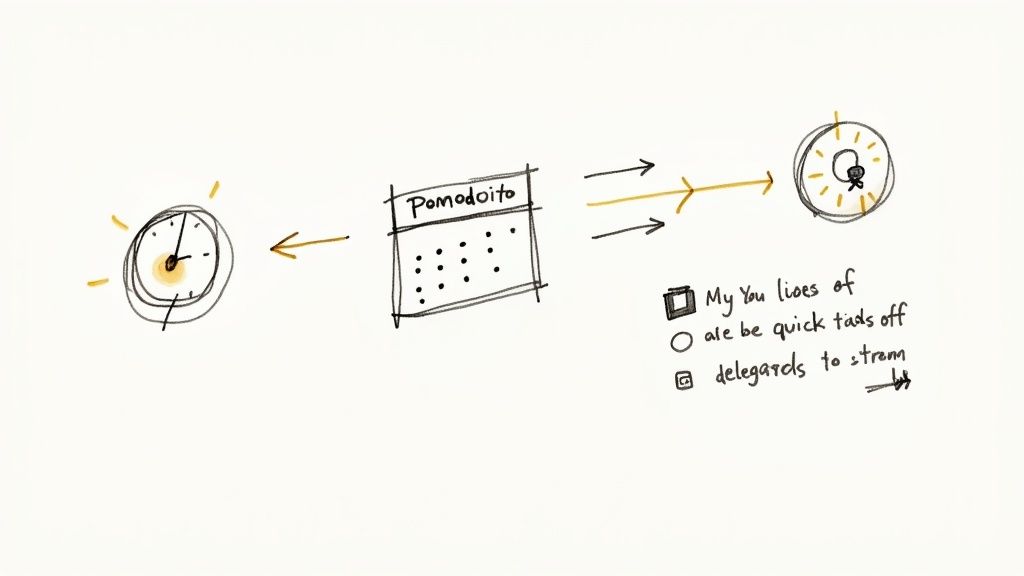
One of the most effective ways to do this is the Pomodoro Technique. It’s a simple time management method where you work in focused 25-minute sprints, separated by short 5-minute breaks.
Take Action Now: Open your calendar and block out two 25-minute “Pomodoro” sessions for this afternoon. During those times, turn off your phone notifications and focus on one task. When the timer goes off, physically stand up and walk away from your desk for five minutes.
This technique works because it:
- Reduces overwhelm: A 25-minute task feels way more doable than an 8-hour day.
- Improves focus: Knowing a break is just around the corner makes it easier to resist distractions.
- Fights fatigue: Those regular breaks prevent the mental exhaustion that comes from staring at a screen for hours on end.
Triage Your To-Do List Ruthlessly
When you’re burned out, your to-do list can feel like an enemy. It’s time to perform a “task triage” and reclaim your agency.
Take Action Now: Look at your to-do list and find one thing you can immediately tackle with the “Drop, Delegate, or Delay” framework.
- Drop It: Is there a task on your list that, realistically, has no major consequences if it’s not done? Example: Compiling an internal-only report that no one has asked for in weeks. Just cross it off.
- Delegate It: Can someone else on your team handle this? Example: Ask a junior team member to gather the initial data for next week’s presentation. Frame it as a development opportunity.
- Delay It: Does this absolutely have to be done today? Example: Move the “organize digital files” task to next Friday. Give yourself that breathing room now.
Your objective here isn’t to clear your entire plate in one day. It’s to prove to yourself that you have control over your workload by intentionally removing just one source of pressure.
This isn’t just a nice idea; it’s an evidence-based strategy. A study in the Academy of Management Journal shows that employees who actively “job craft”—making small changes to their tasks and relationships at work—report higher job satisfaction and lower levels of burnout.
Reclaim Your Evenings with a Digital Sunset
The constant ping of notifications keeps your nervous system in a state of high alert long after you’ve “logged off.” To recover, creating a hard stop is non-negotiable. A “digital sunset” is a simple but powerful routine that signals to your brain that the workday is officially over.
Take Action Now: Decide on your log-off time for tonight. Set an alarm for 10 minutes before that time. When it goes off, follow these steps:
- Send a final status update. Briefly let your team know what you finished and what’s on deck for tomorrow.
- Close all work tabs and—this is key—turn off work-related notifications on all your devices.
- Do a 5-minute transition activity. This could be a short walk around the block, listening to one of your favorite songs, or a quick guided meditation to reset your nervous system.
This small ritual creates a clear psychological boundary between your work life and your personal life, which is absolutely essential for anyone learning how to overcome burnout at work. It allows your mind to truly rest, making you more resilient for whatever tomorrow brings.
Build Sustainable Habits for Long-Term Recovery
The quick fixes are just the emergency brakes. True, lasting recovery means you have to redesign your entire relationship with work. To really move past burnout, you have to get beyond temporary solutions and start building habits that protect your energy for the long haul. This is about creating a work life that actually energizes you.
It all starts by proactively defending your time and energy with clear, enforceable boundaries. A boundary isn’t a wall you build to keep people out; it’s a line you draw in the sand to protect your own well-being.
Take Action Now: If you often get requests after hours, go into your email settings right now and schedule an “out of office” auto-reply to activate at 5:30 PM daily. It can say, “Thank you for your message. I am offline for the day and will respond on the next business day.” This sets a clear expectation without you having to fight a new battle with every single email.
Prioritize with Purpose, Not Panic
When you’re burned out, every single task feels like a five-alarm fire. This creates a constant, draining state of panic. To break that cycle, you need a system to figure out what actually matters versus what’s just making a lot of noise.
The Eisenhower Matrix is a fantastic tool for this. It helps you sort everything on your plate into four simple quadrants:
- Urgent & Important: Do these immediately. Think client crises or hard project deadlines.
- Important, Not Urgent: Schedule these. This is where the real magic happens—things like strategic planning or professional development. You should aim to spend most of your time here.
- Urgent, Not Important: Delegate these. Can someone else handle scheduling routine meetings or answering non-critical emails?
- Not Urgent & Not Important: Eliminate these. Stop scrolling social media or pointlessly organizing old files.
Take Action Now: Grab a piece of paper and draw the four quadrants. Take three items from your to-do list and place them in the matrix. This simple act will immediately bring clarity to what needs your energy first.
Sustainable recovery is built on the small, consistent choices you make every single day. It’s about consciously deciding where your energy goes, rather than letting your inbox call all the shots.
Align Your Role with Your Strengths
Sometimes, burnout isn’t just about the amount of work, but the type of work. If there’s a constant mismatch between what you’re good at and what you’re asked to do, it’s a fast track to exhaustion.
Take Action Now: Take 15 minutes and create three columns on a document:
- Tasks That Energize Me: What parts of your job make you feel capable and engaged? (e.g., “Leading client strategy calls”)
- Tasks That Drain Me: What responsibilities consistently leave you feeling frustrated? (e.g., “Compiling weekly progress reports”)
- Missing Pieces: What skills do you have that are being unused? (e.g., “Graphic design skills”)
Imagine a project manager who does this and realizes that strategic client calls give her a huge boost, but compiling weekly progress reports absolutely crushes her soul. Seeing it written down isn’t just a feeling anymore—it’s data.
Armed with this clarity, she can go to her manager with a real plan. “I’ve noticed my strategic work on the XYZ account led to a 15% increase in client satisfaction. I think I can deliver even more value by focusing more on client strategy. Could we explore delegating the administrative reporting to a junior team member?” A study in the International Journal of Environmental Research and Public Health confirms that having control over your job and using your skills (job crafting) are strongly linked to lower burnout.
Part of this is also about working smarter. Learning science-backed techniques to retain information better can reduce cognitive load and frustration, making you feel more competent and resilient.
The Critical Role of Supportive Leadership
Look, your individual habits are vital, but let’s be real: your work environment plays a massive role. The support—or lack thereof—from your manager can make or break your recovery.
Research consistently shows that supportive managers who receive mental health training and make reasonable adjustments for their team can significantly cut down on stress and burnout. A landmark study from the Journal of Applied Psychology showed that supportive leadership directly reduces employees’ emotional exhaustion and increases job satisfaction.
When you do talk to your boss, frame the conversation around mutual benefits. A less-burned-out you is a more productive, creative, and engaged employee. This isn’t about airing grievances; it’s about collaborative problem-solving to build a role that works for everyone.
Prioritize Your Mental and Physical Well-Being
Trying to fix burnout by just focusing on your job is like trying to fix a sinking boat by polishing the deck. It misses the point entirely. Burnout isn’t a professional problem; it’s a personal health crisis. The exhaustion, the cynicism, the feeling that you’re just not effective anymore—those are symptoms of a system that’s completely run out of fuel.
To truly recover, you have to start treating your well-being as a non-negotiable part of your performance.
This goes way beyond the generic advice to “get more sleep.” It’s about understanding that high-quality rest is one of your most powerful tools for emotional regulation. When you’re sleep-deprived, the logical, problem-solving part of your brain (the prefrontal cortex) essentially shuts down. This leaves your brain’s emotional center, the amygdala, running the show. That’s why a minor email can feel like a full-blown catastrophe. A study in the Journal of Applied Psychology found a direct link: employees who truly detached from work and prioritized sleep felt significantly less emotional exhaustion the next day. The proof is in the data.
Create a Wind-Down Routine
You can’t just slam the brakes on a high-stress day and expect to fall asleep instantly. You need to signal to your brain that it’s time to shift gears.
Take Action Now: Choose one of these actions to incorporate into a 30-minute ‘wind-down’ routine tonight.
- Go screen-free: Put your phone in another room 30 minutes before bed. The blue light is a known enemy of melatonin, your sleep hormone.
- Do some light stretching: Stand up and do a simple forward fold, reaching for your toes. Hold for 30 seconds to release tension in your back and hamstrings.
- Try a “brain dump”: Grab a notebook and spend 5 minutes writing down every single thing worrying you. Getting it onto the page can provide immediate relief.
- Read a real, physical book: Pick something completely unrelated to work that lets your mind wander.
The goal here isn’t to force yourself to sleep. It’s about creating the ideal conditions for sleep to happen naturally. You’re gently guiding your nervous system back to a state of calm.
Weave Movement into Your Workday
Physical activity is a powerful antidote to burnout. When you move your body, you kickstart the production of endorphins—your body’s natural mood elevators—and burn off excess stress hormones like cortisol. The trick is to think smaller.
Take Action Now: Instead of one huge workout, block off two 15-minute ‘movement breaks’ in your calendar for tomorrow and treat them with the same importance as a client meeting.
What this could look like:
- A brisk walk around the block after lunch.
- A quick set of squats and push-ups in your office between calls.
- Putting on your favorite song and just dancing for a few minutes.
Even these short bursts make a huge difference. Research from the International Journal of Workplace Health Management showed that employees who were active during their lunch breaks reported better concentration and less afternoon fatigue. Dealing with stress hormones is also crucial, and our guide on how to reduce cortisol levels naturally offers even more ways to do just that.
Seek Professional Guidance
Trying to climb out of the hole of burnout by yourself is an incredibly tough battle. A therapist or a coach can provide a dedicated, confidential space to dig into what’s really going on.
Take Action Now: If you’re feeling stuck, open a new browser tab and search for “therapists specializing in burnout near me” or “career coach for stress management.” Just taking this first step can be empowering.
Think about it: you’d see a specialist for a recurring physical injury, right? Burnout is a serious injury to your mental and emotional health, and it deserves the same level of expert care.
Use Breathwork to Reset Your Nervous System
When you’re deep in the trenches of burnout, your nervous system is likely stuck in overdrive. It’s that constant, humming state of high alert—the “fight-or-flight” response—fueled by a never-ending drip of stress hormones. It’s utterly draining.
To really start healing from workplace burnout, you need a way to directly address this physiological overload. The good news is, one of the most powerful tools you have is literally right under your nose: your breath.
Breathwork isn’t some mystical practice; it’s a simple, free, and immediate way to intentionally shift your body out of high-stress mode. A 2023 study published in Cell Reports Medicine found that just five minutes of cyclic sighing per day can improve mood and reduce anxiety even more effectively than mindfulness meditation.
Simple Techniques for Instant Relief
You can use these techniques right at your desk to pull yourself back from the edge when stress spikes.
Take Action Now: Try this right now. The Physiological Sigh.
- Take a deep inhale through your nose.
- When your lungs feel full, take another quick, sharp sip of air on top.
- Exhale slowly and fully through your mouth.
- Repeat 2-3 times.
Research out of Stanford University shows this double-inhale super-inflates the tiny air sacs in your lungs, helping you offload carbon dioxide more efficiently and sending a direct signal to your brain to relax.
Another powerful technique is Box Breathing, famously used by Navy SEALs to stay calm under pressure.
How to do it: Inhale for a count of four, hold your breath for four, exhale for a count of four, and hold again for four. Repeat this cycle for one minute. This steady, rhythmic pattern helps regulate your autonomic nervous system.
By focusing on the simple rhythm of your breath, you interrupt the cycle of anxious thoughts that fuels burnout. It’s a physical anchor that brings you back to the present moment.
Releasing Stored Tension and Fatigue
While these quick techniques are fantastic for in-the-moment relief, deeper breathwork practices can help you tackle the chronic emotional and physical tension that’s been building for months. Burnout leaves behind a heavy residue of stored fatigue and unprocessed emotions that you can’t just think your way out of.
This is where deeper, guided breathwork sessions come in. They often use more dynamic breathing patterns to help move that stagnant energy and create space for an emotional release. For many, it feels like hitting a total reset button for the entire system, clearing out the emotional fog and deep-seated exhaustion that comes with prolonged stress.
Many people find these deeper practices are especially good for quieting a racing mind and truly restoring their energy levels. If you’re looking for more direct ways to manage your body’s stress response, there are plenty of accessible breathing exercises to lower heart rate and bring you into a state of calm.
Ultimately, making breathwork a regular part of your routine gives you a tangible way to manage those overwhelming moments as they happen. You’re not just coping; you’re building physiological resilience from the inside out.
Create Your Personal Burnout Prevention Plan
Getting over burnout is a huge win, but keeping it from coming back? That’s the real long game. It means shifting from putting out fires to building a fireproof system that guards your well-being. Think of this plan as your personal playbook for navigating work without getting torched again.
Take Action Now: Identify one recurring situation that drains your energy. Is it that weekly budget meeting? The way a certain client communicates? Write it down. Now, brainstorm one small change you can make to protect your energy before, during, or after that event. Example: If a meeting drains you, block out 15 minutes on your calendar immediately after for a “recovery walk.”
This simple breathwork process can be a lifesaver when a trigger pops up, helping you get a handle on your nervous system.
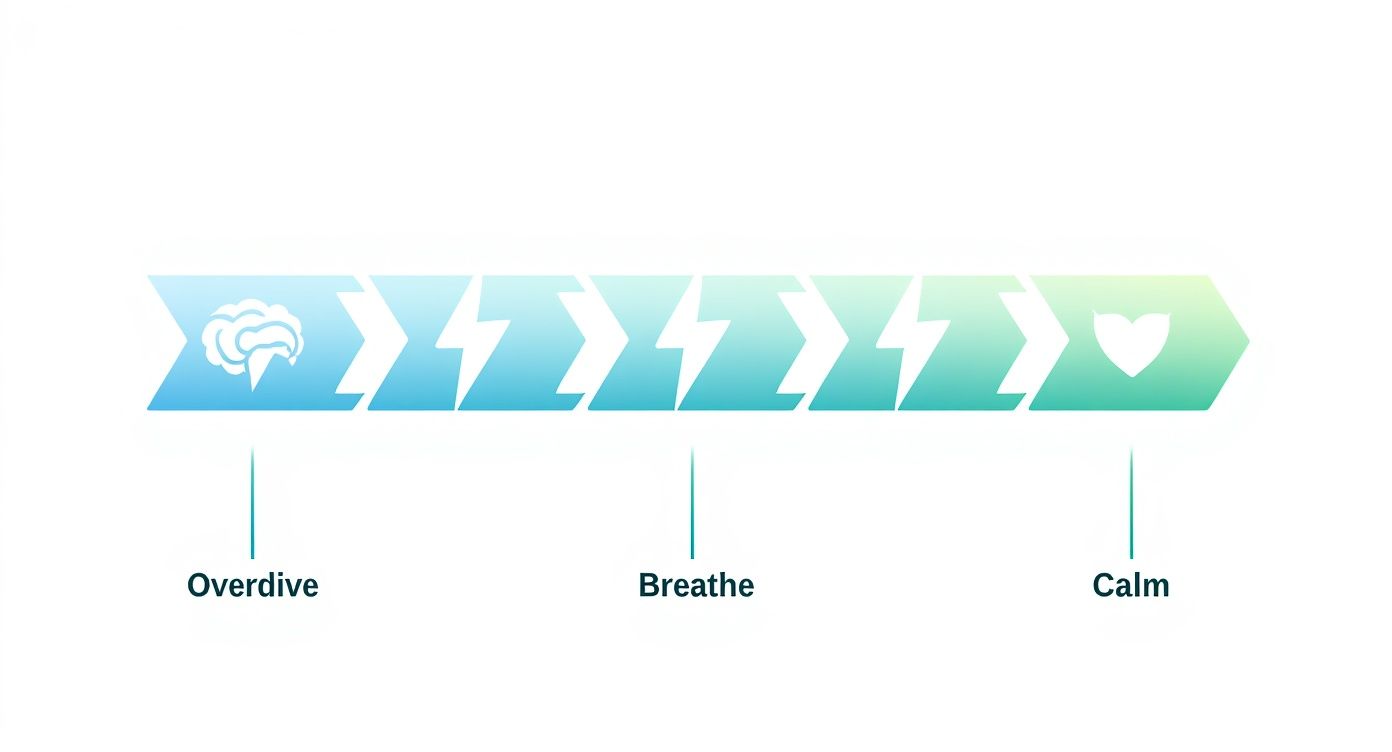
It’s a powerful visualization for using your own breath as a tool to switch from overdrive back to a state of calm.
Schedule Regular Well-Being Check-Ins
You wouldn’t drive your car without a fuel gauge, right? So why try to manage your own energy reserves without one?
Take Action Now: Open your calendar right now and block out a recurring 15-minute ‘Well-Being Check-In’ for every Friday afternoon. Set a reminder. During that time, answer these three questions in a notebook:
- What was my biggest energy drain this week?
- Where did I feel most energized or engaged?
- On a scale of 1-10, how close am I to that familiar feeling of burnout?
This isn’t about adding another chore. It’s about creating a simple, data-driven ritual to catch stress before it snowballs into a full-blown crisis.
Keep Your Plan Alive
Your prevention plan isn’t a “set it and forget it” document; it’s a living guide. You have to revisit it, tweak it, and adapt it as your work and life change. This proactive approach is crucial. When you start to address the roots of workplace stress, you build long-term resilience. For a deeper dive into company-wide strategies, check out this guide on How To Reduce Employee Burnout.
Combining a solid plan with consistent self-awareness is your most powerful defense against ever hitting that wall again.
Got Questions About Burnout? We’ve Got Answers
When you’re trying to find your way back from burnout, a lot of questions pop up. It’s completely normal. Getting clear answers is a huge part of moving forward, so let’s tackle some of the most common ones we hear.
Is Burnout Just Intense Stress?
It’s easy to mix these two up, but they’re fundamentally different. Think of stress as over-engagement. You feel like you’re being pulled in a million directions at once, running on adrenaline, and everything feels urgent. You’re drowning, but you’re still kicking.
Burnout is the opposite; it’s disengagement. It’s the feeling of being completely checked out—emotionally drained, cynical, and just plain empty. That frantic energy is gone, replaced by a sense of “what’s the point?” A seminal study in the Journal of Health and Social Behavior defines burnout by its unique combination of emotional exhaustion, depersonalization, and a reduced sense of personal accomplishment, distinguishing it clearly from the hyper-engagement of stress.
When Is It Time to Get Professional Help?
Knowing when to ask for backup isn’t a sign of weakness—it’s a sign you’re serious about getting better. If you’ve tried making changes on your own and still feel like you’re stuck in the mud, it’s time. If the symptoms are creeping into your health or your relationships, that’s your cue to reach out.
Take Action Now: If any of this resonates, take five minutes to visit a reputable online directory like Psychology Today or the American Psychological Association’s locator tool. Just seeing what resources are available is a concrete first step.
A great therapist, counselor, or coach can offer a neutral, confidential space to unpack what’s really going on. They bring an objective perspective that even the most well-meaning friends and family can’t.
How Do I Even Talk to My Manager About This?
This conversation can feel intimidating, but the key is to approach it with a calm, solution-oriented mindset. Don’t ambush them in the hallway; schedule a proper, private meeting.
Take Action Now: Before the meeting, write down one or two specific, actionable suggestions. Instead of just showing up with a list of grievances, come prepared.
Actionable Script: “I’m really committed to my work here, but I’ve been feeling completely exhausted lately, which is impacting my focus. I believe I could contribute more effectively if we could look at re-prioritizing my projects. For example, if we could push the deadline for Project X, it would allow me to give my full attention to the critical launch of Project Y.” This shows you’re being proactive and want to be part of the solution.
Here at 9D Breathwork, we focus on getting to the physiological root of burnout. Our guided breathwork journeys are specifically designed to help reset your nervous system, release that deep, stored-up stress, and bring your energy back from the inside out. Explore our breathwork experiences and start feeling like yourself again.