If you’re trying to figure out how to quiet your mind, the simplest and most powerful tool you have is your own breath. By intentionally changing your breathing pattern using a specific technique like the 4-7-8 method, you can hit a reset button on your body’s stress response and instantly quiet those racing thoughts.
Find Instant Calm with This Simple Technique
Ever feel like your mind is a web browser with a hundred tabs open at once? That constant buzz of deadlines, personal worries, and endless notifications creates a state of chronic overwhelm. This mental noise isn’t just in your head; it triggers a very real, very physical stress response.
But what if you could pull the emergency brake on that whole process in less than a minute?
You absolutely can. The struggle for mental peace is a universal human experience, especially with the pressures of modern life. It’s no wonder the global meditation market was valued at around USD 7.5 billion in 2025 and is expected to more than double by 2032. People are actively searching for tools that work, and you can learn more about this growing trend from recent market insights.
Your First Step: The 4-7-8 Breathing Method
The 4-7-8 breathing technique, often called “relaxing breath,” is a game-changer developed by Dr. Andrew Weil. Think of it as a natural tranquilizer for your nervous system. Its magic is in its rhythm, which forces your mind to focus on one simple task while directly slowing your heart rate and dialing down physiological stress.
Here’s a practical action plan to do it right now:
- Action Step 1: Get Comfortable: Find a comfortable spot to sit or lie down. Rest the tip of your tongue on the ridge of tissue right behind your upper front teeth. Keep it there for the whole exercise.
- Action Step 2: Exhale Fully: Let all the air out through your mouth with a gentle whoosh sound.
- Action Step 3: Inhale for 4: Close your mouth and breathe in quietly through your nose for a count of four.
- Action Step 4: Hold for 7: Now, hold your breath for a count of seven. This is a crucial step for allowing oxygen to perfuse your body.
- Action Step 5: Exhale for 8: Finally, exhale completely through your mouth—making that whoosh sound again—for a count of eight.
That whole cycle is just one breath. Now, take action: repeat the cycle three more times for a total of four breaths. The real secret sauce is that 7-second hold and the long, controlled 8-second exhale.
This simple routine can be your go-to first action whenever you start to feel overwhelmed.
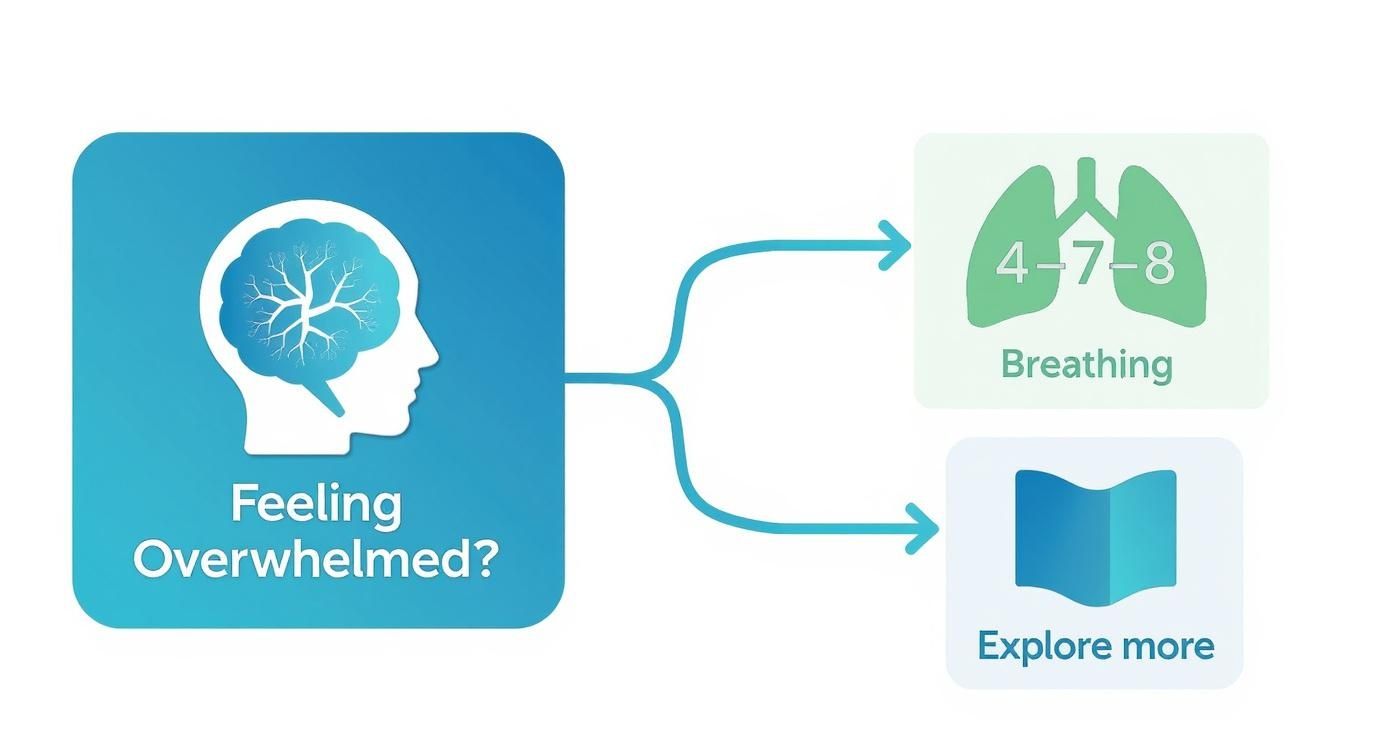
As the infographic shows, taking a single, intentional action is often the most powerful first step you can take to manage mental noise.
Why This Simple Action Works So Well
So, what’s happening in your body when you do this? That long, eight-second exhale is the key. It stimulates the vagus nerve, a major player in your parasympathetic nervous system—your body’s built-in “rest and digest” mode.
This isn’t just theory; it’s backed by science.
- A 2018 study in Frontiers in Human Neuroscience found that slow, controlled breathing exercises directly increase vagal tone, which helps the body snap out of stress and into a state of calm.
- A 2017 study published in Science showed that a specific group of neurons linking breathing to relaxation, attention, and panic was identified in the brainstem, confirming that rhythmic breathing has a direct impact on the brain’s emotional control centers.
- More recently, a 2023 review in Scientific Reports confirmed that even short bursts of this kind of cyclic breathing significantly boost mood and lower physiological arousal. This isn’t just a relaxation hack; it’s a way to consciously take back control of your own physiology.
For those looking for a quick reference, here are a few simple techniques you can use anytime your mind starts to feel cluttered.
Quick-Start Techniques for Immediate Calm
| Technique | How It Works | Best For |
|---|---|---|
| 4-7-8 Breathing | The extended exhale activates the vagus nerve, signaling your body to relax. | Quickly de-escalating high stress or anxiety. |
| Box Breathing | The equal-sided counts (4-4-4-4) create a steady rhythm that focuses the mind and regulates the nervous system. | Moments when you need to regain focus and concentration. |
| Body Scan | Systematically bringing awareness to different parts of the body grounds you in the present moment. | When you’re stuck in your head and need to reconnect with your body. |
These methods are fantastic starting points. They prove that you don’t need to sit for an hour to find peace—sometimes, all it takes is a few conscious breaths to change your entire state.
Master Your Breath to Control Your Thoughts
Your breath is the most direct, powerful tool you have for changing how you feel, right now. It’s not just about calming down; it’s about taking the reins of the very physiological systems that send your mind into a tailspin. If you want to learn how to quiet your mind, mastering your breath is square one.
Moving beyond just “taking a deep breath,” you can build a whole toolkit of breathing techniques for different situations. Think of these as your on-demand controls for dialing down stress, clearing mental fog, and getting back in the driver’s seat of your own thoughts.
Tame Anxiety with Box Breathing
One of the most battle-tested techniques for breaking out of anxious thought loops is Box Breathing, sometimes called four-square breathing. Its real power is in its rhythm and simplicity. It gives your brain a predictable, steady pattern to lock onto instead of juggling a dozen chaotic worries.
This method intentionally forces a pause between your inhale and exhale, which is crucial for interrupting the shallow, rapid breathing that kicks in when anxiety takes over. That simple pause is enough to help reset your nervous system’s fight-or-flight alarm.
A Practical Scenario: The High-Stakes Presentation
Imagine you’re five minutes away from giving a massive presentation. Your heart is hammering, your palms are slick, and your mind is a highlight reel of everything that could go wrong. Instead of letting that anxiety snowball, take this action:
- Step 1: Find a quiet corner, or just close your eyes right there at your desk.
- Step 2: Inhale slowly through your nose for a count of four. Really feel your lungs expand.
- Step 3: Hold your breath for a count of four. Don’t clamp down or struggle; just pause.
- Step 4: Exhale slowly through your mouth for a count of four. Let every bit of air go.
- Step 5: Hold at the bottom for another count of four.
Just two or three minutes of this cycle can make a world of difference. The rigid structure yanks your brain’s attention away from the “what ifs” and grounds it in the physical sensation of breathing. When you open your eyes, you’ll feel more present, clear-headed, and in control.
Instantly Reset with Cyclic Sighing
What about those moments of intense, sudden stress where you need an immediate reset? For that, a science-backed technique called Cyclic Sighing is incredibly effective. Research from Stanford University has shown this specific breathing pattern is one of the fastest ways to improve mood and dial down physiological stress.
In fact, a 2023 study in Cell Reports Medicine found that just five minutes of daily cyclic sighing did more to boost mood and lower respiratory rate than mindfulness meditation.
So, how does it work? When we’re stressed, the tiny air sacs in our lungs (the alveoli) can collapse. Cyclic sighing forces them to reinflate, which immediately improves your body’s oxygen exchange and flips the switch on your nervous system’s calming response.
“Cyclic sighing is the fastest way to lower physiological and psychological stress. It involves two inhales followed by one extended exhale, a pattern our bodies naturally use to soothe themselves during sleep or moments of relief.”
Here’s the action plan:
- Take a deep breath in through your nose.
- Before you exhale, take another short, sharp inhale on top of it to completely fill your lungs.
- Then, let out one long, slow, extended exhale through your mouth until you’re completely empty.
Doing this just three to five times can create a massive, noticeable shift in how you feel. It’s like hitting the manual override button on your stress response. While a simple sigh is a good start, diving into structured techniques like these is covered in many guides on breathing exercises to lower your heart rate.
The best part about these breathing techniques is that you can do them anywhere. No special equipment, no quiet room needed—just a few moments to reconnect with your breath. To really deepen your practice and combine this mental calm with physical movement, getting some professional guidance can be a game-changer. You might be surprised at the benefits of finding a great yoga class instructor. Ultimately, mastering your breath is the foundation for mastering your mind.
Weaving Mindfulness Into Your Daily Routine

Most of us think that to quiet the mind, we need a silent room and a whole hour to ourselves. But mindfulness isn’t about escaping your life; it’s about becoming more present right in the middle of it. You can build this powerful skill by weaving small, intentional practices into the things you already do every day.
The goal isn’t to force your thoughts to just stop. Honestly, that’s an impossible and frustrating task. The real shift happens when you change your relationship with your thoughts—learning to observe them without getting swept away.
This is a huge reason why meditation has exploded as a mental wellness practice.
- A meta-analysis published in JAMA Internal Medicine found that mindfulness meditation produced moderate evidence of improvement in anxiety and depression.
- Brain imaging studies, such as one published in Psychiatry Research: Neuroimaging, have shown that meditation can change brain structure, particularly increasing gray matter density in areas related to learning, memory, and emotion regulation.
- A study from Johns Hopkins University indicated that 30 minutes of daily meditation may improve symptoms of depression by around 10-20%, similar to the effects of an antidepressant in some trials.
Turn Your Commute Into a Grounding Exercise
One of the easiest places to start is with Mindful Walking. Whether it’s the walk from your car to the office, a quick stroll around the block, or your daily commute, you can turn this simple movement into a powerful grounding exercise.
Here’s how to take action:
- Action 1: Feel Your Feet: Pay attention to the sensation of your feet making contact with the ground. Notice the roll from your heel to your toe with each step.
- Action 2: Engage Your Senses: What do you see? The color of the leaves, the texture of the pavement, the way light hits a building. What do you hear? Distant traffic, birds chirping, the sound of your own footsteps.
- Action 3: Anchor to Your Breath: Try syncing your breath with your steps. You could inhale for three steps, then exhale for three steps. This simple rhythm keeps your mind anchored right here, right now.
When your mind inevitably wanders—and trust me, it will—just gently guide it back to the sensation of walking. Every time you do this, you’re strengthening your “focus muscle.”
Transform Your Meal Into a Moment of Presence
In our fast-paced world, eating is often something we do on autopilot while scrolling, working, or watching TV. Mindful Eating is a practice that turns this daily necessity into a genuine opportunity for calm and connection. It’s not about what you eat, but how you eat it.
Here is your action plan for the next meal. Try this for just the first five bites.
- Look: Before taking a bite, pause and really look at what’s on your plate. Notice the colors, shapes, and textures.
- Smell: Bring the food a little closer and take a moment to notice its aroma.
- Chew Slowly: Take that first bite and chew it slowly, deliberately. Try to identify all the different flavors and notice the texture in your mouth.
- Swallow with Awareness: Pay full attention to the sensation of swallowing before you even think about the next bite.
This simple practice helps quiet your mind by focusing it on a single sensory experience. It can also improve digestion and help you recognize your body’s hunger and fullness cues more clearly.
End Your Day with a Body Scan Meditation
After a long day, disconnecting from racing thoughts and worries can feel impossible. A Body Scan Meditation is a perfect way to release tension, reconnect with your body, and set yourself up for restful sleep. The practice involves systematically bringing your attention to different parts of your body, one by one.
The Body Scan is a powerful tool for observing physical sensations without judgment. It teaches you to notice discomfort or tension without needing to immediately react to it—a foundational skill for managing difficult thoughts and emotions.
Here’s a simple walkthrough you can try tonight:
- Step 1: Get Comfortable: Lie down in bed or on the floor. Close your eyes and take a few deep, calming breaths to settle in.
- Step 2: Start with Your Toes: Bring your full attention to the toes on your left foot. Notice any sensations—warmth, coolness, tingling, pressure—without judging them as good or bad.
- Step 3: Move Up Slowly: Gradually move your awareness up your left foot, to your ankle, calf, and thigh. Spend about 15-20 seconds on each part, just noticing what’s there.
- Step 4: Repeat on the Other Side: Once you reach your hip, switch your focus to the toes of your right foot and repeat the process.
- Step 5: Scan Your Torso and Arms: Continue moving your attention up through your pelvis, stomach, chest, and back, then down through your arms to your fingertips.
- Step 6: Finish with Your Head: Finally, scan your neck, face, and the very top of your head.
As you scan, you’re gently observing your body’s state, creating a bit of distance from the internal chatter that keeps you awake. This practice is especially helpful for those working to break negative thought patterns, as it grounds you in physical reality rather than getting you stuck in mental loops.
Rewiring Your Brain for Natural Calm
While powerful breathing techniques and mindfulness are fantastic for quieting the chaos in the moment, finding lasting peace often requires going a little deeper. The truth is, many of us have minds that are just plain noisy by default. This isn’t a personal failing; it’s the result of deeply ingrained, automatic thought patterns we’ve built up over a lifetime.
If you really want to quiet your mind for good, you have to learn how to actively challenge and change those patterns at the source. This is where we can borrow some incredibly effective tools from frameworks like Cognitive Behavioral Therapy (CBT) and Acceptance and Commitment Therapy (ACT). They give us a practical playbook for changing our relationship with our thoughts, so we’re no longer at their mercy.
Separate Yourself from Your Thoughts
The first and most important skill to learn is something called Cognitive Defusion. It sounds technical, but the idea is simple: you learn to see your thoughts and feelings for what they are—temporary mental events passing through your awareness, not objective truths about you or the world. Just because a thought pops into your head doesn’t mean you have to believe it.
This is scientifically supported.
- A 2021 study in the Journal of Affective Disorders showed that using cognitive defusion techniques significantly cut down on rumination and emotional distress. By creating a bit of space from their negative thoughts, people were far less likely to get sucked into those draining mental spirals.
- A 2018 meta-analysis in Cognitive Therapy and Research confirmed that this process—called cognitive restructuring—is highly effective at reducing both anxiety and depression.
- A 2020 study in Behaviour Research and Therapy showed that balanced reappraisal (a form of defusion) is much more effective for managing your emotions than just trying to bottle up or ignore negative thoughts.
Give Your Negative Stories a Name
One of the most practical ways to create that mental space is an exercise called “Name That Story.” We all have them—those greatest hits of negative self-talk that our brains love to play on repeat. By giving these recurring narratives a label, you immediately take away so much of their power.
Here’s the actionable process:
- Step 1: Identify a recurring thought: Start noticing a thought that shows up whenever you’re stressed or feeling low. Maybe it’s, “I’m not good enough,” “I’m going to mess this up,” or “No one gets it.”
- Step 2: Give it a title: Turn that nagging thought into a story title. So, “I’m not good enough” becomes “The Not Good Enough Story.”
- Step 3: Acknowledge it when it appears: The next time that old, familiar feeling of inadequacy creeps in, just say to yourself, “Ah, there’s my brain, playing ‘The Not Good Enough Story’ again.”
This simple act of labeling creates a crucial psychological distance. Suddenly, you’re no longer in the story, living it out as if it were a fact. You become the observer, watching your mind do its thing.
This shift from being tangled up in a thought to simply noticing it is the difference between being caught in a storm and watching it from a safe window. You acknowledge the storm is there, but you aren’t being swept away by it.
Challenge and Reframe Your Thoughts
Once you can observe your thoughts without automatically buying into them, you can start to question them. This isn’t about getting into an argument with yourself. It’s more like approaching your thoughts with a gentle curiosity, like a detective looking at a piece of evidence. This is a core practice for anyone learning how to release stored trauma, as it helps untangle emotional reactions from the stories we tell ourselves about the past.
Here’s a simple framework you can use to put it into practice:
| Step | Action | Practical Example |
|---|---|---|
| Catch It | Notice the automatic negative thought. | “I made a mistake on that report; I’m so incompetent.” |
| Check It | Gently question it. Look for evidence for and against. | “Am I really incompetent? I’ve done dozens of reports just fine. This was one mistake on one day.” |
| Change It | Reframe it into something more balanced and true. | “I made an error on this report, which is frustrating, but it’s a chance to learn, not proof of my worth.” |
This isn’t about slapping on a coat of fake positivity. It’s about finding what’s actually true. By practicing these techniques consistently, you’re not just putting a temporary bandage on a noisy mind—you’re actively rewiring your brain for a more natural and lasting state of calm.
Building Habits for a Sustainably Quiet Mind

Techniques to calm your mind in moments of panic are like mental first aid—absolutely essential. But getting to a place of lasting inner peace isn’t about big, dramatic interventions. It’s about the small, consistent things you do every day.
This is where the real work happens. It’s the bridge between practicing a technique and truly living a calmer life. It all comes down to building solid routines. For anyone serious about this journey, learning how to build good habits that actually stick provides a powerful roadmap. These daily rituals create an internal and external environment that naturally quiets the noise.
Design a Powerful Wind-Down Routine
Let’s be honest, one of the biggest reasons our minds are so loud at night is because we don’t create a clear boundary between our chaotic days and restful sleep. We drag work stress, social media overload, and tomorrow’s anxieties right into bed with us.
A dedicated ‘Wind-Down Routine’ is your non-negotiable buffer zone.
- A 2021 study published in Sleep Medicine Reviews confirmed what many of us feel: evening use of social media is directly linked to worse sleep quality and higher anxiety.
- Research in the Journal of Clinical Sleep Medicine shows that the blue light from our screens throws a wrench in our melatonin production, the hormone that signals to your body it’s time to sleep.
- A 2018 study in Behavior Therapy showed a technique called “structured problem-solving” (like using a worry journal before bed) effectively reduced symptoms of generalized anxiety, clearing the mind for sleep.
Here is a practical routine you can start tonight:
- Step 1: Set a Hard Stop: Pick a time—maybe 9:30 PM—when all screens go off. Phone, TV, laptop. No negotiations.
- Step 2: Swap Blue Light for Soft Light: Switch to a dim, warm lamp. Grab a real book, listen to a calming podcast, or do some gentle stretching.
- Step 3: Engage Your Senses: Brew a cup of non-caffeinated herbal tea, like chamomile or lavender. The warmth and aroma are incredibly grounding.
This simple consistency helps regulate your body’s internal clock, making it easier to not just fall asleep, but to find that mental quiet first.
Your mind doesn’t have an off switch, but a wind-down routine is the next best thing. It’s a dimmer switch that gradually and gently lowers the volume on your internal chatter, preparing you for true rest.
Create a Dedicated ‘Peace Corner’
Your physical space has a huge impact on your mental state. You don’t need an entire zen-den; even a small, dedicated ‘Peace Corner’ can become a powerful psychological anchor for calm. This becomes your go-to spot for breathwork, meditation, or just five minutes of doing absolutely nothing.
The whole point is to create a space that your brain associates only with relaxation.
- Action 1: Choose a spot: A comfy chair in a quiet corner of your bedroom or living room works perfectly.
- Action 2: Add calming elements: Think about what soothes your senses. A soft blanket, a small plant, a candle with a scent you love, or a little speaker for ambient sounds.
- Action 3: Keep it clutter-free: This spot should be sacred. No work papers, no unfolded laundry, no sources of stress.
When you consistently use this space for your quiet-mind practices, you start to condition yourself. Over time, you’ll find that just sitting down in your corner is enough to trigger a sense of calm.
Offload Your Worries with a Journal
Trying to hold all your anxieties in your head is like trying to carry water in your cupped hands—it’s exhausting and eventually, it all spills out. A ‘Worry Journal’ is a container. It gives you a place to put it all down.
The practice is simple: set aside a specific, short amount of time each day—say, 10 minutes in the late afternoon—to just write down everything that’s on your mind. Get it all out.
This simple habit helps you shift from being a passive victim of your anxious thoughts to an active observer. And that’s the first real step toward taking back control.
Common Questions About Quieting Your Mind
As you start using these techniques, it’s totally normal to hit a few snags. Questions will pop up. The journey to a quiet mind isn’t a one-and-done deal; it’s a practice. Working through these common hurdles is where the real magic happens—it’s how your commitment gets stronger and you start seeing genuine progress.
Let’s walk through some of the most frequent sticking points and give you some practical advice to keep you moving forward.
What If I Can’t Stop Thinking During Meditation?
This is, hands down, the most common thing people experience. And guess what? It means you’re doing it right.
The whole point of meditation isn’t to force your mind to go completely blank. That’s an impossible standard that just leads to feeling frustrated. The actual practice is much simpler: just notice when your mind has drifted off.
Every single time you gently bring your focus back to your breath or your body, you’re essentially doing a bicep curl for your brain’s focus muscle. So instead of getting annoyed with yourself, try this practical reframe: acknowledge the thought without judgment—”Oh, there’s that thought about my to-do list again”—and then softly guide your attention back to your anchor. This act of returning, over and over, is the meditation.
A landmark 2018 study in NeuroImage confirmed that this exact process of noticing and returning attention actually strengthens the neural pathways tied to self-regulation and executive control. You are literally rewiring your brain every time you gently redirect your thoughts.
How Long Until I Actually Feel a Difference?
This is a great question. While a technique like Cyclic Sighing can give you immediate relief from a spike of stress, building a sustainably quieter mind is more of a slow burn. Think of it like starting a new workout routine; you might feel great after that first session, but real changes in strength and endurance happen with time and consistency.
Most people start to feel a noticeable dip in their day-to-day stress levels after about 2-4 weeks of consistent practice, even if it’s just for 10 minutes a day. And looking at the bigger picture, a 2019 review in JAMA Internal Medicine found that mindfulness programs consistently led to moderate improvements in anxiety and depression after about 8 weeks.
Just remember: consistency beats duration every time. It’s far more powerful to practice for five minutes every single day than for a whole hour once a month. Those small, daily efforts build the foundation for profound, lasting change.
Can I Use an App to Help Quiet My Mind?
Absolutely. When you use them with a clear purpose, technology can be an incredible ally. Guided meditation apps like Calm or Headspace are fantastic for providing structure, which is a game-changer when you’re just starting out. They remove all the guesswork.
Breathwork apps can also make the practice feel more engaging with visual cues and built-in timers. The trick is to be deliberate about how you use them.
Here’s a practical action plan:
- Action 1: Schedule It: Treat your app time like any other important appointment in your calendar.
- Action 2: Be Intentional: Don’t just open the app and browse. Go in with a specific practice in mind.
- Action 3: Minimize Distractions: Before you start, turn off notifications on your phone.
When used this way, these apps become dedicated tools for your well-being instead of another source of digital noise. In fact, a 2019 study from JMIR Mental Health showed that using a mindfulness app for just 10 minutes a day can significantly boost well-being and cut down on stress. This kind of mindful tech use can absolutely support and even speed up your progress toward a calmer, more centered you.
At 9D Breathwork, we bring together sound, guidance, and breath to create powerful journeys that break old patterns and rewire you from the inside out. If you feel ready to go beyond simple techniques and experience a profound shift, we invite you to explore our transformative sessions.