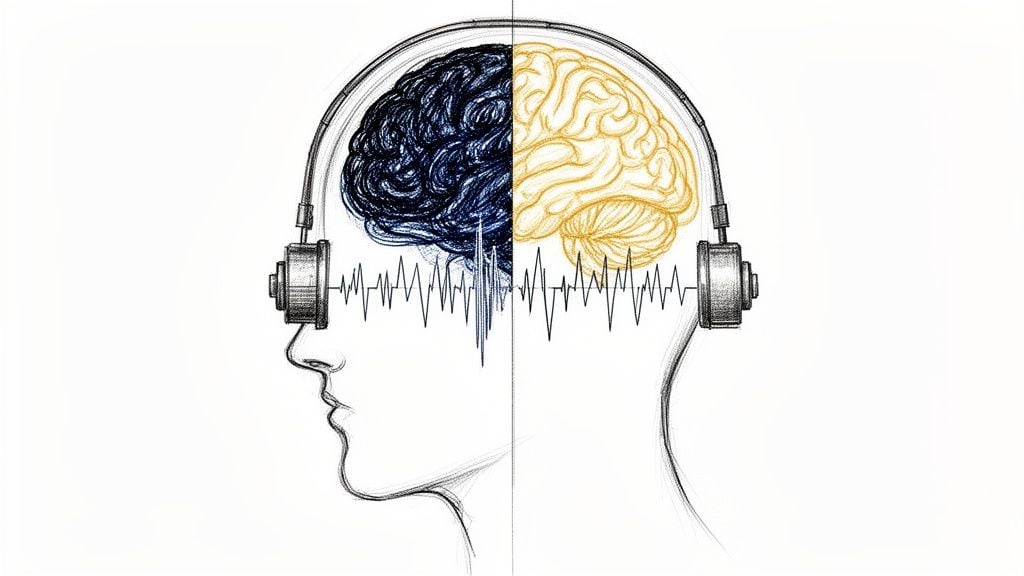
In the high-stakes world of corporate life, mastering your internal state isn’t a soft skill; it’s a critical advantage. Uncontrolled emotional responses can cloud judgment, damage professional relationships, and accelerate burnout. But what if you could respond to pressure with clarity and calm instead of reacting on autopilot? Gaining control over your inner world is the foundation of resilience and effective leadership. Understanding the subtle ways external factors impact your emotional state, such as exploring how scents and candles influence your emotions, can be a valuable part of this journey.
This guide moves beyond generic advice like ‘just breathe.’ We will explore ten powerful, evidence-based emotional regulation strategies designed for real-world application. Each technique is backed by peer-reviewed research and presented with actionable steps you can implement immediately, whether you’re navigating a stressful project or managing chronic anxiety. From the cognitive reframing of CBT to the body-based approaches of Somatic Experiencing, you’ll gain a diverse set of tools to build a robust emotional toolkit. Let’s dive in and start transforming your relationship with your emotions, empowering you to lead a more balanced, intentional, and effective life.
1. Cognitive Behavioral Therapy (CBT)
Cognitive Behavioral Therapy (CBT) is a powerful, evidence-based psychotherapeutic approach that ranks among the most effective emotional regulation strategies. It operates on a simple yet profound principle: our thoughts, feelings, and behaviors are interconnected. By identifying and changing distorted or unhelpful thinking, we can directly influence our emotional responses and actions. This structured method empowers you to become your own therapist by learning to recognize and reframe cognitive distortions.
How It Works in Practice
CBT provides tools to deconstruct and challenge the automatic negative thoughts that often fuel emotional distress. A core technique is cognitive restructuring, where you systematically examine the evidence for and against a stressful thought. For example, if you receive critical feedback at work and immediately think, “I’m a complete failure,” CBT encourages you to challenge that. You would analyze the thought, look for evidence that contradicts it (e.g., past successes, positive feedback), and develop a more balanced, realistic perspective, such as, “This feedback highlights an area for growth, but it doesn’t define my overall competence.”
A 2012 meta-analysis in the Journal of Consulting and Clinical Psychology confirmed CBT’s high efficacy for anxiety disorders by targeting these very thought patterns. Furthermore, a study in a 2017 issue of Cognitive Therapy and Research demonstrated that individuals who actively practiced cognitive reappraisal, a key CBT skill, showed reduced emotional reactivity in stressful situations. Research in the Behaviour Research and Therapy journal also found that CBT interventions significantly improve emotional regulation by teaching individuals to break the link between negative thoughts and subsequent emotional distress.
Actionable Steps for the Workplace
- Use a Thought Record: When you feel overwhelmed by a project deadline, grab a notebook. Write down the situation (“Approaching project deadline”), your automatic thought (“I’ll never get this done in time”), and the resulting emotion (“Overwhelming anxiety”). Then, consciously craft an alternative, more balanced thought: “I feel pressured, but if I break it down into smaller tasks, I can make progress.”
- Practice the ABC Model: Identify the Activating event (e.g., a colleague dismisses your idea), your Belief about it (“They think I’m incompetent”), and the Consequence (feeling angry and withdrawn). Actively work to change the “B” to: “Perhaps they were focused on another aspect, or I didn’t explain it clearly. I can ask for clarification.” This changes the emotional outcome.
- Conduct Behavioral Experiments: If you avoid speaking in meetings because you fear judgment, test that belief. Action: Commit to asking one clarifying question in your next team meeting. Observe the actual outcome—most likely, colleagues will respond professionally, disproving your catastrophic belief.
By consistently applying these techniques, you can methodically dismantle counterproductive mental habits. To go deeper, you can explore specific methods for how to break negative thought patterns.
2. Mindfulness and Meditation
Mindfulness is the practice of paying attention to the present moment intentionally and without judgment. This potent emotional regulation strategy, often cultivated through meditation, creates a crucial pause between an emotional trigger and your reaction. It teaches you to observe your thoughts and feelings as transient mental events rather than absolute truths, which lessens their power over you and allows for more conscious, skillful responses.

How It Works in Practice
Mindfulness works by training your attention and awareness, which fundamentally changes how your brain processes emotions. Instead of being swept away by a wave of anxiety, you learn to acknowledge it (“I am noticing the feeling of anxiety”) without getting entangled in its narrative. This non-reactive observation calms the amygdala, the brain’s alarm center.
Pioneered in Western clinical settings by Jon Kabat-Zinn through his Mindfulness-Based Stress Reduction (MBSR) program, this approach has proven highly effective. A study in the Journal of Internal Medicine demonstrated that MBSR significantly reduces psychological distress in individuals with chronic illness. Research in Social Cognitive and Affective Neuroscience used fMRI to show that mindfulness meditation reduces amygdala activity in response to emotional stimuli. Additionally, a 2019 meta-analysis in JAMA Internal Medicine found that meditation programs consistently resulted in moderate improvements in anxiety and depression. To further enhance your meditative experience, techniques for creating immersive soundscapes with spatial audio can transport you to tranquil environments, aiding in deeper focus and relaxation.
Actionable Steps for the Workplace
- Practice a 3-Minute Breath Anchor: Before a stressful call, set a timer for three minutes. Close your eyes and focus entirely on the physical sensation of your breath. Feel the cool air entering your nostrils and the warm air leaving. When your mind wanders to your to-do list, gently and without judgment, guide it back to your breath.
- Mindful Walking Between Meetings: As you walk from your desk to a conference room, resist pulling out your phone. Instead, pay full attention to the physical sensations of walking: the feeling of your feet hitting the floor, the swing of your arms, and the sounds of the office around you. This turns a routine action into a moment of reset.
- Use the S.T.O.P. Technique: When you feel overwhelmed, Stop what you’re doing. Take a breath. Observe your thoughts and feelings without judgment. Proceed with more awareness. This simple, four-step action can be done in 30 seconds at your desk.
By integrating these small but consistent practices, you build the mental muscle needed for greater emotional balance and clarity under pressure.
3. Dialectical Behavior Therapy (DBT) Skills Training
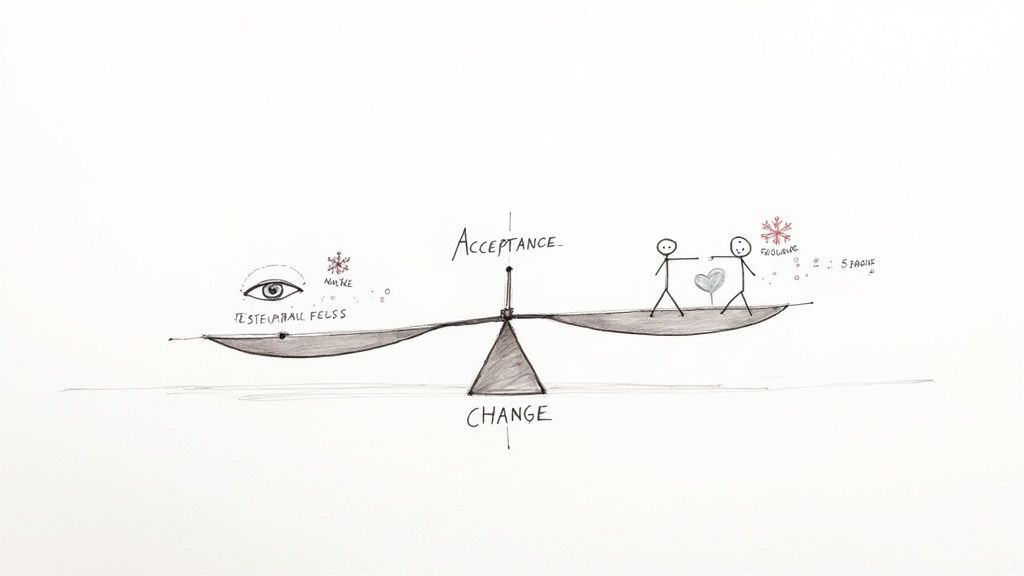
Dialectical Behavior Therapy (DBT) is a highly structured therapeutic model that expands on CBT principles by incorporating concepts of acceptance and dialectics, the idea that two opposing truths can coexist. Developed by Dr. Marsha Linehan, it is one of the most effective emotional regulation strategies for individuals experiencing intense emotional dysregulation. DBT teaches that while change is necessary, accepting reality as it is, without judgment, is the crucial first step toward that change.
How It Works in Practice
DBT’s power lies in its four skills modules: mindfulness, distress tolerance, emotion regulation, and interpersonal effectiveness. A core technique for acute distress is the TIPP skill (Temperature, Intense exercise, Paced breathing, Paired muscle relaxation). When overwhelmed, splashing your face with cold water (Temperature) can activate the mammalian dive reflex, rapidly lowering your heart rate and calming your system.
A 2021 study in BMC Psychiatry highlighted the effectiveness of DBT skills in reducing emotional dysregulation and improving coping mechanisms in real-world settings. A landmark study by Linehan et al. published in the Archives of General Psychiatry demonstrated that DBT significantly reduced suicidal behaviors and hospitalizations compared to treatment-as-usual. Furthermore, research in Behaviour Research and Therapy found that the distress tolerance skills taught in DBT, like radical acceptance, are directly linked to a greater ability to manage intense negative emotions without resorting to impulsive behaviors.
Actionable Steps for the Workplace
- Use the TIPP Skill: Before a high-stakes presentation, you feel your heart pounding. Action: Go to the restroom, hold your breath, and splash your face with cold water for 15-30 seconds. This physiological trick instantly slows your heart rate and reduces panic.
- Practice “Opposite Action”: You make a mistake and feel an intense urge to avoid your boss out of shame. Opposite Action means doing the reverse. Action: Proactively go to your boss, own the mistake, and propose a solution. This builds confidence and counteracts the avoidance emotion.
- Employ Distress Tolerance: Your team’s project just got canceled. Instead of panicking, use radical acceptance. Action: Say to yourself, “It is what it is. The project is canceled. I don’t like it, but I accept this reality.” This stops you from fighting reality and frees up mental energy to focus on the next steps.
4. Emotional Freedom Technique (EFT) Tapping
The Emotional Freedom Technique (EFT), often called Tapping, is a novel mind-body tool that merges cognitive therapy with acupressure principles. This technique operates on the premise that emotional distress is a disruption in the body’s energy system. By gently tapping on specific meridian endpoints on the body while verbally addressing an emotional issue, you can clear these “blockages” and restore balance. EFT is a practical and self-applicable method for processing difficult feelings and reducing their intensity.
How It Works in Practice
EFT Tapping directly targets the amygdala, the brain’s stress center, sending calming signals to the nervous system. By combining this physical stimulation with focused thought on a specific stressor, you can recondition your body’s response to it. For example, if you feel intense anxiety about an upcoming presentation, you would tap through the designated points while saying, “Even though I have this fear of public speaking, I deeply and completely accept myself.”
A 2019 review in Explore: The Journal of Science & Healing found EFT to be effective for both psychological and physiological symptoms. Similarly, a 2016 study in the Journal of Nervous and Mental Disease demonstrated significant reductions in PTSD symptoms and cortisol levels among veterans after EFT sessions. A randomized controlled trial published in the Journal of Evidence-Based Integrative Medicine (2020) found that a single hour of EFT Tapping reduced cortisol levels by 43%, a significantly greater reduction than traditional talk therapy or rest.
Actionable Steps for the Workplace
- Pinpoint the Problem: Before an important meeting, you feel a knot of anxiety in your stomach. Action: Take a moment to identify the core emotion (“anxiety about being judged”). Rate its intensity from 0 to 10 (e.g., an 8).
- Perform a Tapping Round: Gently tap 5-7 times on key meridian points (like the side of the hand, top of the head, eyebrow, and collarbone) while voicing your specific stressor: “This anxiety about being judged…” Followed by an affirmation: “…I choose to feel calm and confident.”
- Re-evaluate and Repeat: After one full round of tapping, take a deep breath and re-rate your emotional intensity. It may have dropped to a 4. Action: Repeat the process, adjusting the language (“This remaining anxiety…”), until the intensity is manageable, allowing you to enter the meeting with greater clarity.
By integrating this simple routine, you can quickly de-escalate stress in real-time. To learn the specific points and sequences, you can find guided sessions and tutorials on the official EFT International website.
5. Emotion-Focused Therapy (EFT)
Emotion-Focused Therapy (EFT) is a humanistic approach that views emotions as central to self-understanding and healthy functioning. Unlike strategies that aim to suppress or bypass difficult feelings, EFT teaches you to welcome, explore, and transform them. The core principle is that emotions are adaptive signals that guide us; by learning to process them effectively, we can resolve inner conflicts and regulate our responses. This method is one of the most profound emotional regulation strategies because it works with emotions, not against them.
How It Works in Practice
EFT provides a framework for identifying and transforming maladaptive emotional states into adaptive ones. A key technique involves distinguishing between primary emotions (your initial, gut reaction) and secondary emotions (reactions to your primary emotions, like feeling ashamed for being angry). The goal is to access the primary emotion to understand its underlying need. For example, if you feel intense anger (secondary emotion) after a manager dismisses your idea, EFT helps you access the primary feeling of being hurt or feeling devalued. Working with that core emotion allows for genuine resolution.
Research published in Psychotherapy found EFT to be highly effective in reducing interpersonal problems by helping individuals process and express these core emotions. A meta-analysis in Clinical Psychology Review confirmed EFT’s efficacy for depression, showing it to be as or more effective than CBT. A 2019 study in the Journal of Consulting and Clinical Psychology also found that the emotional processing facilitated by EFT leads to lasting reductions in anxiety symptoms.
Actionable Steps for the Workplace
- Identify Primary vs. Secondary Emotions: When you feel a strong emotion like anger after receiving feedback, pause. Action: Ask, “What am I feeling underneath this anger?” You might discover the primary emotion is embarrassment or a feeling of inadequacy. Addressing the embarrassment is more productive than lashing out in anger.
- Use the Two-Chair Technique (Solo Version): To resolve an internal conflict (e.g., one part of you wants to ask for a raise, the other is afraid of rejection), sit in a chair and voice the perspective of the part that wants the raise. Then, physically move to an empty chair opposite you and voice the fears of the hesitant part. Action: Continue this dialogue out loud until you reach a point of understanding or integration.
- Listen to Your Body’s Emotional Signals: You’re about to agree to take on another project, but you feel a tightening in your chest. Action: Instead of ignoring it, acknowledge the physical sensation as a signal. Say, “Can I take a moment to review my current workload before I commit?” This honors the emotional data your body is giving you.
6. Somatic Experiencing and Body-Based Approaches
Somatic Experiencing (SE) is a body-centric therapeutic approach that operates on the principle that emotions and trauma are physically stored in the body’s nervous system. Developed by Dr. Peter Levine, SE is one of the most effective emotional regulation strategies for processing experiences that are too overwhelming for cognitive approaches alone. It focuses on releasing this stored survival energy by gently guiding your attention to internal physical sensations, or “felt sense,” helping the nervous system return to a state of balance.
How It Works in Practice
Unlike therapies that focus solely on thoughts, SE helps you become aware of how emotions manifest as physical sensations, like a tight jaw or a hollow feeling in your stomach. The goal is not to relive trauma but to safely release the physiological activation associated with it. This process, known as “titration,” involves touching into difficult sensations for a moment and then returning to a state of safety and resourcefulness, gradually increasing your nervous system’s capacity.
A study in the European Journal of Psychotraumatology found SE to be effective in reducing symptoms of post-traumatic stress disorder by helping individuals complete self-protective motor responses. Research in Frontiers in Psychology (2017) highlighted that body-awareness practices inherent in somatic therapies improve interoception—the sense of the internal state of the body—which is crucial for effective emotional regulation. Another study in the Journal of Traumatic Stress showed that somatic interventions helped reduce hyperarousal and anxiety symptoms in traumatized individuals.
Actionable Steps for the Workplace
- Practice Body Scans: During a tense negotiation, you feel your shoulders creeping up towards your ears. Action: Discreetly bring your awareness to that tension. Without judgment, simply notice it. Then, consciously take a deep breath and feel your shoulders drop as you exhale. Repeat as needed.
- Use Grounding Techniques: Feeling anxious before a performance review? Action: Sit in your chair and press your feet firmly into the floor. Feel the solid ground beneath you. Notice the texture of your chair supporting your back. This simple act pulls your attention out of anxious thoughts and into the present physical reality.
- Engage in Restorative Movement: After a frustrating call, you feel agitated and restless. Action: Find a private space (like a stairwell) and gently shake your arms and legs for 30 seconds. This helps discharge the pent-up adrenaline and cortisol from your nervous system.
By integrating these body-based techniques, you learn to regulate your emotions from the bottom up. For a deeper understanding, explore methods for how to release stored trauma from the body.
7. Acceptance and Commitment Therapy (ACT)
Acceptance and Commitment Therapy (ACT) offers a unique and powerful approach to emotional regulation by shifting the goal from controlling or eliminating unwanted feelings to cultivating psychological flexibility. It operates on the core idea that trying to suppress difficult thoughts and emotions is often counterproductive. Instead, ACT teaches you to accept their presence non-judgmentally, defuse their power, and commit to actions that align with your deepest personal values, even when discomfort arises.

How It Works in Practice
ACT uses a combination of acceptance, mindfulness, and behavior-change strategies to help you engage fully in a meaningful life. A key technique is cognitive defusion, which involves observing your thoughts rather than getting entangled in them. For instance, instead of believing the thought “I am incompetent,” you learn to reframe it as, “I am having the thought that I am incompetent.” This small linguistic shift creates distance, reducing the thought’s emotional impact.
Research published in the Journal of Vocational Behavior found that ACT-based workplace interventions significantly increased psychological flexibility and improved mental health outcomes among employees. A meta-analysis in the Journal of Contextual Behavioral Science confirmed ACT’s effectiveness across a range of conditions, including anxiety and depression. Additionally, a 2015 study in Behaviour Research and Therapy demonstrated that the “acceptance” component of ACT is particularly effective at reducing the impact of negative emotions on behavior.
Actionable Steps for the Workplace
- Identify Core Values: Feeling directionless or burnt out? Action: Take 15 minutes to write down what truly matters to you in your career (e.g., creativity, collaboration, mentorship, integrity). Post these values where you can see them. Use them as a compass when making decisions, especially stressful ones.
- Practice Defusion: The stressful thought “I’m going to fail this presentation” pops into your head. Action: Instead of fighting it, playfully acknowledge it. Say to yourself in a silly voice, “Oh, look, my mind is telling me the ‘I’m going to fail’ story again.” This separates you from the thought and drains its power.
- Take Committed Action: You feel anxious about networking, but you value professional growth. Action: Commit to one small, value-aligned action. It could be as simple as sending a connection request on LinkedIn to one person from another department today. The action is taken alongside the anxiety, not in its absence.
8. Emotional Regulation Through Physical Exercise
Physical exercise is a foundational and highly accessible strategy for emotional regulation. It directly influences brain chemistry and physiology by releasing endorphins, which act as natural mood elevators, and reducing stress hormones like cortisol. This powerful intervention provides an immediate outlet for tension and a long-term foundation for emotional resilience by promoting neural health and growth.
How It Works in Practice
Engaging in physical activity triggers a cascade of neurobiological benefits that support emotional stability. For example, aerobic exercise like running or cycling increases the production of brain-derived neurotrophic factor (BDNF), a protein essential for neuron survival and growth, effectively fortifying the brain against stress.
A 2017 study in Brain Plasticity highlighted how exercise directly enhances the top-down control of emotion from the prefrontal cortex. A meta-analysis published in the Journal of Psychiatric Research found that exercise is a viable and effective intervention for reducing symptoms of depression. Another study from the American Journal of Preventive Medicine showed that even low levels of physical activity (like walking) can prevent future depression. Whether it’s a high-intensity interval training (HIIT) session to release pent-up frustration or a yoga class to calm the nervous system, the physical exertion provides a tangible way to process and transform emotional energy.
Actionable Steps for the Workplace
- Schedule “Movement Meetings”: Have a one-on-one coming up? Action: Instead of booking a conference room, suggest a “walk and talk” meeting outside or around the office. The light activity can reduce tension and stimulate more open, creative conversation.
- Use Micro-Workouts: Feeling stressed and stuck at your desk? Action: Set a timer for 5 minutes and do a “micro-workout.” This could be climbing a few flights of stairs, doing 20 squats, or simply stretching vigorously. This quick burst of activity can instantly shift your emotional state and improve focus.
- The ‘Workout Commute’: If possible, incorporate exercise into your commute. Action: Get off the bus one stop early and walk briskly, or cycle to work one day a week. This bookends your day with a dedicated period for emotional processing and stress reduction.
- Pair Exercise with Mindful Breathing: After your workout, don’t rush back to work. Action: Take two minutes to sit quietly and practice deep, controlled breathing. This amplifies the calming effect and helps transition from a high-energy state to a focused one. You can explore specific techniques like breathing exercises to lower heart rate to enhance this practice.
9. Interpersonal Therapy and Social Connection
Interpersonal Therapy (IPT) is a structured, time-limited therapeutic approach that treats emotional regulation as an inherently social process. It is built on the premise that our relationships and the way we interact with others have a profound impact on our mental health. By improving communication skills, resolving interpersonal conflicts, and navigating social roles, IPT helps build the robust support systems that are essential emotional regulation strategies, buffering us against stress and emotional turmoil.
How It Works in Practice
IPT focuses on four key problem areas: interpersonal disputes, difficult role transitions, grief, and interpersonal deficits (such as social isolation). The therapy helps you identify how these relationship-based issues trigger emotional dysregulation and equips you with skills to manage them effectively. For instance, if ongoing conflict with a manager is causing significant anxiety, IPT would help you analyze the communication breakdown and practice assertive, non-confrontational dialogue to resolve the dispute.
Research published in the American Journal of Psychiatry has repeatedly demonstrated IPT’s efficacy, particularly for depression. A meta-analysis in the Canadian Journal of Psychiatry found IPT to be a robust treatment for mood disorders, emphasizing that improved social functioning directly correlates with reduced depressive symptoms. Furthermore, a 2018 study in The Lancet showed that strong social connections are a significant protective factor against depression, underscoring the core principle of IPT.
Actionable Steps for the Workplace
- Practice Assertive Communication: A coworker keeps pushing their work onto you. Action: Instead of letting resentment build, use an “I” statement. Say, “I feel overwhelmed with my current projects when I take on extra tasks. I need to focus on my priorities right now.” This is clear, respectful, and sets a boundary.
- Schedule Connection Time: Feeling isolated while working remotely? Action: Intentionally block 15 minutes in your calendar twice a week for a “virtual coffee” with a colleague you trust. Proactively nurturing these bonds creates a vital support network.
- Engage in Active Listening: In a team meeting, a colleague is explaining a problem. Action: Resist the urge to jump in with a solution. Instead, listen fully and then paraphrase what you heard: “So, if I’m understanding correctly, the main obstacle is…” This builds trust and ensures you’re solving the right problem, reducing future conflict.
10. Narrative Therapy and Story Reconstruction
Narrative Therapy is a respectful, non-blaming approach to counseling that centers people as the experts in their own lives. It operates on the core idea that our identities are shaped by the stories we tell about ourselves. This therapeutic model, one of the more profound emotional regulation strategies, helps individuals recognize that they are separate from their problems. By deconstructing “problem-saturated” narratives and co-authoring new, preferred stories, you can reclaim your agency and change your relationship with your emotions.
How It Works in Practice
This method involves externalizing the problem, which means viewing it as a separate entity rather than an intrinsic part of you. For instance, instead of saying “I am an anxious person,” you would reframe it as “I am a person who is sometimes visited by anxiety.” This simple linguistic shift creates distance, allowing you to explore the problem’s influence on your life without shame.
Research published in the Journal of Systemic Therapies highlights how this externalization helps clients diminish the power of their problems and discover “unique outcomes” or moments when the problem wasn’t in control. A study in the Family Process journal found that re-authoring conversations helped individuals develop a more positive identity and reduce symptoms of distress. Furthermore, research in the British Journal of Guidance & Counselling showed that narrative approaches empower individuals by helping them see their skills and resilience, which are often obscured by problem-focused stories.
Actionable Steps for the Workplace
- Externalize Your Stress: You’re feeling crushed by work pressure. Action: Name the stress as an external force (e.g., “The Q4 Crunch”). Ask yourself, “What tricks does ‘The Q4 Crunch’ use to make me feel overwhelmed?” and “When have I managed to resist its influence?” This separates you from the problem and gives you agency.
- Map the Problem’s Influence: Feeling stuck with “Imposter Syndrome”? Action: Grab a piece of paper. In one column, list all the ways “Imposter Syndrome” affects your work (e.g., “stops me from speaking up,” “makes me over-prepare”). In another column, list actions you’ve taken that pushed back against it, no matter how small (e.g., “I spoke up in that one meeting,” “I trusted my gut on that decision”).
- Document Unique Outcomes: Keep a “Win” journal. Action: At the end of each workday, write down one instance where “self-doubt” tried to take over, but you acted anyway. For example, “Self-doubt told me not to send that proposal, but I did it.” These documented moments are the building blocks for a new, more empowering professional story.
10-Strategy Emotional Regulation Comparison
| Method | Implementation complexity | Resource requirements | Expected outcomes | Ideal use cases | Key advantages |
|---|---|---|---|---|---|
| Cognitive Behavioral Therapy (CBT) | Moderate — structured protocol, therapist-guided or self-help | Trained therapist or guided programs, worksheets, weekly sessions | Symptom reduction, skill acquisition, measurable improvement | Anxiety, depression, OCD, short-to-mid term problems | Strong research base, time-limited, skills for self-use |
| Mindfulness and Meditation | Low to moderate — practice-based, scalable | Minimal cost (apps/groups), daily practice time | Reduced rumination, stress reduction, improved awareness | Stress, general anxiety, maintenance, attention issues | Accessible, low-cost, neuroplastic benefits with practice |
| Dialectical Behavior Therapy (DBT) Skills Training | High — multi-component program (group + individual + coaching) | Highly trained therapists, group classes, significant time | Improved emotion regulation, reduced self-harm and suicidality | Borderline personality disorder, chronic emotion dysregulation | Practical teachable skills, strong outcomes for high-risk clients |
| Emotional Freedom Technique (EFT) Tapping | Low — simple protocol, self-administered | Very low cost, minimal equipment, brief sessions | Possible rapid short-term relief for some; variable durability | Acute stress, performance anxiety, self-help stress relief | Quick to learn, combines somatic and cognitive elements |
| Emotion-Focused Therapy (EFT) | High — experiential, therapist-dependent | Highly trained empathic therapists, longer-term work | Deep emotional processing, improved relationships and trauma recovery | Complex emotions, trauma, couples therapy | Addresses emotional roots, strong therapeutic alliance |
| Somatic Experiencing / Body-Based Approaches | High — body-focused, nuanced pacing | Specialized clinicians, safe clinical space, time | Nervous system regulation, trauma symptom reduction | PTSD, chronic trauma, somatic symptoms, chronic pain | Targets bodily storage of trauma, effective when talk therapy falls short |
| Acceptance and Commitment Therapy (ACT) | Moderate — experiential and values-based | Trained therapist or structured self-help, exercises | Increased psychological flexibility, values-driven behavior | Chronic conditions, avoidance, long-term behavior change | Emphasizes acceptance and meaningful action, flexible integration |
| Emotional Regulation Through Physical Exercise | Low to moderate — planning and adherence required | Access to activity space/equipment, time commitment | Improved mood, reduced anxiety/depression, physical health gains | Mild–moderate depression/anxiety, stress management, prevention | Evidence-based, multiple health co-benefits, social options available |
| Interpersonal Therapy (IPT) & Social Connection | Moderate — therapist-led, relational focus | Trained IPT therapists, involvement of social supports | Improved relationship functioning, reduced depression tied to relationships | Postpartum depression, role transitions, interpersonal conflict | Builds lasting social supports, short-term focused treatment |
| Narrative Therapy & Story Reconstruction | Moderate to high — collaborative and interpretive | Skilled facilitator, time for re-authoring and witnessing | Reframed identity, reduced shame, empowerment | Identity issues, cultural conflict, trauma with meaning concerns | Non-pathologizing, empowers client agency and multiple perspectives |
Integrating Your Toolkit: The Path from Strategy to Habit
Navigating the high-stakes environment of the modern workplace requires more than just professional skill; it demands emotional resilience. Throughout this guide, we have explored a comprehensive suite of ten powerful emotional regulation strategies, from the cognitive restructuring of CBT and ACT to the somatic awareness of Somatic Experiencing and the interpersonal focus of Narrative Therapy. Each method offers a unique pathway to understanding, managing, and transforming your emotional responses.
The central takeaway is not to become a master of all ten disciplines overnight. Instead, the goal is to cultivate a personalized toolkit. True emotional mastery is a dynamic process of self-awareness and consistent practice, not a final destination. Your journey begins with conscious, deliberate application of these techniques, eventually leading to an intuitive and habitual state of emotional balance.
Your Actionable Path Forward
The bridge between knowing these strategies and living them is built with small, consistent actions. Here is a practical framework to begin integrating these tools into your daily life:
- Select Your Starting Point: Review the ten strategies. Which one or two resonated most deeply with your current challenges? Perhaps the logic of CBT appeals to your analytical mind, or maybe the body-based approach of Somatic Experiencing feels more aligned with your needs. Action: Choose one strategy to focus on for the next week.
- Commit to Micro-Practices: Don’t aim for a complete overhaul. Instead, commit to a small, daily practice. Action: If you chose mindfulness, commit to a five-minute breath anchor before your first meeting each day. If you chose ACT, identify one value-driven action to take each day. Make it so small you can’t say no.
- Track and Reflect: Keep a simple journal to note when you use a strategy and how it impacts your emotional state. Action: At the end of each day, write one sentence: “Today I used [strategy] when I felt [emotion], and the result was [outcome].” This reflection reinforces learning and helps you refine your approach.
The Long-Term Value of Emotional Regulation
Mastering emotional regulation strategies is a direct investment in your career longevity and personal well-being. It transforms how you lead, collaborate, and innovate. Instead of reacting impulsively to pressure, you learn to respond with intention and clarity. This capacity is what separates good professionals from great leaders.
A 2018 study in Frontiers in Psychology highlighted that effective emotional regulation is directly linked to lower burnout rates and higher job satisfaction among professionals. By actively managing your internal state, you are not just coping; you are building a sustainable foundation for long-term success and fulfillment, protecting your mental health while enhancing your professional impact. The journey is one of continuous practice, but the rewards-calm, clarity, and control-are immeasurable.
Ready to accelerate your journey and hardwire these new emotional patterns? 9D Breathwork offers a powerful somatic modality that helps you release stored stress and rewire your nervous system for resilience, making it easier to integrate these strategies into your daily life. Explore the transformative potential of a guided session at 9D Breathwork.