When you’re looking to release stored trauma, it’s crucial to see it for what it truly is: a physical state. It’s not just a collection of bad memories. Your nervous system is essentially stuck in survival mode, and the key is using body-based (somatic) practices and intentional breathwork to help your system finally complete the stress responses that got trapped.
This guide will walk you through safe, evidence-informed actions you can take to begin that journey.
Understanding How Trauma Lives in The Body
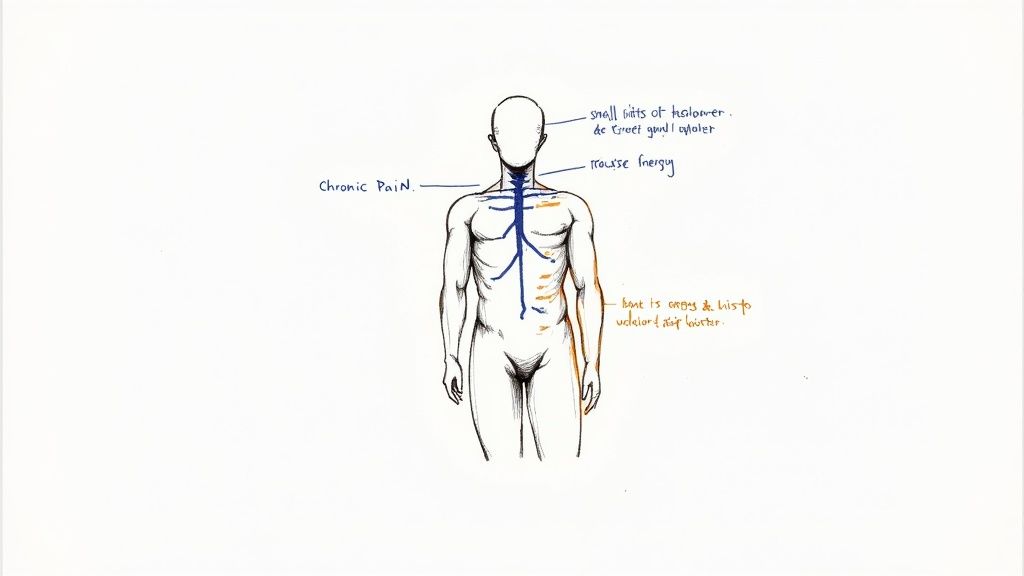
We usually think of trauma as a mental issue—the intrusive thoughts, flashbacks, or waves of emotion. But trauma isn’t just an event that happened to you; it’s the imprint that event leaves on your body and nervous system long after it’s over.
When you face a real threat, your body’s survival response kicks in: fight, flight, or freeze. This is a brilliant short-term solution. Your system gets a jolt of adrenaline and cortisol to help you survive. Once the danger passes, your body is designed to discharge all that intense energy and return to a state of balance.
The problem is, sometimes that cycle gets interrupted. The energy gets trapped, and your nervous system stays on high alert.
That’s the core of stored trauma. It’s not a memory problem; it’s a nervous system problem. Your body is still acting as if the threat is present, even years down the road.
Why Your Body Remembers What Your Mind Forgets
This happens because our brains process traumatic experiences differently than everyday memories. They get lodged in the non-verbal, sensory parts of the brain and body—the parts that don’t respond to logic.
This is why traditional talk therapy, while incredibly valuable, can sometimes feel like it’s not getting to the root of the issue. You can’t always talk your way out of a physiological state. Your body has to be part of the healing conversation.
The key shift in perspective is moving from asking, “What’s wrong with me?” to compassionately asking, “What happened to me, and how is my body still trying to protect me?”
This stored energy can show up in ways that seem completely disconnected from the original event. It’s the invisible force behind a lot of chronic physical and emotional struggles. Below is a table that breaks down some of the common signs.
Common Signs of Stored Trauma
Use this table to recognize how stored trauma can manifest physically and emotionally, making the concept more tangible and relatable to your own experience.
| Physical Signs | Emotional & Psychological Signs |
|---|---|
| Chronic pain or unexplained muscle tension (e.g., neck, back) | Persistent anxiety or panic attacks |
| Migraines and tension headaches | Feeling numb, disconnected, or detached |
| Digestive issues like IBS | Hypervigilance (always on alert) |
| Unexplained fatigue or exhaustion | Difficulty concentrating or “brain fog” |
| A tendency to startle easily | Irritability or sudden anger outbursts |
| Autoimmune conditions | Avoidance of people, places, or things related to the trauma |
Recognizing these signs can be a huge first step. It validates your experience and confirms that your body is simply stuck in a protective loop, trying to keep you safe.
Trauma Is More Common Than You Think
It can feel incredibly isolating to live with the after-effects of trauma, but you are far from alone. Statistics show that about 70% of people worldwide will experience a potentially traumatic event in their lifetime.
While exposure is common, not everyone develops Post-Traumatic Stress Disorder (PTSD). In the United States, the lifetime prevalence of PTSD is estimated at around 6.8% for adults, with women experiencing it more often than men. These numbers show just how resilient we are, but they also remind us that sometimes our bodies need a little help to complete the healing cycle.
If you struggle with the sudden overwhelm of panic, our guide on how to calm panic attacks offers practical strategies to regain a sense of control in the moment.
The goal here is to introduce you to somatic and breathwork practices that communicate directly with your nervous system in a language it understands. By using your body as a resource, you can gently and safely begin to release this stored energy and, over time, teach your system that the danger is truly over.
Creating a Safe Space for Emotional Release
Let’s be clear: releasing stored trauma is vulnerable work. Before you can even begin, your nervous system needs to get a loud and clear signal that it’s finally safe to let its guard down. So, before diving into any specific breathwork or somatic practice, the first and most important action is to intentionally build a container of safety—both in the room around you and inside your own mind.
This preparation isn’t just a preliminary step; it’s a profound act of self-compassion. If you’ve lived through prolonged or repeated trauma, the world often feels like an unsafe place. This is especially true for those with Complex Post-Traumatic Stress Disorder (C-PTSD), a condition recognized in the ICD-11 that comes from chronic trauma and can deeply impact how you regulate emotions and see yourself. With studies suggesting that nearly 8.6% of people globally show signs of C-PTSD, it’s clear many of us are navigating life with a nervous system perpetually braced for a threat.
Creating a safe space is how you start to talk back to that hypervigilance. It’s about consciously proving to your body that right here, in this moment, you are secure.
Action Step 1: Ground Yourself in the Present Moment
Before you create safety around you, you must find it within you. Grounding techniques are simple, powerful tools that pull your focus out of distressing memories and plant you firmly in the present. The point is to connect with the physical reality of right now.
A fantastic, go-to method for this is the 5-4-3-2-1 Method. Use it anytime you feel your mind starting to spin. Wherever you are, pause and gently notice:
- 5 things you can see: Look around and name them. “I see my blue ceramic mug. I see the succulent on the windowsill. I see the grain of the wood on my desk.” Notice their color, texture, and shape.
- 4 things you can feel: Bring your awareness to physical sensations. “I feel the soft knit of my sweater on my arms. I feel the cool floor under my feet. I feel the solid weight of my body in this chair.”
- 3 things you can hear: Tune in to the sounds around you. “I hear the low hum of the fridge. I hear the distant sound of traffic. I hear my own breath.”
- 2 things you can smell: Take a gentle sniff. “I can smell the faint scent of coffee. I can smell the rain outside.”
- 1 thing you can taste: What’s the taste in your mouth? Or, take a sip of water and focus on that sensation.
This exercise is a direct message to your brain: you are not in danger. You are here, now, and you are okay.
Action Step 2: Set Up Your Physical Sanctuary
Your environment has a massive impact on your internal state. Think of the space where you’ll do this work as a sanctuary—a spot dedicated entirely to your healing. It doesn’t have to be a special room; it just needs to be intentional.
Your Action: Find a place where you feel at ease and won’t be disturbed. This could be your bedroom, a quiet corner of the living room, or even your car parked in a safe spot. Let roommates or family know you need some uninterrupted time.
Once you’ve picked your spot, make it feel truly supportive with these actionable steps:
- Gather comfort items: Grab a soft blanket, a favorite pillow, or a weighted blanket. These things offer physical comfort that can be incredibly regulating.
- Adjust the lighting: Dim the lights or switch on a soft lamp. Harsh overhead lights can be agitating.
- Use calming scents: A diffuser with lavender essential oil or a familiar, comforting candle can set a peaceful tone.
Making your immediate practice space feel safe is key, but you can also extend that feeling outward. You might want to explore some cozy home decor ideas to transform your space into a sanctuary to make your entire living area feel more supportive.
The purpose of creating a physical sanctuary is to remove external stressors so your internal system has the bandwidth to do its healing work. It’s about minimizing the need for hypervigilance.
Action Step 3: Establish Boundaries for Your Practice
Finally, creating a safe space means setting clear boundaries around the practice itself. This is about you taking the reins and reassuring your subconscious that you are the one in charge.
Your Action: Decide on a specific amount of time for your practice—even just ten minutes. Set a gentle timer. Knowing there’s a defined endpoint can make the process feel much less intimidating.
Most importantly, give yourself explicit permission to stop at any time. If an emotion or sensation feels too intense, you have full authority to pause, use a grounding technique, and come back to it later—or not at all. You are in control. This is a non-negotiable principle for safely releasing stored trauma.
Your Breath: The Control Panel for Your Nervous System
Your breath is the only part of your autonomic nervous system you can consciously control. Think about it—you can’t just tell your heart to slow down or your digestion to speed up. But you can change the rhythm and depth of your breathing in an instant. This is a game-changer because how you breathe sends a direct signal to your brainstem, telling your body whether to be on high alert or to stand down and relax.
When we’re working with stored trauma, the breath becomes both our anchor and our regulator. Short, shallow breathing is the language of threat. Slow, deep, intentional breathing activates the parasympathetic nervous system—your body’s built-in “rest and digest” mode—and lets your entire being know it’s safe to let go.
Before diving deeper, the first action is always to create safety. Without that foundation, the nervous system stays on guard.
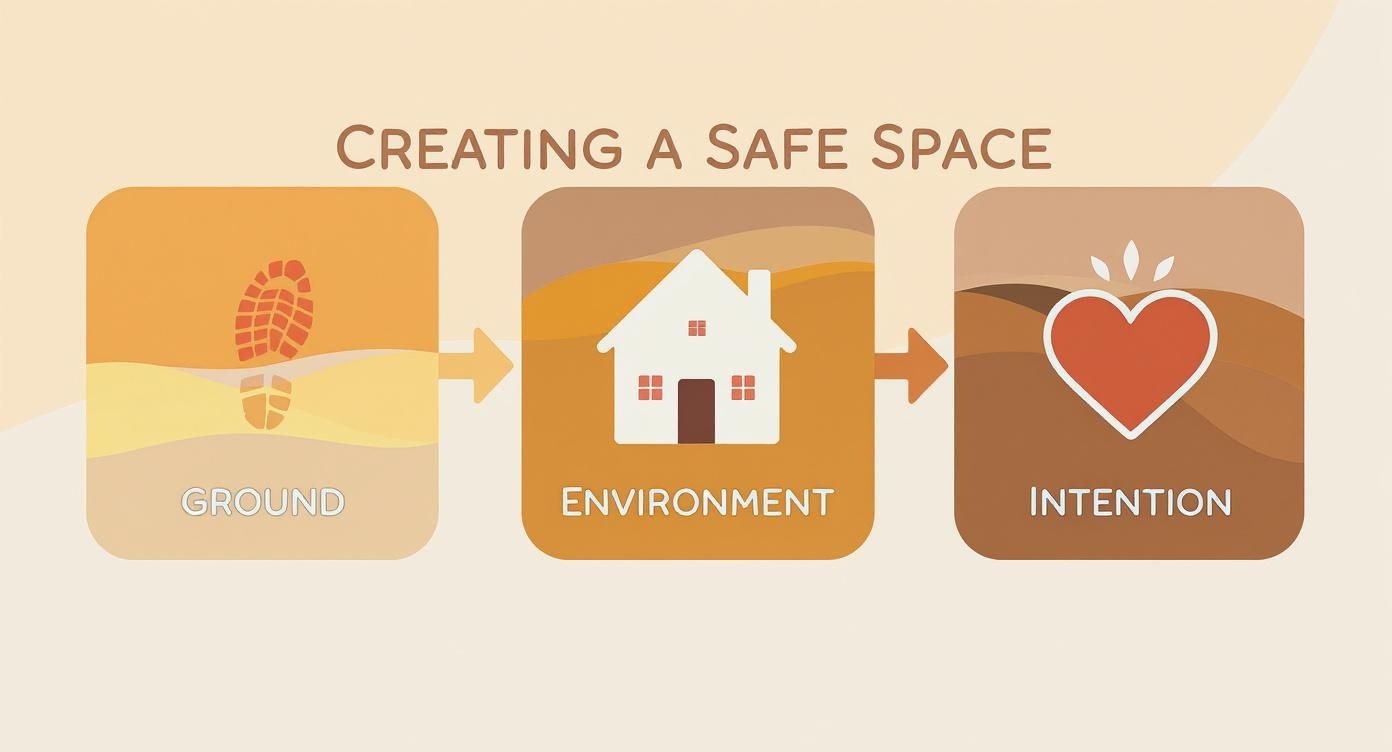
This process is about getting into your body, making sure your physical space feels secure, and then setting a clear intention for your practice. These three pillars create the container you need for healing.
Find Your Calm with Box Breathing
One of the most reliable tools for building stability is Box Breathing. It was made famous by Navy SEALs who use it to stay calm under pressure, but its power lies in its simplicity. You can do it anywhere, anytime, without anyone knowing.
The magic of Box Breathing is its rhythm. By making your inhales, holds, and exhales equal, you create a predictable pattern that interrupts frantic, shallow breathing. You’re telling your nervous system, “Everything is steady. We are in control.”
Here’s how to practice it:
- Step 1: Inhale slowly through your nose for a count of four. Feel your belly expand.
- Step 2: Hold your breath gently for a count of four. Don’t strain.
- Step 3: Exhale slowly and smoothly through your mouth for a count of four.
- Step 4: Pause at the bottom of the exhale for a count of four before starting again.
Practical Example: You have a difficult conversation coming up. Before you go, step into a bathroom stall and do this for two minutes. This simple act can pull you out of anxious anticipation and into a grounded state, helping you walk into that conversation with a much clearer head.
Box Breathing is your portable off-switch for chaos. It gives your nervous system the structure and predictability it craves, reassuring it that you are safe and in control.
Instantly Down-Regulate with the Cyclic Sigh
Sometimes you don’t need steady calm—you need an emergency brake. That’s where the Cyclic Sigh (or Physiological Sigh) comes in. This is a powerful technique backed by neuroscience to rapidly slam the brakes on stress. Researchers like Dr. Andrew Huberman have pointed to it as the single fastest way to voluntarily calm a hyper-aroused nervous system.
It works by mimicking the body’s natural release valve—a sob or a deep sigh. When we get stressed, tiny air sacs in our lungs (alveoli) can collapse. The Cyclic Sigh forces them to reinflate, allowing for a much more efficient gas exchange that helps rapidly offload carbon dioxide and anxiety.
It’s just two simple steps:
- Step 1: Take two sharp inhales in a row through your nose—a big one, then a smaller one to top it off, filling your lungs completely.
- Step 2: Let out a long, slow, complete exhale through your mouth. Really let everything go.
Practical Example: A stressful email just landed in your inbox and you feel your heart start to pound. Before you get swept away, stop and do one to three rounds of the Cyclic Sigh. You will feel a near-instant physical shift as your body comes down from that high-alert state.
If you want to explore more tools for these moments of high activation, there are several other simple breathing exercises to lower your heart rate that can offer immediate relief.
Your Breathwork Toolkit for Emotional Regulation
Think of these techniques as different tools for different jobs. This quick reference guide helps you choose the right one for what you’re feeling in the moment.
| Technique | Primary Goal | Best Used When You Feel… |
|---|---|---|
| Box Breathing | To create calm, stability, and focus. | Anxious, scattered, or preparing for a stressful event. |
| Cyclic Sighing | To quickly reduce high levels of stress and anxiety. | Overwhelmed, panicky, or in a state of high activation. |
Having the right tool for the job makes all the difference when you’re navigating your emotional landscape.
Guided Modalities for Deeper Release
While techniques like Box Breathing and the Cyclic Sigh are incredible for managing your state moment-to-moment, they are primarily regulators. When you’re ready to safely access and release the deeper layers of stored trauma, a more structured and guided approach is often the next step.
This is where modalities like 9D Breathwork really shine.
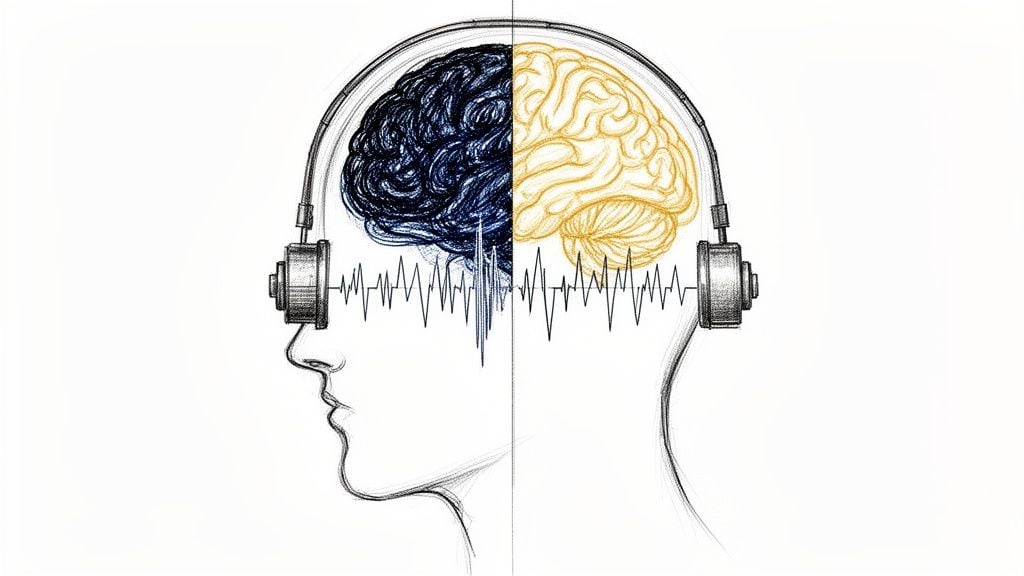
A guided journey like this is more than just breathing exercises. It’s an immersive experience that weaves together specific breathing patterns, binaural beats, powerful music, and verbal guidance. This combination is designed to help you gently bypass your analytical mind and connect directly with the wisdom of your body.
The structure itself provides the safety needed for your nervous system to finally feel like it can let go of old patterns and deeply held tension. Think of it as having an experienced guide holding a lantern for you, illuminating the path through your inner world so you can navigate it with confidence and support. For many people, this is a pivotal part of their healing, making the profound work of releasing trauma feel both accessible and manageable.
Somatic Exercises to Reconnect Mind and Body
When we go through trauma, it’s common to feel disconnected from our bodies. Living in our heads can feel like a necessary escape from physical sensations that are just too much to handle. Somatic exercises are all about gently, safely rebuilding that bridge between mind and body.
The goal isn’t to force a release or push through discomfort. Instead, it’s about creating the right conditions for your body to finally complete the survival responses it couldn’t finish back then. Your body holds an incredible amount of wisdom; our job is simply to learn how to listen again.
Build Resilience with Pendulation
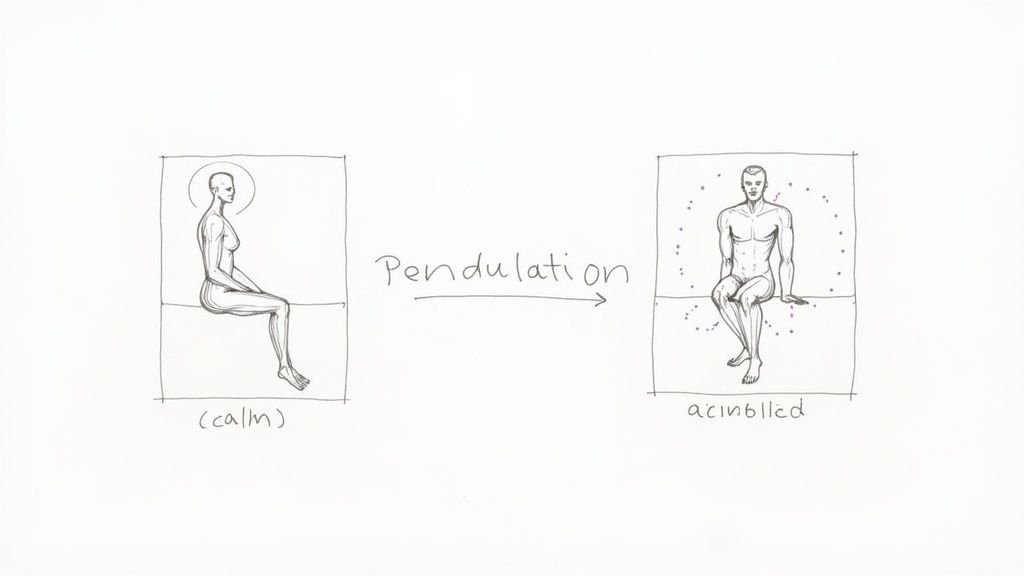
One of the most powerful and gentle places to start is a practice called Pendulation. The idea is beautifully simple: you mindfully shift your focus back and forth between a sensation of stress in your body and a place that feels neutral, calm, or even a little bit pleasant.
Think of it as a gentle workout for your nervous system. By “pendulating” between these states, you’re teaching your system that it can touch upon difficult feelings without being completely swallowed by them. This process gradually expands your “window of tolerance,” which is your capacity to stay present and handle emotional and physical stress.
Try This Action: Find a comfortable seat and, if it feels safe, allow your eyes to close.
- Find Your Anchor: Scan your body to find a place that feels relatively calm or neutral. This could be the solid feeling of your feet on the ground, the warmth of your hands resting in your lap, or the gentle rise and fall of your belly as you breathe. Rest your attention here for 30 seconds.
- Gently Touch Activation: Now, gently bring your awareness to a place where you feel a bit of tension. Maybe it’s a tightness in your chest or a knot in your stomach. Don’t dive into the deepest point of distress—just find a small, manageable edge of that feeling. Stay here for just 5-10 seconds.
- Pendulate Back to Safety: Guide your attention back to your anchor point—that place of calm. Notice the shift in sensation as you do. Let your nervous system settle and rest in that neutral space for as long as you like.
- Repeat as Tolerable: Continue this gentle swing for a few minutes, always spending more time in the place of calm than in the place of activation. The goal isn’t to “fix” the tension but to simply notice that both sensations can exist and that you have the power to move between them.
Pendulation isn’t about confronting trauma head-on. It’s about building the internal resources and nervous system flexibility you need to process difficult sensations safely, one small piece at a time.
Discharge Stress with Therapeutic Tremoring
Have you ever seen an animal shake after a scare? A dog after a loud thunderclap, for instance? That shaking, or tremoring, is the body’s brilliant, natural way of discharging the massive surge of survival energy—adrenaline, cortisol—that floods the system during a threat. As humans, we’ve often been taught to suppress this instinct, which means that stress gets stuck inside.
Therapeutic Tremoring is the practice of consciously inviting this natural release mechanism back online. It’s a powerful way to let your body physically complete the stress cycle.
Try This Action: Find a private, safe space where you won’t feel self-conscious. Stand with your knees slightly bent.
- Start small: Begin by just shaking out your hands, as if you’re flicking water from your fingertips. Do this for 30 seconds.
- Move up your arms: Let that gentle shaking travel up into your forearms, elbows, and shoulders. Keep everything loose and don’t force it.
- Involve your legs: Allow your knees to bounce, letting the vibration travel up into your hips and torso.
- Listen to your body: You might feel an impulse to shake more vigorously or to focus on a particular area. Follow that instinct without judgment for a few minutes.
Practical Example: You’ve just walked in the door after a tense meeting at work. You can feel that stress buzzing under your skin—your jaw is tight, your shoulders are up by your ears. Instead of ignoring it, slip into your bedroom, close the door, and spend just two to three minutes letting your body shake. You might feel silly at first, but you’ll notice a real sense of relief and lightness as your body lets go of that pent-up energy.
For more structured practices that blend mindful movement with breath, exercises like Pilates can be incredibly helpful for regulating the nervous system. Resources like this guide to Pilates for Women Over 50 show how controlled, body-aware movements can support this mind-body reconnection at any stage of life.
These somatic exercises aren’t a quick fix. They are a way to re-establish a trusting, compassionate relationship with your body. By consistently showing up and listening to its subtle cues, you slowly teach your nervous system that the threat is over, and it is finally safe to rest.
Integrating Healing Into Your Daily Life
Releasing stored trauma isn’t a one-and-done event; it’s more like the beginning of a whole new chapter. What you do in the hours and days after a big emotional or somatic release is just as important as the release itself. This period is all about integration, and it’s where real, lasting change takes root.
Think of it like this: your session cleared out a cluttered, chaotic room inside you. Integration is the process of deciding how you want to live in that new, open space. It’s about letting your nervous system get comfortable with a calmer baseline and weaving these new feelings of safety into the very fabric of your life.
If you skip this part, it’s all too easy to slip back into old, familiar patterns. The goal is to gently support your entire system as it reorganizes itself around this newfound sense of ease.
Gentle Practices for Aftercare
Right after a deep breathwork session or somatic practice, your system is wide open and highly receptive. The most important thing you can do is be gentle with yourself. Avoid the temptation to jump right back into your to-do list or a stimulating environment. Your nervous system needs a quiet buffer to let the experience settle.
Here are a few simple, powerful actions you can take to support your integration process:
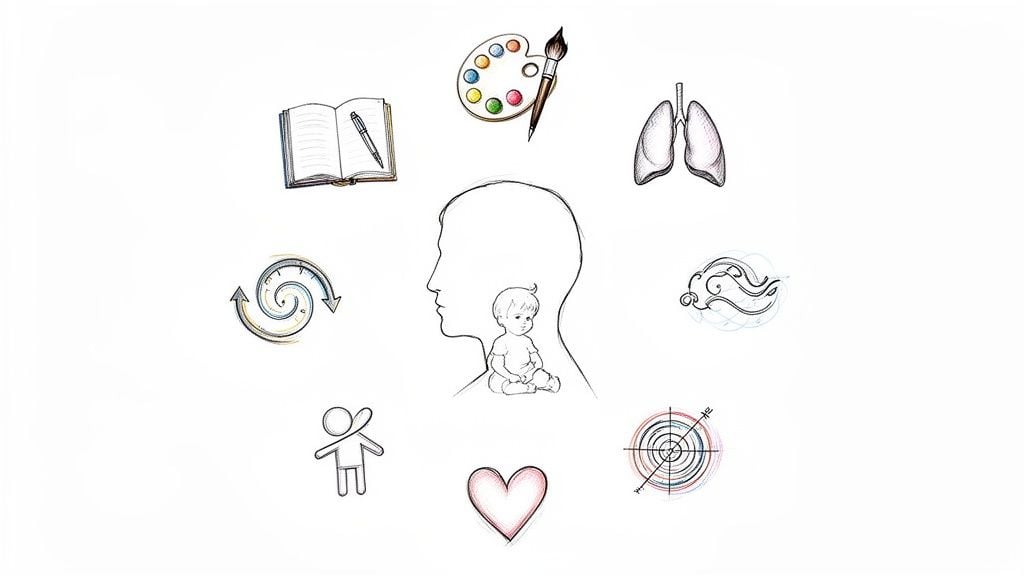
- Journal It Out: Don’t worry about writing a perfect narrative. Grab a pen and paper and free-write for 5 minutes. Use prompts like, “What sensations am I noticing in my body right now?” or “What feels different?”
- Get Creative: If words feel too limiting, try expressing yourself with color. Grab some crayons or paint and just draw the shapes, textures, or feelings of your experience. It’s a great way to process the non-verbal insights that came up.
- Connect with Nature: Go for a slow, 10-minute mindful walk. Feel the ground under your feet with each step. Listen to the birds. Notice the intricate patterns on a leaf. Nature has an incredible ability to regulate our nervous systems and ground our energy.
True integration isn’t about marking a finish line. It’s about honoring the release as a new beginning and consciously nurturing the space you’ve created within yourself.
Giving yourself this time allows the insights from your session to move from a temporary state into a more permanent part of who you are. This is a vital step in learning how to release stored trauma for good.
Recognizing the Subtle Signs of Progress
Healing rarely feels like a lightning bolt moment. More often, it shows up in small, quiet shifts in your everyday life. Learning to recognize these subtle wins is one of the most powerful things you can do to stay motivated and honor how far you’ve come.
It’s easy to dismiss these tiny changes, but they are the real proof that your nervous system is rewiring itself. You’re building a foundation of safety and resilience from the inside out, one small moment at a time.
What Healing Actually Looks Like
Forget waiting for some huge epiphany. Real progress is often found in the small stuff. Start a “progress log” in a notebook and jot down moments like these when you notice them:
- Less Reactivity: That comment from your boss that would have sent you spiraling last month? You might notice it just lands as a minor annoyance now. You’re finding a little more space between a trigger and your reaction.
- More Presence: Maybe you find yourself actually tasting your morning coffee instead of just downing it on autopilot. You’re more in your body, more engaged with your senses, and more present in your own life.
- A Softer Inner Critic: That harsh voice of self-judgment might still pop up, but maybe it’s a little quieter. Or perhaps you’re able to catch it more quickly without letting it run the show.
- Shifting Physical Sensations: You might suddenly realize your jaw isn’t clenched for the first time all day, or that chronic knot in your shoulders has eased up a bit. Research confirms that as we release trauma, physical symptoms like muscle tension and digestive issues often start to improve.
- More Energy: Do you get to 5 p.m. and realize you aren’t completely drained? The constant, low-level hum of hypervigilance was using up a massive amount of your energy. As that subsides, that energy becomes available for you to use in other ways.
These small victories are the real building blocks of profound change. Each one is a testament to your courage and commitment to yourself.
For anyone looking for a structured way to create these shifts, learning the essentials of guided breathwork can provide a powerful framework for supported release and integration. When you learn to spot your own progress, no matter how small, you fuel the journey forward—and healing starts to feel less like a chore and more like a path of coming home to yourself.
Your Questions About Trauma Release, Answered
As you start exploring how to release stored trauma, it’s natural for questions to pop up. Feeling informed is a key part of feeling safe, so let’s walk through some of the things people often ask when they begin this work.
What Does Releasing Trauma Actually Feel Like?
This is a big one, and the honest answer is: it’s different for everyone. There’s no single “right” way for a release to happen. For some, it might be a big, cathartic experience—a sudden wave of tears or a deep sob that seems to come from nowhere.
For others, it’s purely physical. You might experience involuntary shaking or trembling as your nervous system discharges pent-up energy. It could also feel like a sudden warmth spreading through your chest or limbs.
But it can also be much more subtle. Sometimes, a release is simply a deep, spontaneous sigh you didn’t realize you were holding in. Or it might just be a quiet, internal shift where you suddenly feel a sense of lightness or peace. The key is to let your body lead the way without judging the experience.
Can These Practices Replace Professional Therapy?
No, and it’s important to be really clear about this. The somatic and breathwork exercises in this guide are powerful allies on your healing journey, but they absolutely are not a substitute for professional therapy.
A skilled, trauma-informed therapist offers something crucial: a safe, relational space to process your experiences verbally and emotionally. This is a vital piece of the healing puzzle that body-based work alone can’t provide.
Think of these practices as a way to support and even accelerate your therapy. They help your body process and integrate the insights you’re uncovering with your therapist, making the healing feel more whole and complete.
How Do I Know If It’s Safe for Me to Try This Alone?
Your body’s wisdom is your best guide here. The techniques we’ve covered are designed to be gentle and put you in the driver’s seat. Always start slowly, pay close attention to how you feel, and never push through anything that feels overwhelming. You can stop at any time.
However, if you have a history of severe trauma, dissociation, C-PTSD, or other significant mental health conditions, it is highly recommended to work with a professional. A qualified therapist or a certified somatic facilitator can provide the skilled support needed to navigate the deeper, more complex layers of trauma safely. Your well-being always comes first.
Ready to explore a guided path to releasing stored trauma? The immersive journeys from 9D Breathwork are designed to provide a safe, structured container for profound release and rewiring. Learn more and begin your journey today.