To really get a handle on calming a panic attack, the first thing you need to grasp is what’s actually happening inside your body. It’s not a sign of weakness or a loss of control; it’s your body’s alarm system—the fight-or-flight response—going off at the wrong time. The intense, scary physical symptoms are just a byproduct of a massive adrenaline dump.
Once you can reframe it this way—from “I’m in danger” to “This is just a false alarm”—you can start to take back control. It’s the crucial first step from reacting with fear to responding with a plan.
Understanding What a Panic Attack Feels Like
A panic attack is a sudden, terrifying wave of fear that seems to appear out of thin air, often with no obvious trigger. It feels like your internal emergency broadcast system has been hijacked, blaring a full-scale alarm when there’s no real fire. This isn’t just “feeling anxious”—it’s an overwhelming, full-body event that can genuinely convince you that something catastrophic is happening right now.
The experience is intensely physical. Adrenaline floods your system, prepping your body to either fight off a predator or run for your life. This ancient biological surge is what causes the very real, very scary symptoms.
- Racing Heart: Your heart pounds so hard and fast in your chest that it’s easy to mistake it for a heart attack.
- Shortness of Breath: You might gasp for air, feeling like you’re suffocating or can’t get a full breath.
- Dizziness or Lightheadedness: The world can start to feel unsteady or surreal, making you fear you’re about to faint.
- Trembling or Shaking: Your hands, or even your whole body, might shake uncontrollably.
The Mind-Body Chaos
While your body is in overdrive, your mind is racing with catastrophic thoughts. “I’m dying,” “I’m losing my mind,” “I’m going to lose control”—these aren’t just passing worries; in that moment, they feel like absolute certainties. This mental chaos fuels the physical symptoms, creating a vicious feedback loop. The more your heart races, the more you fear you’re having a heart attack, which only makes your heart race faster.
It’s an incredibly isolating experience, but you are far from alone. An estimated 4.7% of U.S. adults will experience panic disorder at some point in their lives. That means millions of people know exactly what this feels like and are looking for ways to manage it, just like you. You can find more data on panic disorder prevalence from the National Institute of Mental Health.
Key Takeaway: A panic attack is your body’s primal survival instinct firing at the wrong time. The symptoms are real and terrifying, but they aren’t dangerous. Knowing this is the foundation for learning how to ride out the wave.
Panic Attack vs. Anxiety At a Glance
People often use the terms “anxiety attack” and “panic attack” interchangeably, but they are very different experiences. Knowing which one you’re dealing with is key to using the right calming techniques.
General anxiety is often a slow burn. It might creep up over hours or days, usually tied to a specific worry like an upcoming presentation or a tough conversation. A panic attack, on the other hand, is a sudden explosion. It hits hard and fast, peaks within about 10 minutes, and often feels like it comes from nowhere.
Use this quick comparison to identify the differences between a general feeling of anxiety and an acute panic attack.
| Symptom | Panic Attack | General Anxiety |
|---|---|---|
| Onset | Sudden, comes out of the blue | Gradual, builds over time |
| Intensity | Severe, peaks within minutes | Varies from mild to severe |
| Duration | Typically lasts 5-20 minutes | Can last for hours, days, or even weeks |
| Trigger | Often has no clear trigger | Usually linked to a specific stressor or worry |
| Physical Signs | Intense and overwhelming (chest pain, choking sensation, feeling of detachment) | Persistent but less intense (muscle tension, fatigue, trouble sleeping) |
| Core Feeling | A sense of terror or impending doom | A feeling of worry, nervousness, or unease |
Recognizing whether you’re dealing with the slow burn of anxiety or the sudden fire of a panic attack helps you choose the right tools for the moment. For panic, you need immediate, powerful grounding techniques. For anxiety, broader stress-management strategies are often more effective.
Grounding Techniques for Immediate Panic Relief
When a panic attack hits, it feels like you’ve been hijacked. Your mind is screaming “DANGER!” while every rational part of you knows you’re perfectly safe. This disconnect is terrifying. The most powerful thing you can do in that moment is to yank your focus out of the storm in your head and plant it firmly back in reality. That’s what grounding is all about—it’s your emergency anchor.
Grounding techniques are so effective because they interrupt the vicious cycle between a racing mind and the body’s fight-or-flight response. By forcing your brain to process concrete, external information from your senses, you’re sending a direct message to your nervous system: “I am here. I am now. I am safe.” This conscious shift can stop the escalation of panic dead in its tracks.
This visual shows how a panic response typically unfolds, from the initial trigger to the intense physical reaction. But look closely—it also shows the critical point where you can intervene.
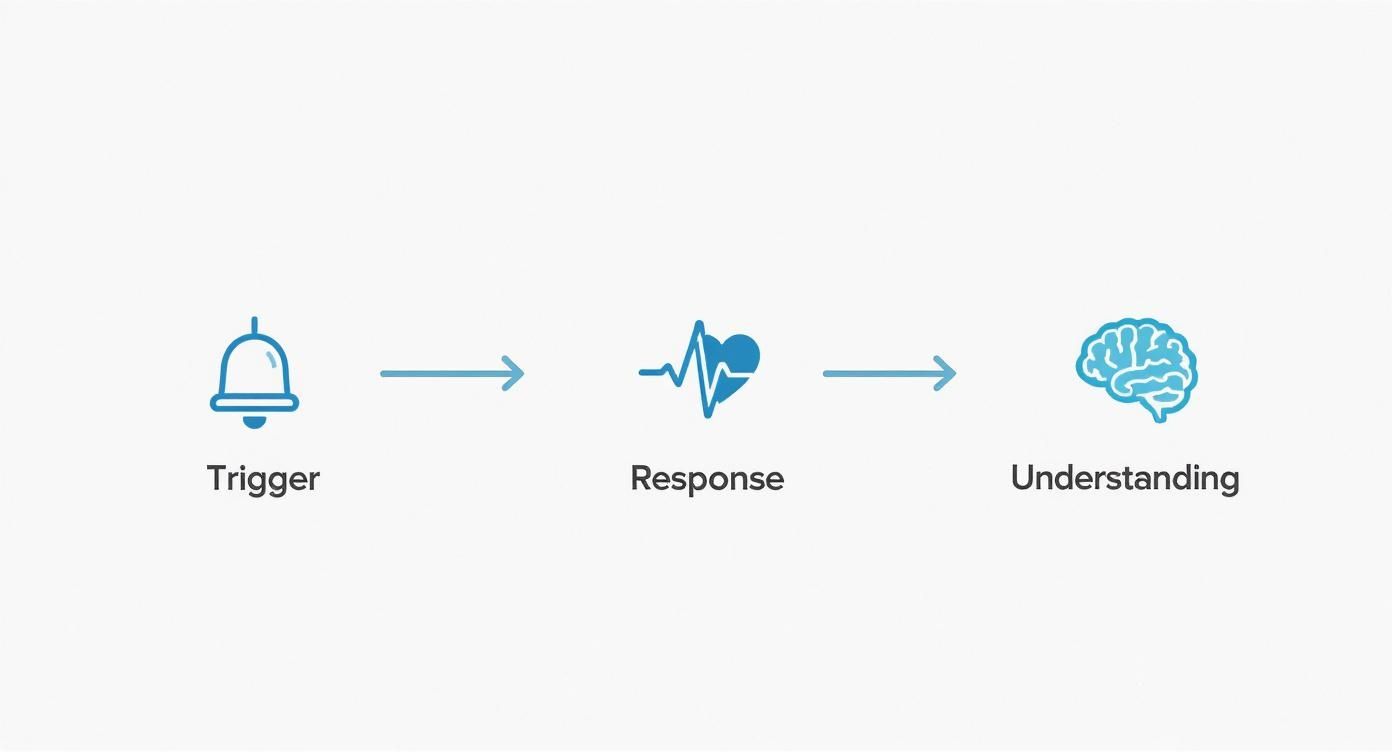
That intervention point is your opportunity. It’s the moment you can deploy a grounding technique to disrupt the cycle before it gains full momentum.
Use Your Senses with the 5-4-3-2-1 Method
One of the best and most discreet grounding tools is the 5-4-3-2-1 method. It’s brilliant because you can do it anywhere—in a packed conference room, on a busy train, or at your desk—and no one will know. The goal is to walk your mind through your senses, one by one.
Here’s how to do it with real-world examples:
- 5 Things You Can See: Look around and deliberately name five objects. Don’t just list them; truly see them. Instead of a quick “pen, monitor, plant,” get specific in your mind: “I see the smooth, blue plastic of my pen. I see the tiny pixel grid on my dark monitor. I see the waxy green leaf with a brown spot on the office plant.”
- 4 Things You Can Feel: Shift your focus to touch. What are four things you can physically feel right now? Notice the soft knit of your sweater on your forearms. Feel the cool, solid pressure of the desk against your wrists. Sense the weight of your body in your chair and the subtle texture of your jeans on your legs.
- 3 Things You Can Hear: Now, listen. Tune in and identify three distinct sounds. They don’t have to be loud. It could be the low, constant hum of the server room down the hall, the distant siren outside, or the soft clicking of your own mouse.
- 2 Things You Can Smell: This one can be a little harder, but give it a try. What are two things you can smell? Maybe it’s the faint scent of coffee from the kitchen or the clean, sharp smell of a whiteboard marker. If you can’t pick up on anything, just imagine two of your favorite smells, like rain on hot asphalt or freshly baked cookies.
- 1 Thing You Can Taste: Finally, focus on one thing you can taste. Take a slow sip of water and notice its temperature. Pop a strong mint or a sour candy in your mouth—many people keep these on hand for just this purpose. Even just noticing the current taste in your mouth is enough.
This works because it’s impossible for your brain to ruminate on catastrophic “what-ifs” when it’s busy cataloging the details of the world around you.
Physical Grounding to Reconnect with Your Body
Sometimes, what you really need is a strong physical jolt to cut through the mental noise of panic. Physical grounding techniques use your body as the tool to bring you back to the present moment, fast.
By focusing on the tangible, you remind your brain that the perceived threat is not real. You are physically present and safe, even if your internal alarm system is malfunctioning. This is a crucial step in learning how to calm panic attacks effectively.
Think of these as powerful pattern-interrupters for your nervous system.
Plant Your Feet Firmly
Whether you’re sitting or standing, press both feet flat on the floor. Really feel the solid ground beneath you, holding you up. Wiggle your toes inside your shoes. Notice the connection and the pressure in your heels and the balls of your feet. This simple act is incredibly powerful for reinforcing your stability in the here and now.
Use Temperature to Shock Your Senses
A sudden temperature change can be a fantastic way to reset your system. The sharp sensation demands your brain’s full attention.
- Hold an ice-cold can or water bottle against the inside of your wrists or the back of your neck.
- Excuse yourself to the restroom and splash cold water on your face.
- If you can, hold an ice cube in your hand and focus entirely on the intense cold as it melts.
That blast of cold is a reality check. It’s a physical sensation so strong that it overrides the internal chaos, pulling you out of the panicked spiral.
Reclaiming Control with Your Breath
When panic hits, the first thing to spiral out of control is usually your breath. Suddenly, you’re taking short, shallow gasps, a classic sign of the body’s fight-or-flight response kicking into high gear. This hyperventilation messes with the oxygen and carbon dioxide balance in your blood, which can bring on even scarier symptoms like dizziness or tingling in your hands and feet, only adding fuel to the fire.
But here’s the good news: just as your breathing can escalate panic, it can also be your most powerful tool to shut it down. The trick isn’t just to “take a deep breath.” It’s about breathing in a controlled, deliberate way. Doing this sends a direct message from your body back to your brain that says, “Hey, the danger has passed. You can stand down now.”
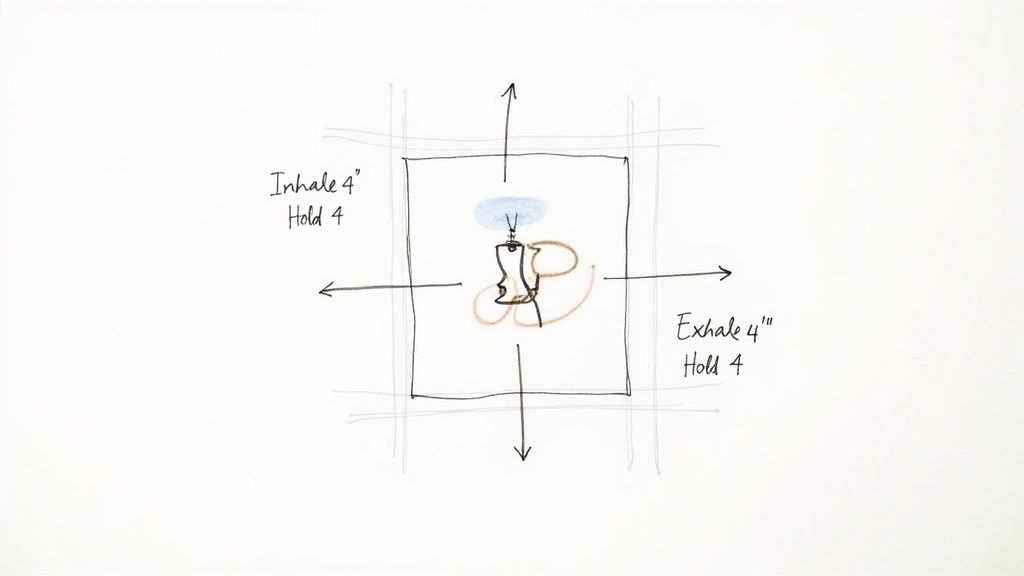
This simple act of consciously managing your breath activates your parasympathetic nervous system—your body’s built-in “rest and digest” mode. Think of it as the biological off-switch for the panic alarm. By focusing on slow, steady breaths, especially long exhales, you can physically slow your racing heart and bring yourself back to solid ground.
Master the Box Breathing Technique
One of the most effective and easy-to-remember methods is Box Breathing, sometimes called four-square breathing. It’s incredibly discreet, so you can do it anywhere without anyone noticing, and its structure gives your frantic mind something tangible to focus on besides the fear.
The idea is to visualize a square. Each of the four sides represents a step in the breathing cycle, and each step lasts for a count of four.
- Inhale Slowly: Breathe in gently through your nose to a slow count of four. Try to feel your belly expand with air, not just your chest.
- Hold Your Breath: For a count of four, just pause. Don’t clench up; simply hold the breath.
- Exhale Slowly: Breathe out completely through your mouth for another count of four. Imagine the tension leaving your body with that exhale.
- Hold Again: Hold for a final count of four with your lungs empty before you start the cycle again.
Keep this up for a few minutes. You should start to feel your heart rate settle and your thoughts become a bit clearer. The predictable, rhythmic pattern is a powerful antidote to the chaos of a panic attack.
By giving your brain a simple, repetitive task—counting to four—you divert its resources away from catastrophic thinking. You’re not just breathing; you’re actively managing your focus and physiology at the same time.
Why Controlled Breathing Is So Effective
The real power of Box Breathing is in the extended exhale and the pauses. During a panic attack, your exhales become short and sharp. Deliberately slowing them down is a direct counter-command to your nervous system.
A long, controlled exhale stimulates the vagus nerve, a major player in your parasympathetic nervous system. This nerve runs from your brain down through your torso, regulating things like your heart rate and digestion. Stimulating it is like hitting a reset button that tells your entire body to calm down.
Of course, practicing this when you’re not in a state of panic is key. Run through a few cycles of Box Breathing each day to build muscle memory. That way, it becomes a reliable, almost automatic reflex you can deploy the second you feel that familiar dread creeping in. It gives you a tangible way of learning how to calm panic attacks before they completely take over. If you want to explore further, there are many specific breathing exercises to lower your heart rate that can give you even more control.
Putting It Into Practice: A Real-World Scenario
Let’s say you’re sitting in a team meeting when you feel that all-too-familiar tightness in your chest. Your heart starts pounding. Instead of letting the fear take over, you can immediately and discreetly use Box Breathing.
- Glance down at your notes or laptop. No one will have any idea you’re doing anything other than paying attention.
- Begin the cycle: Inhale-2-3-4… Hold-2-3-4… Exhale-2-3-4… Hold-2-3-4.
- Tune into the physical sensation. Feel the cool air coming in through your nose and the warm air leaving your mouth.
- Keep going for a minute or two. Often, that’s all it takes to stop a full-blown panic attack in its tracks.
This simple technique shifts you from being a passive victim of your panic to an active participant in your own well-being. Once you’ve mastered it, it becomes a lifelong anchor you can rely on in any storm.
Challenge Catastrophic Thoughts Mid-Panic
When you’re in the middle of a panic attack, your body is only half the battle. The other, often more powerful, opponent is your own mind. It starts whispering—then screaming—terrifying lies like, “I’m having a heart attack,” “I’m losing control,” or “This is never going to end.”
These catastrophic thoughts are the very fuel that turns a flicker of panic into a raging inferno. Learning how to calm panic attacks means learning how to stand up to these thoughts. The goal isn’t to ignore them, but to question their authority and strip them of their power.
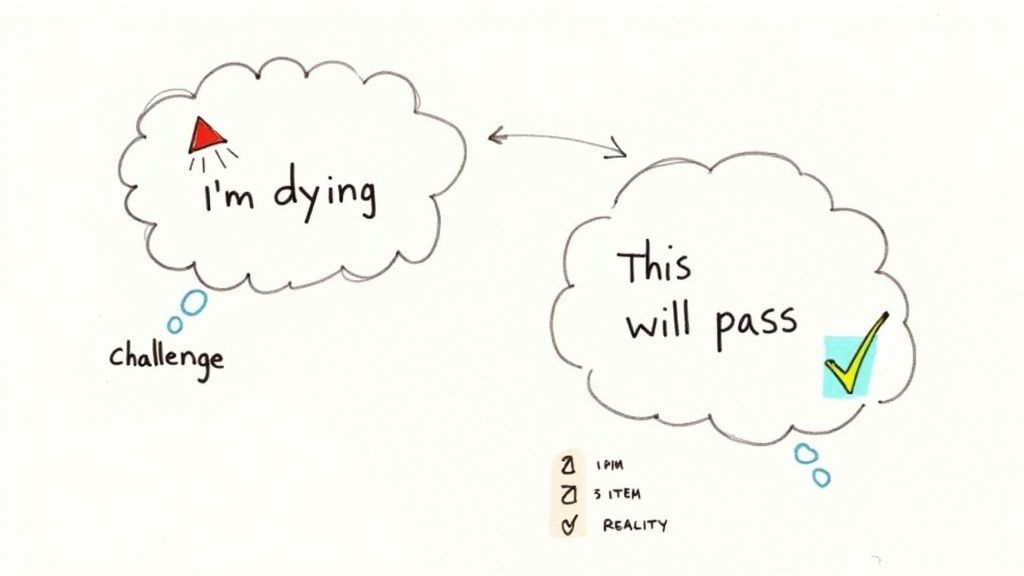
This entire approach is grounded in the principles of Cognitive Behavioral Therapy (CBT), a proven method for reframing distorted thinking patterns. The good news? You don’t need to be in a therapist’s office to start using these mental tools right now.
Ask Reality-Check Questions
Your first move is to become a gentle detective of your own mind. Instead of blindly accepting the terrifying narratives your panicked brain is spinning, start asking some simple, evidence-based questions. This simple act interrupts the fear spiral by pulling the more logical part of your brain back into the driver’s seat.
Try asking yourself these questions when panic hits:
- “What’s a more likely explanation for this feeling?” Instead of “I’m having a heart attack,” could it be, “My adrenaline is spiking, which is making my heart race, just like it has before”?
- “Have I felt this before and been okay?” This is a big one. Remind yourself of every single past attack you’ve survived. It’s concrete proof that this feeling, while absolutely awful, is temporary and not fatal.
- “What’s the actual evidence that I’m in danger?” Look around the room. Are you in a physically safe place? Is there a real, tangible threat, or is the threat coming from inside your head?
- “If my best friend were feeling this, what would I tell them?” Stepping outside of yourself for a moment helps you access a more compassionate and rational point of view.
This isn’t about scolding yourself. It’s about calmly and gently examining the facts. The goal is to create just enough mental friction to slow the panic’s momentum.
To make this even more practical, it helps to have some go-to responses ready. When your brain serves up a terrifying thought, you need a rational comeback locked and loaded.
Challenging Catastrophic Thoughts During Panic
| Panic Thought | Rational Response |
|---|---|
| “I’m having a heart attack!” | “My heart is just racing because of adrenaline. It’s a symptom of panic, not a heart attack. I’ve felt this before, and it always passes.” |
| “I’m losing control / going crazy.” | “This feels out of control, but it’s just a strong rush of feelings. It’s a natural fear response, and I am not losing my mind. I am safe.” |
| “I can’t breathe.” | “My breathing is shallow, but I am getting enough air. I can slow it down. This feeling is a classic panic symptom, not suffocation.” |
| “This is never going to end.” | “Panic attacks always end. The most intense part only lasts a few minutes. I just need to ride this wave, and it will be over soon.” |
| “I’m going to faint.” | “Fainting during a panic attack is extremely rare because my blood pressure is actually going up, not down. This is just a feeling of dizziness.” |
Thinking through these rational responses before an attack happens makes them much easier to access when you’re actually in the thick of it.
Arm Yourself with Coping Statements
Sometimes, deep, logical questioning feels impossible. In the heat of the moment, you need something simpler. That’s where coping statements—short, powerful mantras—come in. Think of them as a mental shield.
These statements work best when they’re realistic and reassuring, not dismissive. Acknowledging the discomfort while denying the actual danger is the key.
The most effective coping statements validate your experience (“This feels awful”) while reminding you of the truth (“…but it’s not dangerous”). This balance helps calm your nervous system without invalidating your very real fear.
Try repeating one of these to yourself, either in your head or out loud, until you feel it start to sink in:
- “This is uncomfortable, but it is not dangerous.”
- “This feeling is a wave, and I will let it pass over me.”
- “My body is having a strong reaction, but I am safe.”
- “I have survived this before, and I will survive it now.”
- “This will be over in a few minutes.”
This kind of mental reframing is a crucial skill. Overthinking and anxiety are deeply connected, and learning to manage these thought patterns is essential for finding long-term relief. For a deeper dive, check out our guide on how to stop overthinking and anxiety.
By actively challenging your thoughts and repeating calming truths, you shift from being a victim of your panic to an active participant in your own rescue. It’s a skill that builds real strength with every single use.
Build Long-Term Resilience Against Panic
While grounding techniques and breathing exercises are crucial for getting through the storm of a panic attack, the real goal is to build a life where those storms happen less often and with far less intensity. It’s about shifting from a reactive, crisis-management mode to a proactive one. This means making deliberate lifestyle choices that strengthen your nervous system’s resilience over time.
Think of it as creating a strong foundation. When life’s stressors inevitably hit, your system is better prepared to handle them without sounding a false alarm. The idea isn’t to get rid of stress—that’s impossible—but to lower your baseline anxiety, giving you more breathing room before panic can even think about taking over.
Actionable Lifestyle Adjustments
Small, consistent habits can make a huge difference in your body’s sensitivity to stress and adrenaline. For true, lasting change, focus on building healthy habits that support your overall well-being.
Here are a few key areas to look at:
- Rethink Your Caffeine Intake: That morning coffee might feel like a non-negotiable, but caffeine is a powerful central nervous system stimulant. For people prone to panic, it can mimic those first few scary symptoms (like a racing heart or jitteriness), which can easily trick your brain into launching a full-blown attack. Action Step: For one week, switch your second cup of coffee to a decaf or herbal tea and notice if you feel a difference in your baseline anxiety.
- Get Your Body Moving Regularly: Exercise is one of the best tools we have for managing adrenaline and burning off stress hormones. You don’t need to run a marathon. Action Step: Put a 20-minute walk into your calendar three times this week, just like you would a meeting. The consistency is more important than the intensity.
- Weave in Simple Mindfulness: You can significantly lower your baseline stress with just five minutes of mindfulness a day. This could be as simple as using a guided meditation app or just sitting quietly and focusing on the sensation of your breath. Action Step: Before you check your phone in the morning, sit on the edge of your bed and do 10 slow, deliberate breaths. That’s it. This simple act starts your day with calm instead of chaos.
Key Insight: Building resilience isn’t about one big, dramatic gesture. It’s the cumulative effect of all the small, sustainable choices you make. Each healthy decision is a vote for a calmer, more stable nervous system.
When to Seek Professional Support
Self-help strategies are powerful, but sometimes you need a guide to help you find your way. If panic attacks are seriously disrupting your life, causing you to avoid places or situations, or leaving you in constant fear of the next one, that’s a clear sign it’s time to get professional support.
Reaching out isn’t a sign of failure; it’s a sign of strength. Globally, anxiety disorders have been on the rise. Data shows that between 1990 and 2021, the prevalence of these disorders climbed from 3.7% to 4.4%. Yet, despite effective treatments being available, only about 25% to 27.6% of people affected actually get help. You can learn more about these global anxiety statistics and treatment gaps on SingleCare.com.
Therapies like Cognitive Behavioral Therapy (CBT) are widely considered the gold standard for treating panic disorder. CBT is a practical, goal-oriented therapy that gives you skills you can use for the rest of your life. A therapist will work with you to:
- Identify Your Triggers: You’ll work together to pinpoint the specific thoughts, feelings, and situations that tend to kick off a panic attack.
- Challenge Distorted Thoughts: You’ll learn how to systematically dismantle the catastrophic “what if” thinking patterns that fuel the fear cycle.
- Use Gradual Exposure: In a safe and controlled way, your therapist will help you slowly re-engage with situations you’ve been avoiding, proving to your brain that they aren’t actually dangerous.
The goal of therapy isn’t to erase anxiety from your life completely. It’s about changing your relationship with it. It teaches you that you have the power to handle uncomfortable sensations and scary thoughts without letting them control you. And for those looking to expand their toolkit, it’s also worth exploring the range of alternative therapies for anxiety that can complement traditional methods and support your journey toward lasting calm.
Got Questions About Panic Attacks? Let’s Get Them Answered.
When you’re dealing with panic attacks, it’s natural to have a swirl of questions and deep-seated fears. Getting clear, honest answers is one of the best ways to disarm the anxiety. It helps you understand what’s really happening in your body and mind, which is a massive step toward taking back control.
Let’s dive into some of the most common questions I hear and get you some straight answers.
Can a Panic Attack Actually Harm Me or Cause a Heart Attack?
This is easily the most terrifying and frequent question people ask. The answer is a firm, reassuring no. A panic attack, on its own, is not physically dangerous.
What you’re feeling—the racing heart, the chest tightness, the shortness of breath—is your body’s fight-or-flight response kicking into overdrive. It’s a massive, uncomfortable surge of adrenaline, but it is not a heart attack.
Think of it this way: In a heart attack, there’s a physical blockage stopping blood from getting to the heart. During a panic attack, your heart is structurally fine; it’s just temporarily overreacting to your brain’s alarm signals.
Once a doctor has given you the all-clear on any underlying health issues, you can hold onto that fact like a lifeline. Remind yourself, even when the feelings are intense: “This is just adrenaline. It feels awful, but it is not dangerous, and it will pass.”
What Should I Do If a Panic Attack Happens in a Public Place?
An attack in public is a whole different beast. You’re not just fighting the physical symptoms; you’re also battling a wave of social fear and embarrassment. The key is to have a simple, go-to plan.
If you feel the familiar signs creeping in, your first move is to find a small pocket of privacy if you can. A restroom, your car, or even a quiet corner of a store can give you the space you need to regroup.
If you can’t get away, turn your focus inward immediately with a grounding technique.
- Physically feel your surroundings. Press your back firmly into the chair you’re sitting in. Dig your heels into the floor.
- Grip something real and solid. Squeeze your keys or your phone in your hand. Focus on the cold, hard texture.
- Start Box Breathing. No one needs to know you’re doing it. Just start counting in your head: in for four, hold for four, out for four, hold for four.
Your goal is to shift your brain from the panicked thought, “Everyone is staring at me,” to a more powerful one: “What’s one thing I can do for myself right now?” And honestly, most people are far too wrapped up in their own worlds to even notice.
How Long Do Panic Attacks Usually Last?
When you’re in the middle of one, a minute can feel like an eternity. It’s easy to believe the terror will never end. But the reality is that panic attacks are usually quite short.
The peak intensity—that overwhelming, can’t-breathe, heart-pounding climax—typically hits within the first 10 minutes.
After that peak, the adrenaline starts to burn off, and the symptoms begin to recede. You might feel drained, jittery, or just ‘off’ for a while afterward, but the worst of the storm passes surprisingly quickly.
Knowing this timeline is a powerful tool. You can tell yourself, “Okay, this is hell. But it’s a 10-minute hell. I can survive this for a few more minutes.” That simple thought can stop you from adding more fearful thoughts to the fire.
When Should I Seek Professional Help for My Panic Attacks?
It’s probably time to seek professional help if your attacks are becoming frequent or, more importantly, if the fear of an attack starts running your life.
The biggest red flag is avoidance. When you start shrinking your world to sidestep potential triggers, that’s a clear sign you need more support.
Look for a professional if you find yourself:
- Avoiding specific places or activities like driving, going to the grocery store, or attending social events.
- Constantly worried about when the next attack will strike.
- Noticing that the fear is hurting your job, relationships, or overall quality of life.
- Trying self-help techniques that just aren’t cutting it.
If panic is making your life smaller, a therapist or doctor can help you make it big again. Treatments like Cognitive Behavioral Therapy (CBT) are incredibly effective and can give you the tools not just to manage panic, but to overcome it for good.
At 9D Breathwork, we focus on getting to the root of what’s causing the nervous system to be on high alert. Our immersive journeys use a powerful combination of breathwork, sound, and guided coaching to help you release stored stress and build true resilience from the inside out. If you’re ready to find a deeper sense of calm, explore our transformative experiences at https://9dbreathwork.com.