In the quest for restorative sleep, we often overlook the most powerful tool we possess: our breath. The frantic pace of modern life can keep our nervous system on high alert, making it nearly impossible to power down at night. This isn’t just a feeling; it’s a physiological state where stress hormones like cortisol prevent the body from entering deep, restorative sleep cycles. For many professionals, this constant state of “on” translates directly into restless nights and exhausted days.
This guide moves beyond generic advice like ‘just relax.’ Instead, we will explore seven of the best breathing techniques for sleep, each backed by scientific research and designed to be immediately actionable. You will learn not just what to do, but why specific patterns of inhalation and exhalation work to shift your nervous system from a state of stress to one of deep rest. A 2018 study in Frontiers in Psychiatry found that slow, deep breathing practices can significantly enhance vagal nerve activity, a key component of the body’s relaxation response. A similar 2021 study published in the journal Cell Reports Medicine demonstrated that controlled breathing exercises measurably improved mood and reduced physiological arousal before sleep.
By mastering these methods, you’ll gain a practical toolkit to reclaim your nights. While breath is a potent tool, exploring other natural ways to improve sleep quality can create a more holistic and effective evening routine. This article will provide clear, step-by-step instructions for each technique, empowering you to consciously guide your body toward the peaceful sleep it needs.
1. 4-7-8 Breathing (Relaxation Breath)
The 4-7-8 breathing technique, often called the “Relaxing Breath,” is a powerful, yet simple method championed by integrative medicine pioneer Dr. Andrew Weil. This scientifically-backed practice acts as a natural tranquilizer for the nervous system, making it one of the best breathing techniques for sleep. It works by intentionally slowing your heart rate and calming your mind through a rhythmic pattern: inhaling for four seconds, holding the breath for seven, and exhaling for a full eight seconds.
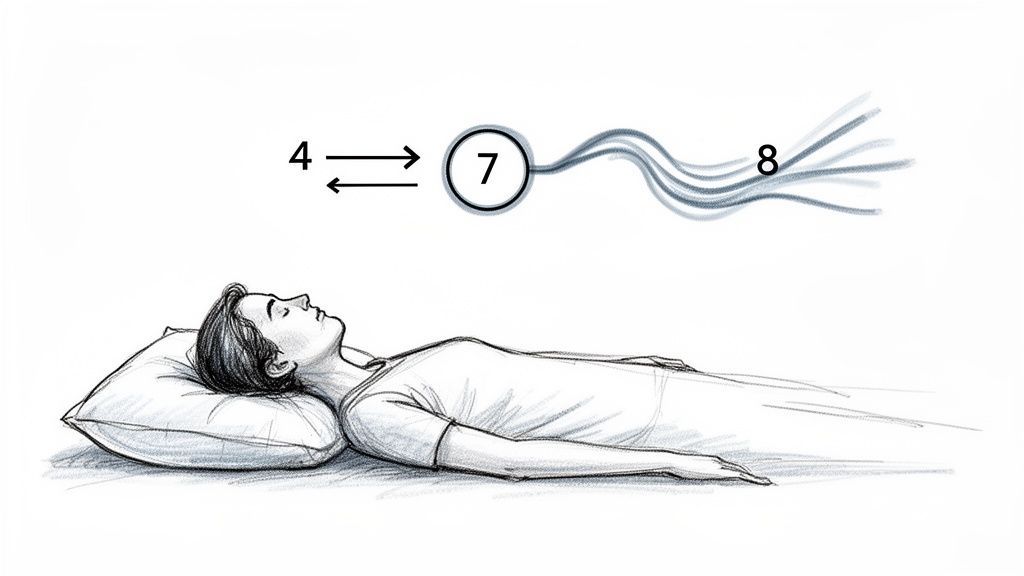
This extended exhalation is the key; it activates the parasympathetic nervous system, our body’s “rest-and-digest” mode. This process counteracts the sympathetic nervous system’s “fight-or-flight” response, which often keeps us awake with racing thoughts and physical tension. Research from a 2022 study in Physiological Reports highlighted that even a single session of slow, deep breathing can significantly lower blood pressure and heart rate. Further, a 2023 study in the journal Sleep Science specifically linked the 4-7-8 technique to improved sleep quality and reduced anxiety in individuals with insomnia.
How to Practice 4-7-8 Breathing
- Sit or lie down in a comfortable position. Place the tip of your tongue against the ridge of tissue just behind your upper front teeth and keep it there throughout the entire exercise.
- Exhale completely through your mouth, making a gentle whoosh sound.
- Close your mouth and inhale quietly through your nose to a mental count of four.
- Hold your breath for a count of seven.
- Exhale completely through your mouth, making that whoosh sound for a count of eight.
- This is one breath cycle. Inhale again and repeat the cycle three more times for a total of four breaths.
Actionable Tips for Success
- Tonight’s Action Plan: Before you turn out the lights, perform exactly four cycles of the 4-7-8 breath. Commit to doing this every night for one week.
- Practice Under Low Stakes: Don’t wait until you’re stressed. Practice this technique for two minutes while waiting for your coffee to brew or sitting in your car before you go inside. This builds the skill when you don’t need it, so it’s ready when you do.
- Practical Example: Feeling anxious before a big presentation? Excuse yourself to the restroom and complete two cycles of 4-7-8 breath. This will immediately lower your heart rate and bring you back to a state of calm.
2. Box Breathing (Square Breathing)
Box breathing, also known as square breathing or tactical breathing, is a simple yet profoundly effective technique for calming the nervous system. Popularized by U.S. Navy SEALs and elite athletes, this method uses a balanced, four-part cycle to regulate the autonomic nervous system. The equal counts for inhaling, holding, exhaling, and holding again create a predictable rhythm that reduces cognitive load and quiets the mind, making it one of the best breathing techniques for sleep.
The technique’s power lies in its symmetry. This balanced rhythm helps synchronize brain hemispheres and stabilize heart rate variability (HRV), a key indicator of our body’s resilience to stress. By engaging in this structured pattern, you shift from the sympathetic “fight-or-flight” system to the parasympathetic “rest-and-digest” state. A 2017 study in the journal Frontiers in Psychology confirmed that even short periods of slow, structured breathing can significantly enhance vagal tone, which helps the body relax more efficiently. Additionally, a 2020 study published in the Journal of Affective Disorders found that diaphragmatic breathing exercises, like Box Breathing, were effective in reducing cortisol levels, the primary stress hormone that disrupts sleep.
How to Practice Box Breathing
- Sit upright or lie down comfortably in your bed, closing your eyes if it feels right.
- Slowly exhale all the air from your lungs through your mouth.
- Inhale slowly and quietly through your nose to a mental count of four.
- Hold your breath for a count of four, trying not to clamp your mouth or throat.
- Exhale gently through your mouth for a count of four.
- Hold your breath again at the end of the exhale for a count of four.
- This completes one breath cycle. Continue the pattern for at least five minutes, or until you feel your mind and body begin to relax.
Actionable Tips for Success
- Visualize the Square: As you breathe, use your finger to trace a square on your palm or thigh. Each side represents a four-second count. This physical anchor keeps you focused and out of your head.
- Tonight’s Action Plan: Set a five-minute timer on your phone. Lie in bed and practice Box Breathing until the timer goes off. Do not stop early.
- Practical Example: If you wake up at 3 AM with a racing mind, Box Breathing is your tool. Instead of tossing and turning, immediately begin the 4-4-4-4 count. Focus intensely on counting and visualizing the box. This structured task gives your anxious mind a job to do, helping it quiet down and allowing you to drift back to sleep.
3. Alternate Nostril Breathing (Nadi Shodhana)
Alternate Nostril Breathing, or Nadi Shodhana, is an ancient yogic pranayama technique revered for its ability to balance the body and mind. It involves gently closing one nostril at a time while inhaling and exhaling through the other. This practice is believed to harmonize the left and right hemispheres of the brain, calming the nervous system and clearing the mind of cluttered thoughts, making it one of the best breathing techniques for sleep.
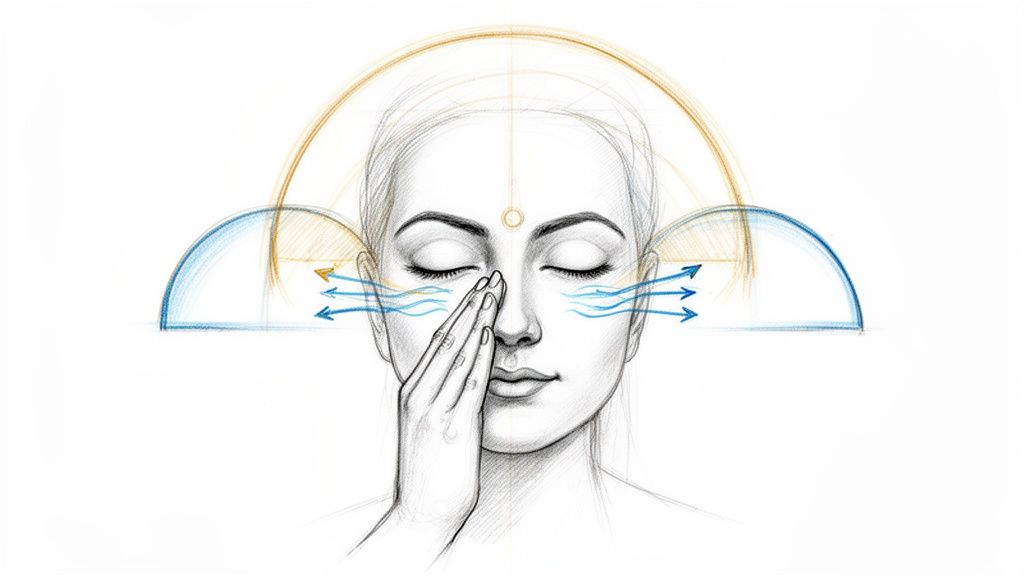
The core principle behind Nadi Shodhana is balancing the body’s energy channels, which directly influences the autonomic nervous system. By regulating the breath in this rhythmic way, you shift from the sympathetic (fight-or-flight) state to the parasympathetic (rest-and-digest) state. A study published in the Journal of Indian Medical Association found that Nadi Shodhana practice significantly reduced heart rate, respiratory rate, and systolic blood pressure. A 2019 study in the International Journal of Yoga also concluded that this technique improved cardiovascular function and reduced perceived stress levels after several weeks of regular practice.
How to Practice Alternate Nostril Breathing
- Find a comfortable seated position with your spine straight. Rest your left hand on your left knee.
- Bring your right hand up to your nose. Fold your index and middle fingers toward your palm, leaving your thumb, ring finger, and pinky finger extended (this is Vishnu Mudra).
- Close your eyes and take a deep breath in and out through your nose.
- Close your right nostril with your right thumb. Inhale slowly and steadily through your left nostril.
- Close your left nostril with your right ring finger so both nostrils are held closed. Briefly pause.
- Open your right nostril and exhale slowly. Inhale through the right nostril.
- Close the right nostril with your thumb, pause, and then open the left nostril to exhale.
- This completes one full cycle. Continue for 5-10 cycles, or for 3-5 minutes.
Actionable Tips for Success
- Tonight’s Action Plan: Sit on the edge of your bed and complete exactly ten full cycles of Nadi Shodhana before lying down. Make sure you end by exhaling through the left nostril.
- Focus on the Sensation: Pay close attention to the feeling of the air moving through each nostril. Is one side more open than the other? Does the air feel cool on the inhale and warm on the exhale? This sensory focus prevents your mind from wandering.
- Practical Example: Feeling mentally scattered after a long day of meetings? Before you transition to your evening, take three minutes to practice Nadi Shodhana. This acts as a “reset button” for your brain, helping you leave work behind and be more present at home.
4. Coherent Breathing (Resonance Frequency Breathing)
Coherent Breathing, also known as Resonance Frequency Breathing, is a precisely paced technique designed to synchronize your heart, lungs, and brain. The method involves breathing at a steady rate of approximately five to six breaths per minute (inhaling for five seconds, exhaling for five seconds). This specific rhythm aligns with the body’s natural cardiovascular resonance frequency, which maximizes heart rate variability (HRV), a key indicator of your nervous system’s resilience and adaptability.
This technique is scientifically validated to induce a state of “coherence,” where the body’s systems operate with increased efficiency and harmony. By consciously regulating your breath to this frequency, you actively shift your autonomic nervous system from a stressed “fight-or-flight” state to a calm “rest-and-digest” mode. A study in the International Journal of Environmental Research and Public Health found that resonance frequency breathing significantly reduces anxiety and stress by increasing parasympathetic activity. Another 2017 review in Breathe confirmed that breathing at this rate optimizes the baroreflex, a mechanism that regulates blood pressure, leading to profound physiological calm. This makes it one of the most effective and research-backed breathing techniques for sleep.
How to Practice Coherent Breathing
- Find a quiet, comfortable position, either sitting upright or lying down.
- Close your eyes and bring your awareness to the natural rhythm of your breath without trying to change it.
- Begin to slowly even out your inhales and exhales. You can use a timer or a breathing app for guidance.
- Gently inhale through your nose for a count of five. Feel your belly expand as you breathe in.
- Without pausing, gently exhale through your nose (or mouth) for a count of five.
- Continue this smooth, even cycle of breathing in for five and out for five. Focus on maintaining a continuous, circular rhythm. Aim to practice for at least 10 minutes before sleep.
Actionable Tips for Success
- Tonight’s Action Plan: Download a free breathing pacer app (like “Breathe+”) and set it to a 5-second inhale and 5-second exhale. Follow the guide for 10 minutes tonight in bed.
- Use a Metronome: If you don’t want screen time, use a simple metronome app set to 60 beats per minute. Inhale for five beats, and exhale for five beats. The steady tick provides a non-visual guide.
- Practical Example: Stuck in traffic and feeling your stress rise? Turn off the radio and practice Coherent Breathing. Inhale for 5 seconds, exhale for 5 seconds. This proactive measure prevents stress from accumulating during the day, making it easier to wind down at night.
5. Humming Bee Breath (Bhramari Pranayama)
Humming Bee Breath, or Bhramari Pranayama, is an ancient yogic technique renowned for its profound calming effect on the nervous system. This practice involves creating a low-pitched humming sound, similar to a bee, during a slow, controlled exhalation. This unique combination of breath and sound vibration makes it one of the best breathing techniques for sleep, as it directly stimulates the vagus nerve, quieting the mind and gently shifting the body into a state of deep relaxation.
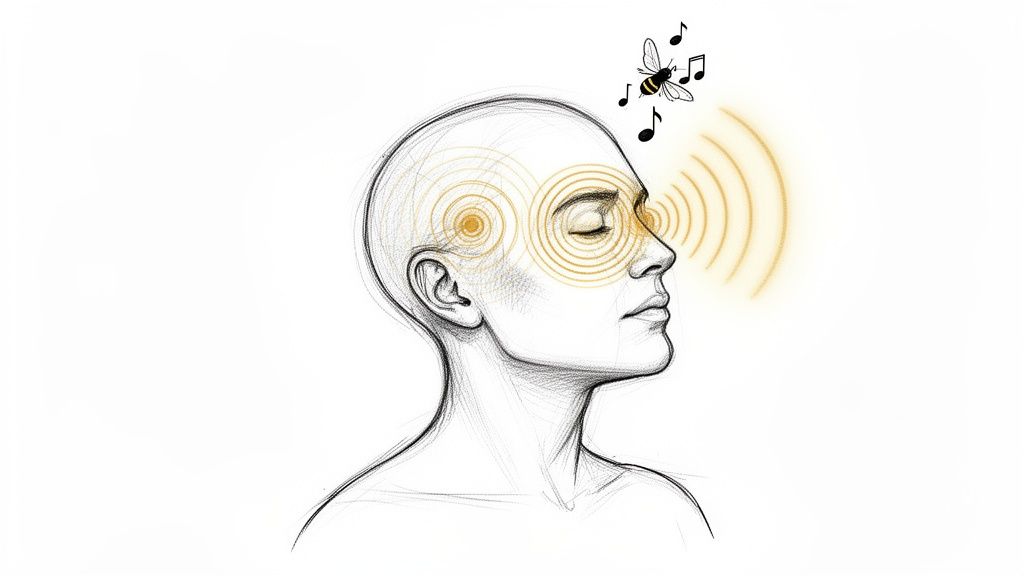
The gentle vibrations created by the humming reverberate through the head and chest, providing a soothing internal massage. Research indicates this process has tangible physiological benefits. A 2017 study found that Bhramari Pranayama significantly activated the parasympathetic nervous system, leading to a decrease in heart rate and blood pressure after just five minutes of practice. Another study in the Journal of Clinical and Diagnostic Research showed that the sound vibrations can increase nitric oxide production in the nasal passages, which helps reduce inflammation and improve respiratory function, further promoting relaxation.
How to Practice Humming Bee Breath
- Find a comfortable seated or lying position in a quiet space. Gently close your eyes.
- Take a slow, deep breath in through your nose.
- As you exhale, keep your mouth closed and begin to make a low-to-medium-pitched humming sound from the back of your throat, like the buzzing of a bee.
- Continue the humming sound for the entire duration of your exhalation. Try to make it smooth and continuous.
- Focus on the sensation of the vibrations in your nasal passages, forehead, and throughout your skull.
- This completes one round. Continue for 5-10 rounds or for several minutes, allowing your mind to become absorbed by the sound and vibration.
Actionable Tips for Success
- Tonight’s Action Plan: Lie down in bed and complete seven rounds of Humming Bee Breath. After the final exhale, stay still and notice the lingering feeling of calm and quiet in your mind.
- Feel the Vibration: Place your fingertips gently on your forehead or the sides of your nose. This allows you to physically feel the vibrations, which can enhance your focus and deepen the calming effect.
- Practical Example: If you have tinnitus (ringing in the ears), the humming sound can provide a form of sound therapy, giving your brain a different, more soothing frequency to focus on, which can be particularly helpful for falling asleep.
6. Extended Exhale Breathing (Longer Exhalation Protocol)
Extended Exhale Breathing is a foundational technique that calms the nervous system by making your exhalation longer than your inhalation. This simple yet profound practice, often built on a 1:2 ratio (like a 4-second inhale and an 8-second exhale), directly stimulates the vagus nerve. This activation shifts your body into its parasympathetic “rest and digest” state, making it one of the most accessible and best breathing techniques for sleep.
This technique is scientifically grounded in its ability to improve heart rate variability (HRV), a key marker of a resilient nervous system. A 2017 study in Frontiers in Psychology confirmed that slow breathing with prolonged exhalation significantly enhances vagal tone, which helps reduce stress and promote relaxation. Furthermore, a 2018 study in Scientific Reports showed that longer exhales increase the influence of the parasympathetic nervous system on the heart’s rhythm almost instantly. By mimicking the natural breathing patterns of deep rest, it sends a powerful signal to your brain that it’s safe to power down and fall asleep.
How to Practice Extended Exhale Breathing
- Find a comfortable position, either sitting up or lying down in your bed. Close your eyes and allow your body to feel heavy.
- Begin by taking a few normal breaths to settle in. Notice the natural rhythm of your breathing without trying to change it.
- Inhale gently through your nose for a comfortable count, for example, a count of four.
- Exhale slowly and completely through your mouth or nose for double the count of your inhale, for instance, a count of eight.
- Focus on the sensation of release and relaxation as you fully empty your lungs.
- Repeat this cycle for 5 to 10 minutes, allowing your body to sink deeper into a state of calm with each extended exhale.
Actionable Tips for Success
- Tonight’s Action Plan: Get into bed and practice breathing with a 3-second inhale and a 6-second exhale. Do this for 10 consecutive breaths. That’s your only goal.
- Use a Physical Cue: As you exhale, imagine you are slowly deflating a balloon in your belly. This visualization helps you maintain a slow, steady, and complete exhalation, ensuring you get the full physiological benefit.
- Practical Example: Feeling overwhelmed by a long to-do list at the end of the day? Stop, close your eyes, and take three deep breaths using the extended exhale method (e.g., inhale 4, exhale 8). This acts as a circuit breaker for stress, allowing you to approach your evening with a clearer mind.
7. Sleep-Specific Guided Breathwork Protocols (Structured Journeys)
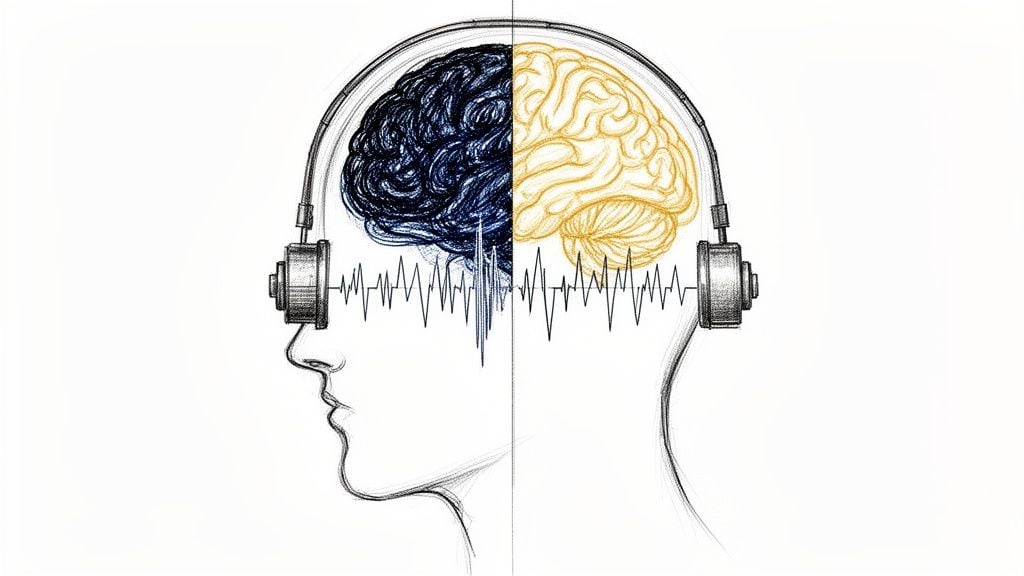
Beyond single techniques, sleep-specific guided breathwork protocols offer a comprehensive, multi-layered approach to conquering sleep disruption. These structured journeys are meticulously designed, combining various breathing patterns with synchronized elements like binaural beats, hypnotic guidance, and neurolinguistic programming (NLP) prompts. They function as an integrated system to address the root causes of poor sleep on physiological, cognitive, and emotional levels.
Unlike practicing one technique in isolation, these guided protocols are engineered to create a synergistic effect. They leverage neuroplasticity by stimulating multiple brain pathways at once, helping to interrupt the stubborn patterns of a racing mind and a stressed nervous system. Research from institutions like Johns Hopkins has shown that guided mind-body therapies can be as effective as prescription medications for chronic insomnia. A 2022 study in the Journal of Medical Internet Research further found that app-based guided mindfulness and breathing interventions significantly improved sleep quality. This integrated method represents a cutting-edge approach among the best breathing techniques for sleep, designed for profound and lasting change. For instance, the specialized protocols developed in 9D Breathwork are increasingly used in corporate wellness programs to measurably improve employee productivity and reduce burnout-related sleep issues.
How to Practice with Guided Protocols
- Select a Program: Choose a structured, sleep-focused protocol from a reputable source like 9D Breathwork, Calm, or an integrative health practitioner. These are typically delivered as audio files.
- Create a Sanctuary: Find a quiet, dark, and comfortable space where you will not be disturbed for the duration of the session (usually 20-60 minutes).
- Use Quality Headphones: Stereo headphones are essential for experiencing the full effect of binaural beats and immersive audio cues.
- Follow the Guidance: Simply lie down, press play, and allow the audio to guide you. The facilitator’s voice will lead you through different breathing patterns, visualizations, and mental exercises.
- Let Go of Control: Your only job is to follow the instructions and breathe. Trust the process and allow your body and mind to respond naturally to the guidance.
Actionable Tips for Success
- Tonight’s Action Plan: Choose a guided sleep meditation or breathwork journey (10-20 minutes long) on an app like Calm or YouTube. Commit to completing the entire session without distraction before sleeping.
- Schedule It: Don’t leave it to chance. Add your guided session to your calendar like any other important appointment. This ensures you make time for it.
- Practical Example: If you travel frequently for work and struggle with sleep in unfamiliar hotels, having a go-to guided breathwork file on your phone is a powerful tool. It creates a consistent, familiar sleep cue regardless of your location, helping you fall asleep faster and improving your performance on the road.
Comparison of 7 Breathing Techniques for Sleep
| Technique | Implementation complexity | Resource requirements | Expected outcomes | Ideal use cases | Key advantages |
|---|---|---|---|---|---|
| 4-7-8 Breathing (Relaxation Breath) | Low — simple 4‑7‑8 counts; quick to learn | None; quiet space or timer optional | Immediate calming; reduced anxiety; faster sleep onset | Acute anxiety, pre-presentation calm, bedtime routine | Immediate effects; beginner-friendly; clinically referenced |
| Box Breathing (Square Breathing) | Low–Medium — rigid timing (4‑4‑4‑4) requires discipline | None or metronome app/binaural beats for rhythm | Stabilized HRV; rapid nervous system regulation; improved focus and sleep | Tactical stress, corporate pressure, acute insomnia episodes | Highly structured; measurable HRV benefits; quick acute regulation |
| Alternate Nostril Breathing (Nadi Shodhana) | Medium — requires hand mudra and alternating technique | None; clear nasal passages; quiet environment | Hemispheric balance; reduced rumination; meditative calm aiding sleep | Anxiety with racing thoughts, yoga practice, nightly ritual | Balances brain hemispheres; gentle; supports sustained practice |
| Coherent Breathing (Resonance Frequency) | Medium — paced 5–6 breaths/min; needs consistency | Metronome/binaural beats recommended; wearable biofeedback optional | Increased HRV; reduced cortisol and BP over weeks; improved sleep architecture | Chronic stress, insomnia, biofeedback programs, corporate wellness | Strong scientific validation; measurable physiological outcomes |
| Humming Bee Breath (Bhramari) | Low–Medium — simple hum but may feel awkward initially | Privacy; quiet comfortable position | Vagal stimulation; calming vibrations; may support melatonin pathways | Restless minds, tinnitus co-occurrence, evening wind-down | Direct vagal/pineal stimulation; strong meditation anchor; soothing |
| Extended Exhale Breathing (Longer Exhalation) | Low — simple 1:2 (e.g., 4:8) ratio; highly adaptable | None; comfortable posture | Immediate parasympathetic activation; rapid calming; sleep facilitation | Acute anxiety, quick sleep onset tool, foundational breathing practice | Extremely accessible; immediate effect; flexible for all users |
| Sleep-Specific Guided Breathwork Protocols (Structured Journeys) | High — multi-technique sequencing, guided design, facilitator training | Quality audio production, binaural beats, training; 20–45 min sessions | Deep, sustained sleep improvements; pattern disruption; measurable ROI | Chronic insomnia, corporate wellness programs, therapy adjuncts, premium services | Multi-layered approach; faster sustainable results; scalable and trackable |
From Technique to Transformation: Building Your Nightly Sleep Ritual
You have now explored a powerful toolkit of the best breathing techniques for sleep, from the calming rhythm of 4-7-8 Breathing to the focused balance of Nadi Shodhana. We have seen how these practices are not just ancient traditions but are backed by modern science, demonstrating a direct influence on our autonomic nervous system and our ability to transition from a state of high alert to one of deep rest. The common thread weaving through each method is the profound power of conscious, intentional breathing to down-regulate stress and prepare the body for restorative sleep.
However, simply knowing these techniques is not enough. The bridge between knowledge and transformation is consistent, deliberate action. The true value lies in integrating these practices into a reliable nightly ritual, creating a powerful signal to your mind and body that it is time to wind down.
Your Actionable Path to Better Sleep
To avoid feeling overwhelmed by choice, start small and build momentum. Your goal is not to master every technique at once but to find what works for you and make it a non-negotiable part of your evening.
- Choose Your Starting Point: Select just one technique from this list that resonated with you. Perhaps it was the simplicity of Box Breathing or the soothing vibrations of Humming Bee Breath.
- Commit to Consistency: Practice your chosen technique for just five minutes every night for one week. Place a reminder on your phone or a sticky note on your pillow. Consistency is far more impactful than intensity.
- Observe and Adapt: Pay close attention to how you feel before, during, and after your practice. Does your mind feel quieter? Is your body more relaxed? This self-awareness will help you refine your approach and build a practice that truly serves you.
From Simple Techniques to Profound Change
Mastering these individual breathing techniques is a significant first step toward reclaiming your nights. They are powerful tools for managing acute stress and calming an overactive mind at bedtime. Research from a 2017 study published in Frontiers in Psychology highlighted how slow, deep breathing practices can enhance vagal tone, which is crucial for activating the body’s “rest and digest” system and promoting relaxation.
While these practices are effective on their own, their true potential is unlocked when they are integrated into a more comprehensive, structured system. For individuals dealing with deep-seated stress, chronic anxiety, or unfulfilled professional lives, a more immersive approach may be necessary to address the root causes of poor sleep, not just the symptoms. This is where a holistic protocol can create lasting change, moving beyond temporary relief to facilitate a fundamental reset of your nervous system. By combining specific breathing patterns with elements like binaural beats and targeted linguistic coaching, you can access and reprogram the subconscious patterns that keep you stuck in cycles of stress and sleeplessness. Your journey to better sleep, and a more energized life, begins with a single, conscious breath tonight.
Ready to move beyond simple techniques and experience a profound shift in your sleep quality and overall well-being? 9D Breathwork integrates the principles discussed here into powerful, guided journeys that combine specific breathing patterns with sound, music, and subconscious reprogramming to unlock deep transformation. Discover how a structured approach can help you achieve the restorative sleep you deserve at 9D Breathwork.