Figuring out how to boost team morale is about more than just surface-level perks. It’s about cultivating a consistently positive and supportive environment where people genuinely feel valued. Lasting improvements come from building psychological safety, offering meaningful recognition, and fostering real human connection. When you get that right, you unlock the kind of energy, trust, and motivation that truly moves the needle.
Why Team Morale Is Your Most Valuable Business Metric
When the energy on a team feels low, it’s not just a “vibe” problem—it’s a serious business risk with very real costs. Low morale quietly eats away at productivity, leads to more sick days, and ultimately drives your best people to look for work elsewhere. This isn’t something a new ping-pong table or a stocked snack drawer can fix; those are just band-aids for much deeper issues.
Real morale is built on a foundation of respect, trust, and a sense of shared purpose. It’s that collective feeling of being part of something bigger, where every person’s contribution is seen and appreciated. Without it, engagement plummets, and the financial hit isn’t far behind.
The Real Cost of Low Engagement
A disengaged team doesn’t just underperform; they actively cost your company money. The financial fallout from low team morale goes way beyond daily output. In fact, research shows that disengaged employees are costing companies up to $550 billion annually. The data also reveals that teams with low engagement are 43% likelier to see high turnover. And with the cost to replace an employee hovering around 21% of their annual salary, you can see how quickly this becomes a major financial drain.
This infographic really puts the financial consequences of letting morale slide into perspective.
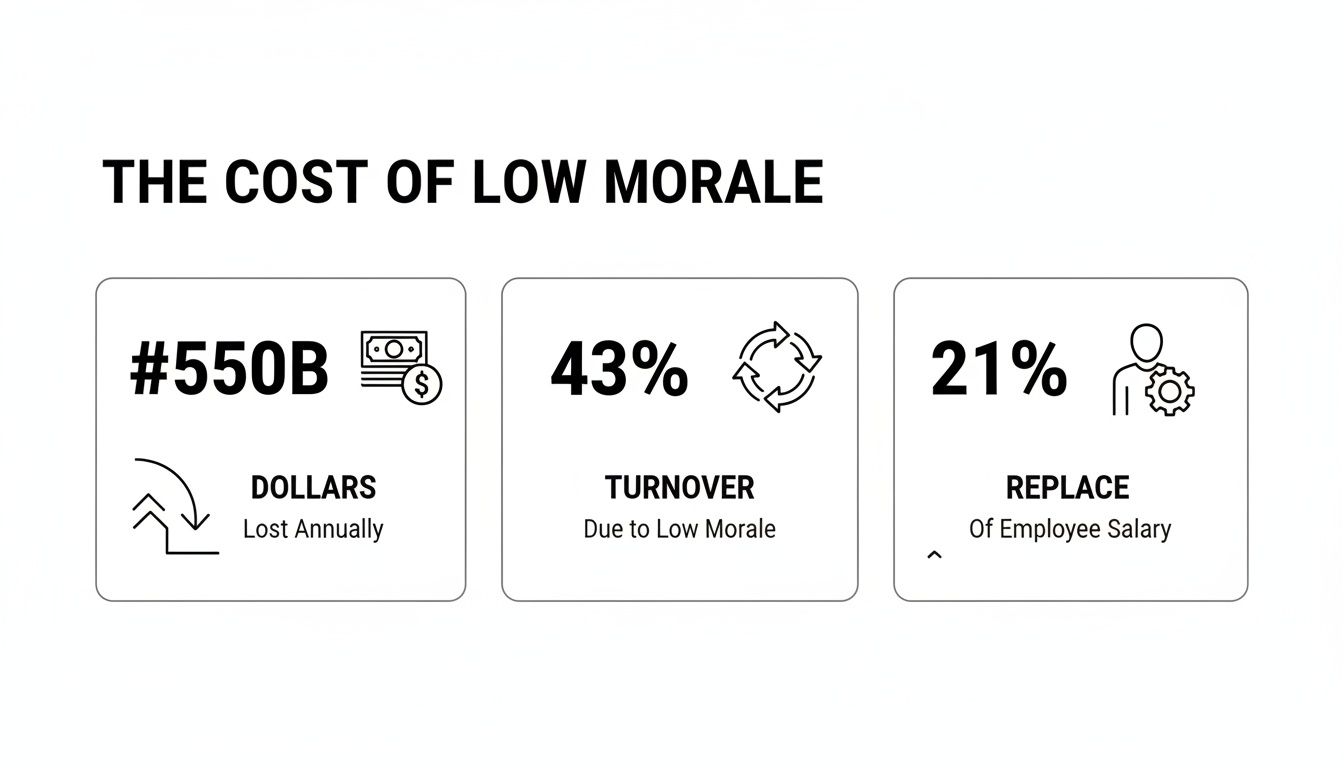
These numbers make it crystal clear: low morale isn’t a soft HR issue. It’s a hard financial liability that directly hits your bottom line through recruitment costs, training new hires, and lost productivity.
Moving Beyond Surface-Level Solutions
It’s easy to throw quick, visible perks at a morale problem and hope for the best. But a study from the University of Warwick found that while happy people were about 12% more productive, that happiness was tied to deep, intrinsic satisfaction—not just external rewards. To create lasting change, you need a much more thoughtful approach.
A healthy culture is a competitive advantage. When your team feels psychologically safe and supported, they bring their best creative and problem-solving skills to the table every single day.
To really grasp why team morale is such a critical metric, it helps to look at how specific essential policies to boost morale can lay the groundwork for success. This is where you shift from putting out fires to proactively building a strong, resilient culture. By focusing on the core elements of a great workplace, you create an environment where people don’t just show up to work—they show up to thrive.
Building and maintaining high morale requires a mix of immediate actions and long-term commitments. The table below helps break down where to focus your energy for both quick wins and sustainable growth.
Quick Wins vs Long-Term Strategies to Boost Morale
| Strategy Type | Example Action | Impact Level | Time to Implement |
|---|---|---|---|
| Quick Win | Publicly recognize a team member’s specific contribution in a weekly meeting. | Medium | < 1 Week |
| Quick Win | Surprise the team with a catered lunch or an early finish on a Friday. | Low-Medium | < 1 Week |
| Long-Term | Implement a structured mentorship program to foster growth and connection. | High | 3-6 Months |
| Long-Term | Develop and launch a clear, transparent career progression framework. | High | 6-12 Months |
While quick wins provide an immediate boost, they are most effective when they’re part of a broader, sustained effort. The real, lasting change comes from the long-term strategies that prove your commitment to the team’s well-being and professional future.
Build a Foundation of Psychological Safety
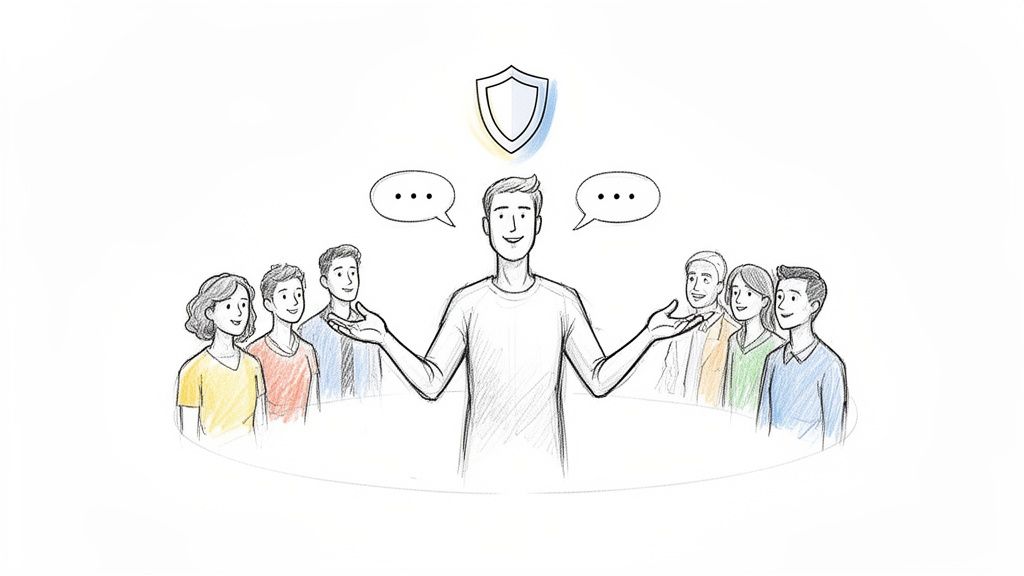
Before you can genuinely boost morale, you have to build a bedrock of trust. This all comes down to psychological safety—that shared belief that it’s okay to speak up, ask questions, or admit a mistake without getting shut down or blamed. Think of it as the invisible force field that allows teams to be vulnerable, innovative, and ultimately, resilient.
When that safety net is missing, people operate from a place of fear. They won’t point out a flaw in a plan or share a brilliant, off-the-wall idea. This silence isn’t a sign that everything is fine; it’s a sign that valuable insights are being buried, which can lead to project failures and simmering resentment.
On the flip side, a study in the Journal of Organizational Behavior found that teams with high psychological safety were much better at sharing information and learning from each other. This directly fuels better performance and, more importantly, higher morale because people feel respected and heard.
Model Vulnerability from the Top
You can’t just declare a “psychologically safe zone.” It has to be demonstrated, and that starts at the top. As a leader, one of the most powerful things you can do is show your own vulnerability.
Actionable Example: At the next team meeting where a project went sideways, start the discussion by saying, “Looking back, I realize I should have allocated more resources to this from the start. That’s on me, and it put extra pressure on the team. My goal for next time is to bring you all into the planning process earlier. What other lessons can we take from this?”
This simple act instantly shifts the dynamic from blame to collective learning. It turns a moment of failure into a real opportunity for growth and reinforces that it’s safe to be imperfect. Our own leadership development training programs dive deep into mastering these exact communication skills.
Reframe Mistakes as Learning Opportunities
The way you react to mistakes defines your team’s culture. If your first reaction is punitive, you’ll crush morale and teach people to hide problems. But if you react with curiosity, you build resilience and trust. The trick is to shift your language from blame to genuine curiosity.
Instead of asking, “Why did you miss that deadline?”—which immediately puts someone on the defensive—try a more open-ended question that invites reflection, not justification.
Here’s a simple way to reframe common blame-focused questions:
| Instead of This (Blame-Focused) | Try This (Curiosity-Focused) |
|---|---|
| Why did that happen? | What factors led to this outcome? |
| Who was responsible for this? | Can you walk me through the process here? |
| Why wasn’t this caught sooner? | What can we learn for our review process? |
Actionable Example: A team member reports a bug in a new feature. Instead of asking “How did you miss this?”, respond with “Great catch. Can you walk me through your testing process? Let’s see if we can identify a gap we can close for next time.” This makes them a partner in the solution, not the source of the problem.
Empower Quieter Voices
In any group, some people are naturally more outspoken. A psychologically safe environment ensures that introverted or more cautious team members feel just as empowered to share their perspectives. If you’re only hearing from the same two people in every meeting, you’re missing out on a huge chunk of your team’s collective intelligence.
Research consistently shows that diverse perspectives lead to better problem-solving, but that can only happen if every voice is actively encouraged. An easy-to-implement method is the “round-robin,” where you simply go around the room (or virtual meeting) and give each person a moment of uninterrupted time to share their thoughts.
Actionable Steps to Amplify All Voices:
- Send agendas in advance: Give people time to process topics and formulate their thoughts, not just those who think best on their feet.
- Try silent brainstorming: Before anyone speaks, use a tool like Miro to have the team spend 5 minutes writing ideas on digital sticky notes. This levels the playing field and helps prevent groupthink.
- Explicitly invite opinions: Directly ask quieter members for their input. A simple, “Sarah, we haven’t heard from you yet—what are your thoughts on this?” can make all the difference.
By creating structures that intentionally make space for every voice, you aren’t just being inclusive. You’re making your team smarter, more innovative, and far more engaged.
Rethink Recognition to Make It Meaningful
Let’s be honest: the “employee of the month” plaque is dead. More often than not, these kinds of generic awards feel forced and can accidentally create a weird sense of competition or even resentment. You know the feeling—when people feel their hard work is constantly getting glossed over. If you really want to light a fire under your team, recognition has to be real, it has to be timely, and it has to be specific. It’s time to move on to an approach that makes people feel genuinely seen for what they bring to the table.
And the payoff is huge. A study in the Journal of Personality and Social Psychology found a direct link between feeling appreciated and a person’s overall happiness. When your team members feel genuinely valued, it doesn’t just make them feel good; it builds their confidence, reinforces the exact behaviors you want to see, and makes them more committed to the team’s mission.
Make Praise Specific and In the Moment
The best recognition happens right after something great occurs, not weeks later during a formal review. A quick “good job” is fine, but it doesn’t really land. Why? Because it doesn’t tell the person what they did well or why it actually mattered. Getting specific is what turns a simple compliment into a powerful motivator.
Instead of a generic, “Thanks for your work on the project,” try getting into the details. Connect their specific action to a positive result.
Actionable Example:
“Sarah, thank you so much for catching that bug in the code before it went live. Your attention to detail saved us from a major headache with our biggest client and really demonstrated our commitment to quality. I appreciate you going the extra mile.”
This kind of feedback actually works because it’s crystal clear. It identifies:
- The specific action: Catching that nasty bug.
- The positive impact: Saving the team from a major client issue.
- The valued quality: Attention to detail and commitment.
Take Action: Set a calendar reminder for every Friday afternoon to reflect on the week. Identify one person on your team who did outstanding work and send them a specific, detailed message of recognition before you log off.
Build a Culture of Peer-to-Peer Recognition
Great feedback shouldn’t just be a top-down affair. When you empower your team to celebrate each other, you kickstart a powerful, self-sustaining cycle of positivity. Recognition from a peer often feels more authentic because it comes from someone who’s right there in the trenches with them and sees the effort firsthand.
In fact, a study in The Journal of Applied Psychology found that social recognition—praise from colleagues and managers—can actually be a stronger motivator than money alone. This tells us that creating simple systems for people to appreciate each other is a high-impact, low-cost way to lift everyone’s spirits.
Actionable Example: This week, create a dedicated channel in Slack or Microsoft Teams called #kudos or #props. Kick it off by posting the first shout-out yourself, tagging a colleague and explaining specifically how they helped you. For example: “Big thanks to @John for helping me troubleshoot that tricky spreadsheet formula. You saved me hours of work!”
Know When to Go Public and When to Go Private
While public praise is great for many, it’s definitely not one-size-fits-all. Some people cringe at being the center of attention, and for them, a public shout-out can feel more like a punishment than a reward. The key is knowing your people.
Public praise is a great fit for:
- Celebrating big team-wide wins and project milestones.
- Highlighting work that perfectly embodies the company’s values.
- Recognizing someone you know is comfortable (and even energized by) the spotlight.
Private praise often works better for:
- Giving constructive feedback or talking about areas for growth.
- Acknowledging someone on your team who’s more introverted or shy.
- Showing appreciation for a personal effort that wasn’t necessarily visible to the whole team.
Actionable Example: For a team member who is more reserved, skip the public announcement. Instead, send them a direct message: “Hey Alex, I just wanted to say that your analysis in the quarterly report was brilliant. The way you visualized the data made a complex topic easy for everyone to grasp. Really impressive work.” This delivers the same positive reinforcement without causing discomfort.
Foster Genuine Connection with Inclusive Team Rituals
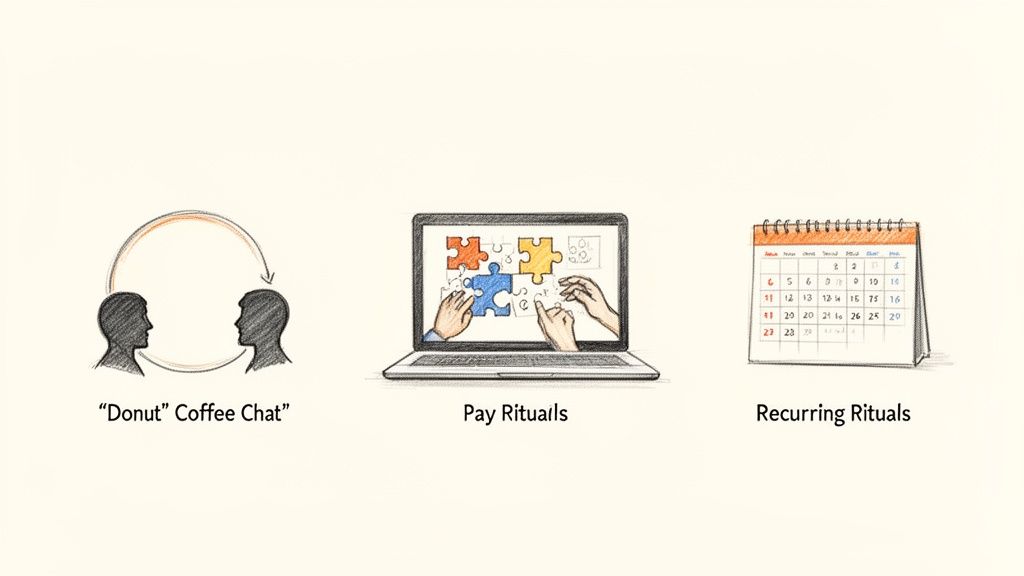
In a remote or hybrid world, those spontaneous coffee-machine chats that build real bonds just don’t happen on their own anymore. If your morale-boosting efforts feel more like forced fun than genuine connection, it’s a sign that your approach needs a refresh.
Let’s be honest: nobody loves an awkward virtual happy hour. The goal isn’t just to get everyone in the same Zoom room. It’s about creating shared experiences that strengthen your team’s social fabric and build real rapport—a powerful antidote to the isolation that so easily creeps into distributed work.
Move Beyond Forced Fun
Truly effective team rituals are the ones that don’t feel like a mandatory good time. They create low-pressure opportunities for people to connect as humans, not just as coworkers with deadlines. Research from Harvard University has shown a direct link between social connection at work and employees’ overall well-being and productivity.
This tells us that the foundation of high morale isn’t about extravagant events. It’s built on consistent, small-scale interactions that foster trust and camaraderie over time. You just need to create the space for people to let their guard down.
Actionable Ideas:
- ‘Donut’ Calls: Use a Slack app like Donut to randomly pair up two or three people for a quick, 15-minute non-work chat each week. It’s a brilliant, automated way to spark conversations between people who might not otherwise interact.
- Collaborative Gaming: Block off 30 minutes for a fun online game, like a virtual escape room or a group puzzle on a digital whiteboard like Miro. The focus is on teamwork, not winning, which is great for building collaborative muscle.
- Team “Show-and-Tell”: Kick off a weekly team meeting with a voluntary five-minute “show-and-tell.” Someone can share a photo from a recent trip, introduce their pet, or talk about a hobby. It’s a simple, humanizing way to see different sides of your teammates.
Co-Design Rituals With Your Team
Want to know the secret to creating rituals people actually look forward to? Just ask them. Imposing activities from the top down almost never works because it ignores different personalities, interests, and comfort levels.
When you co-design team-building activities, you’re not just planning an event; you’re sending a powerful message that everyone’s voice and preferences matter. This act of inclusion is, in itself, a significant morale booster.
Actionable Example: Create a simple, anonymous poll using Google Forms or a similar tool. List a few ideas (e.g., Virtual Lunch & Learn, Online Trivia, Collaborative Playlist) and include an open-ended “What would you like to do?” box. Share the results with the team and implement the most popular idea. This process demonstrates that their input directly shapes the culture. For more ideas, check out our guide to the best corporate team-building activities.
Make Connection a Habit
One-off events are great, but the morale boost they provide is often short-lived. The real magic happens when connection becomes a consistent, predictable part of your team’s culture. Rituals are most powerful when they are woven into the natural rhythm of the workweek.
This doesn’t mean you need to schedule hours of non-work activities every day. Consistency is far more important than duration. Even brief, regular touchpoints can have a profound impact on how connected your team feels.
Actionable Example: Schedule a recurring 15-minute “Team Check-in” every Monday morning with one rule: no work talk allowed. Use this time for people to share a weekend highlight or something they’re looking forward to in the week ahead. This creates a steady drumbeat of positive interaction that reinforces your team’s bonds.
Weave in Practical Mental Wellness Support
Great morale isn’t just about feeling good during the workday; it’s about feeling supported as a whole person, especially when things get tough. A lot of companies think having an Employee Assistance Program (EAP) tucked away in a handbook is enough, but real support is proactive, not just reactive. It’s about building meaningful mental and emotional health strategies directly into your team’s daily culture.
If you really want to know how to boost team morale, you have to create an environment where wellness isn’t an afterthought. It needs to be a core part of how your team operates, moving beyond benefits to build daily practices that protect your team’s well-being.
Normalize Conversations Around Mental Health
First things first: you have to dismantle the stigma. For way too long, talking about mental health at work has been taboo, forcing people to suffer in silence. Leaders have the power to change this just by openly and respectfully discussing topics like stress, burnout, and anxiety.
This doesn’t mean you need to be a therapist. It’s much simpler than that. It’s about creating a space where it’s okay for someone to say, “I’m feeling completely overwhelmed today,” without fearing judgment. In fact, a study in the Journal of Occupational Health Psychology found that supportive leadership and open communication were crucial factors in reducing employee burnout.
Actionable Example: As a leader, you can say in a team meeting, “This has been a high-pressure quarter, and I know I’ve been feeling the stress. I’m making a point to block off time for a walk every day to clear my head. I encourage all of you to find and protect time for whatever helps you recharge. Your well-being is a priority.”
Equip Your Team with Practical Stress Management Tools
Telling someone to “manage their stress” is pretty useless without giving them the actual tools to do it. Practical, accessible techniques can make a huge difference in helping your team regulate their nervous systems during high-pressure moments. This is about handing them skills, not just vague suggestions.
Think about introducing a simple, five-minute guided breathing exercise at the start of a high-stakes meeting. It’s a perfect example. It can calm collective nerves, sharpen focus, and set a more centered tone for the whole discussion. Research has shown time and again that controlled breathing techniques can significantly lower stress and improve cognitive function.
Actionable Tools You Can Introduce:
- Guided Breathwork Sessions: Offer access to guided audio or video breathwork sessions specifically designed for stress reduction. It’s worth exploring how structured workplace mental health programs can provide these kinds of resources.
- Mindfulness Apps: Provide subscriptions to well-regarded mindfulness apps like Calm or Headspace, which offer short, guided meditations people can use anytime.
- “Focus Blocks” in Calendars: Encourage everyone on the team to block off “no-meeting” time in their calendars for deep work. This reduces the cognitive load that comes from constantly switching gears.
These aren’t just trendy perks; they are essential tools for building resilience and preventing the kind of chronic stress that completely erodes morale over time.
Respect Boundaries to Prevent Burnout
A culture that consistently glorifies overwork is a culture that’s destined for burnout. It’s just impossible to sustain high morale when people feel like they have to be “always on.” Setting and respecting clear boundaries is one of the most powerful forms of mental wellness support you can offer.
This has to start with leadership modeling healthy behaviors. If managers are firing off emails at 10 PM, the team will feel obligated to be online and respond. True support means actively protecting your team’s time to disconnect and recharge.
Actionable Examples to Reinforce Boundaries:
- Implement “No-Meeting” Fridays: Dedicate Friday afternoons as a time where no internal meetings can be scheduled. Communicate this as a time for focused work and weekly wrap-up.
- Use Scheduled Send: If you work odd hours, write your emails but use the “schedule send” feature to ensure they arrive during your team’s working hours. This prevents creating a sense of urgency after hours.
- Promote PTO Usage: Don’t just let vacation days pile up. Actively encourage people to take their time off. A manager can say something like, “Hey, I see you haven’t taken a break in a while. Let’s get some time off on the calendar for you in the next month.”
Creating a culture where wellness is woven into the fabric of your operations shows your team that you care about their long-term well-being, not just their short-term output. This deep sense of being cared for is the ultimate foundation for high and sustainable team morale.
Common Questions About Boosting Team Morale
As you start working on your team’s spirit, you’re bound to run into some practical questions and real-world hurdles. Leading a team is complex, and knowing how to handle specific situations is key. Let’s dig into some of the most common questions I hear from leaders trying to get this right.
How Can I Boost Team Morale with a Very Limited Budget?
This is the one I get asked the most. The good news? Boosting morale isn’t about throwing money at the problem. Honestly, some of the most powerful changes you can make are behavioral and cultural—and they cost nothing but your time and intention. Big financial gestures can feel good for a moment, but it’s the consistent, thoughtful actions that build real, lasting trust.
The single most effective, no-cost strategy is consistent, specific, and public recognition. Don’t just say “good job.” In a team meeting, call out someone’s contribution and tie it directly to a positive result for the team or a client. It makes people feel genuinely seen and reinforces the exact behaviors you want to encourage.
Actionable No-Cost Strategies:
- Be Radically Transparent: Hold a 15-minute “State of the Team” update every other week. Share company updates openly—wins, challenges, and what’s coming next. When you let your team in, you build incredible trust.
- Act on Their Feedback: The next time a team member suggests an improvement to a process, say “That’s a great idea. Can you take the lead on implementing that this week?” Nothing tells your team their voice matters more than seeing their ideas come to life.
- Guard Their Time Fiercely: Before scheduling any meeting, ask yourself: “Can this be an email?” Run meetings that are efficient and end on time. This shows respect in a way a gift card never can.
Investing in psychological safety and showing you respect your team’s time and input will always give you a better return than superficial perks. It’s the real currency of modern leadership.
What Are the First Signs My Team’s Morale Is Declining?
A drop in morale rarely happens overnight. It’s more like a slow leak, starting with subtle shifts in behavior. If you can spot these early warning signs, you can step in before the problem takes root and spreads—because low morale is definitely contagious.
Often, one of the very first signs is a drop in proactive communication. People just get… quiet. Team members who used to bubble with ideas in meetings suddenly have nothing to say. Chat channels get less responsive. That silence isn’t a sign of contentment; it’s the sound of people checking out.
Keep an eye out for these indicators:
- A Rise in Absenteeism: Are last-minute sick days becoming more common? Do you notice a pattern of people seeming “off” or disengaged on Mondays and Fridays? That can be a major red flag.
- Discretionary Effort Dries Up: People start doing just enough to get by. They’ll hit their deadlines, but they stop going the extra mile, offering to help a teammate, or showing any real excitement for new projects.
- The Tone Changes: Listen to the language people use in meetings and team chats. Is there an uptick in gossip, cynical humor, or just a generally critical vibe? That’s often a sign of frustration bubbling under the surface.
- Silos Start Popping Up: Team members who used to collaborate seamlessly now seem to be working in isolation. They stop sharing information freely or offering support to each other.
How Do I Measure the Impact of My Morale-Boosting Initiatives?
Trying to measure something as intangible as “morale” can feel tricky, but it’s not impossible. You just need a mix of hard data and good old-fashioned observation. Relying on just one or the other will only give you half the story. The goal here is to track trends over time to see if what you’re doing is actually making a difference.
For the hard data, use short, frequent, and anonymous pulse surveys. Ask a few simple questions on a rating scale about things like job satisfaction, workload, and feeling valued. Tracking these scores monthly gives you a real-time view of how things are trending. You should also watch key metrics like employee turnover and absenteeism rates. If those numbers start trending down, it’s a strong sign you’re on the right track.
But the numbers don’t tell you why. That’s where qualitative feedback comes in.
Actionable Measurement Tactics:
- Try ‘Stay Interviews’: Schedule 30-minute informal chats with your team members. Ask them: “What’s one thing you’d change about our team if you could?” and “What was your best day at work in the last month, and why?” The insights are gold.
- Watch the Room: Pay attention to the energy in your meetings. Are people brainstorming and solving problems together more openly? A tangible shift toward more positive, proactive collaboration is a huge win.
- Listen for the Little Things: Keep your ears open for unsolicited positive comments. When a team member casually mentions how much they appreciated that new meeting format or how a leader’s support made a difference, you’re getting real-time confirmation that your efforts are landing.
Research published in The Journal of Applied Psychology has shown that when employees feel heard and see their feedback acted upon, their commitment to the organization deepens. So don’t just collect the data—close the loop. Share the survey results (the good and the bad) and tell the team exactly what you plan to do about it. That act alone is a massive morale booster.
Ready to integrate a powerful, practical tool for mental wellness and stress reduction into your team’s culture? 9D Breathwork offers scientifically-backed sessions that help regulate the nervous system, improve focus, and build resilience from the inside out. Discover how you can support your team’s well-being and unlock their full potential.