Holotropic Breathwork is a powerful technique that uses accelerated breathing and evocative music to help you explore non-ordinary states of consciousness for deep, personal healing. Developed by Stanislav and Christina Grof, the whole point is to tap into your own inner healing intelligence. This isn’t just about relaxation; it’s about profound psychological and spiritual work. The practice itself is a journey, built on a unique blend of preparing your mind and body, the breathing session itself, and the crucial integration work that follows.
Getting to the Core of Holotropic Breathwork
Think of Holotropic Breathwork as more than just a set of breathing exercises—it’s a deep, experiential process for self-discovery. The name itself says it all. It comes from the Greek words holos (whole) and trepein (to move toward), literally meaning “moving toward wholeness.” That’s the entire intention behind it.
The method was officially born back in 1974 at the Esalen Institute, created by psychiatrist Stanislav Grof and his wife, Christina. It grew out of their extensive research into non-ordinary states of consciousness and was seen as a drug-free alternative to psychedelic therapy. Since then, it has spread across the globe. We’re talking over 100,000 people who have attended workshops in more than 50 countries.
Set and Setting: The Two Pillars of the Practice
To really understand what makes these sessions work, you have to get familiar with two foundational ideas: set and setting. These aren’t just buzzwords; they are critical for ensuring a safe and effective journey.
- Set (Your Mindset): This is all about your internal state as you go into the session—your thoughts, feelings, and what you hope to gain. The best approach is to come with an open, curious mind rather than a rigid agenda. Actionable Example: Instead of thinking, “I have to fix my anxiety right now,” try setting a more open intention like, “I am open to understanding the root of my anxiety and what it needs from me.”
- Setting (Your Environment): This is the physical and emotional container for the experience. A proper setting feels safe, comfortable, and supportive, with absolutely no interruptions. In a group setting, this includes the facilitator’s presence, the carefully chosen music, and the shared energy of everyone in the room.
The real magic happens when your internal readiness (set) meets a secure and supportive container (setting). This creates the ideal conditions for your own inner wisdom to take the lead.
To give you a clearer picture, here’s a breakdown of what a session typically involves.
Core Components of a Holotropic Breathwork Session
| Component | Purpose and Description |
|---|---|
| Preparation | This involves a detailed introduction to the process, establishing group trust, and setting clear personal intentions. It’s about creating a safe container. |
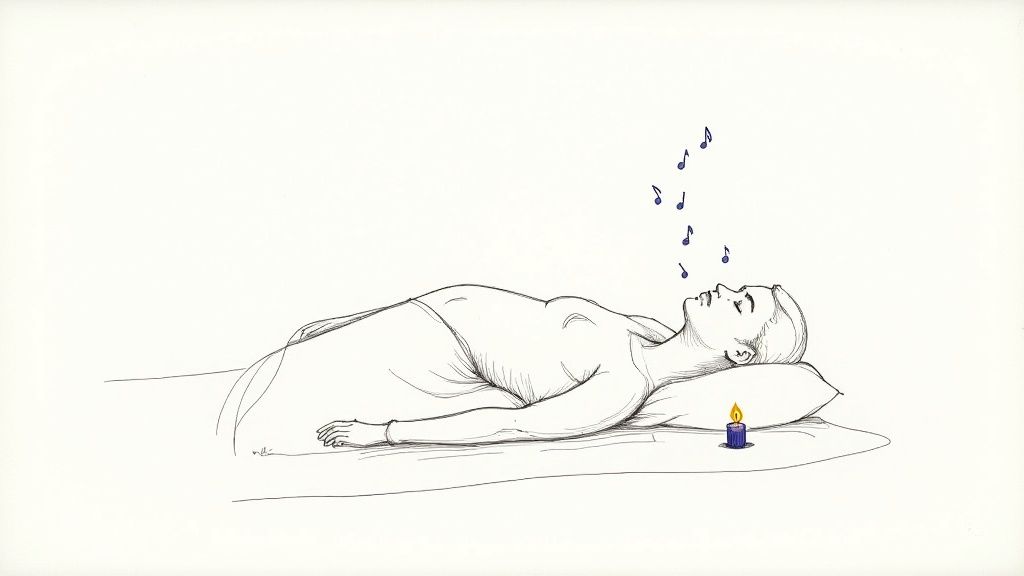
| The Breathwork | Participants lie down, close their eyes, and begin breathing faster and deeper than usual. The focus is on a full, connected breath without pausing. |
| Evocative Music | A powerful, multi-layered musical score guides the journey, starting with dynamic and intense tracks and transitioning to more serene, heart-opening pieces. |
| Focused Bodywork | If energy blockages or unresolved tensions arise, facilitators may offer focused bodywork (with permission) to help release them. |
| Creative Expression | After breathing, participants express their experience non-verbally, often through mandala drawing, to help ground and process what came up. |
| Group Sharing | The session concludes with an optional sharing circle where participants can talk about their experiences without analysis or interruption from others. |
This structure ensures that the entire process, from start to finish, is supportive of the deep work being done.
Who Is This Practice For?
Holotropic Breathwork can be a game-changer for a wide range of people looking for personal growth. It tends to be especially impactful for:
- Corporate Professionals: Anyone feeling the weight of burnout or chronic stress can find this a space for genuine emotional release, often leading to new clarity on their life and career.
- Individuals on a Healing Journey: For those working through past trauma, grief, or emotional roadblocks, the practice can lead to major breakthroughs and a feeling of coming back to oneself.
- Seekers of Spiritual Connection: Many people report profound spiritual experiences, feeling a deeper, more meaningful connection to themselves, others, and the universe.
By understanding the broader mental health sector, you can see how this powerful modality fits into the larger picture of personal development tools. If you’re just starting to explore this world, it’s a good idea to check out the essentials of guided breathwork and its benefits to get your bearings.
Getting Ready for Your Breathwork Journey
A truly profound breathwork experience doesn’t just happen out of the blue. It all starts with setting the stage. Getting your mind, body, and environment ready is the key to unlocking your own inner healing intelligence and allowing it to guide the way. Think of this prep work as building a foundation of trust and surrender, which is what this whole practice is about.
Your physical space, whether it’s your own living room or a formal workshop, needs to feel like a safe container for the journey ahead. You need a spot where you feel totally secure and know, without a doubt, that you won’t be interrupted. You’re essentially creating a personal sanctuary just for this inner work.
Creating Your Ideal Setting
First things first, let’s dial in your environment. Comfort is everything. If you’re physically distracted, it’s nearly impossible to go deep.
- Secure Your Space: Make sure the room is private. Actionable Step: Put a “Do Not Disturb” sign on your door. Give your family or roommates a clear timeframe: “I need 2-3 hours of uninterrupted quiet time starting at 7 PM.” Your phone? Turn it completely off.
- Comfort is King: You’re going to be lying down for a while. A comfortable mat, a mattress on the floor, or a few thick blankets will do the trick. Keep some pillows handy—one for your head and another to tuck under your knees can work wonders for relieving lower back pressure.
- Minimize Sensory Input: An eye mask or even a soft cloth draped over your eyes is a game-changer. Blocking out the light is a simple but powerful way to help you turn your awareness inward. Research shows that combining rapid breathing with intentional relaxation helps the brain enter a meditative state.
One last thing on the environment: think about the temperature. Your body temp can go on a bit of a rollercoaster ride during a session. Having a light blanket nearby means you can adjust on the fly without breaking your flow.
Fueling Your Body and Mind
What you eat and drink in the 24 hours leading up to your session really does matter. The goal here is to feel light, clear, and energized—not bogged down by a heavy meal or buzzed on caffeine.
Your body is the vessel for this experience, so you want it running as cleanly as possible. A big, greasy meal diverts a ton of energy to your digestive system, which can leave you feeling sluggish and physically uncomfortable.
A study in the Journal of Alternative and Complementary Medicine actually pointed out how our physical state, including what we’ve eaten, can directly shape our experiences during meditative practices. Eating light keeps your body’s energy available for the deep processing that breathwork facilitates.
A Few Practical Tips on Diet:
- 24 Hours Before: Steer clear of heavy or greasy foods, tons of sugar, and red meat. Stick to whole foods—think fruits, veggies, and lean proteins.
- Day Of: Have a light meal at least three to four hours before you start. A simple soup, a smoothie, or a small salad are all great choices. Honestly, showing up with a relatively empty stomach is usually for the best.
- Hydration: Drink plenty of water throughout the day, but maybe slow down about an hour before you begin so you’re not thinking about a bathroom break mid-session.
And it probably goes without saying, but skip the caffeine and other stimulants on the day of your session. They can ramp up anxiety and make it much harder to just let go and trust the process.
Setting a Powerful Intention
This might be the most important thing you do before you even take that first deep breath: setting a clear, heartfelt intention. This isn’t about setting a rigid goal or demanding a specific outcome from the universe. Not at all.
Instead, think of your intention as a gentle question or a warm invitation to your own inner wisdom. It gives your journey a direction without trying to micromanage the destination. A 2017 study in Frontiers in Psychology confirmed that goal-setting and intention can significantly enhance focus and reduce stress, preparing the mind for deep inner work.
Actionable Intention Examples:
- “Show me what I need to see for my highest good.”
- “Help me release what no longer serves me.”
- “I am open to healing the root of my anxiety.”
- “Help me connect more deeply with my creativity.”
Try this action: Write your intention down on a small piece of paper. Read it aloud a few times right before you lie down, place it nearby, and then… let it go. Trust that your inner healer heard you and will take it from here.
The Breathing Technique and Musical Journey
At the heart of any holotropic breathwork session is a powerful partnership: a specific breathing rhythm married to a meticulously crafted musical score. This combination is what helps you sidestep your chatty, analytical mind and drop into much deeper states of awareness. The technique itself is deceptively simple but incredibly profound once you get going.
The core breathing pattern is a continuous, circular rhythm—faster and deeper than you breathe normally. The key is that there is no pause between the inhale and the exhale. Picture a connected loop of energy moving through you. You take a full breath in, and just as your lungs peak, you simply let it go in a relaxed exhale, flowing right into the next inhale without stopping.
Mastering the Core Breathing Pattern
To keep this rhythm going without tensing up your shoulders and neck, the breath needs to come from your diaphragm, not your chest. This is classic “belly breathing.”
- Here’s a practical action: Lie down and put one hand on your chest and the other on your belly. For one minute, practice breathing deeply into your belly, focusing only on making the hand on your abdomen rise and fall. The hand on your chest should stay relatively still. This builds the muscle memory for the session.
The pace is deliberately sped up to help quiet the thinking part of your brain. But remember, it’s not a race. You need to find a rhythm that feels a little challenging but is ultimately sustainable for you. The aim isn’t to force anything; it’s to let the breath build its own momentum naturally.
The Role of Evocative Music
In a holotropic session, music isn’t just mood-setting background noise—it’s an active co-therapist. A well-designed playlist is absolutely essential for guiding the emotional arc of the journey. The music becomes a non-verbal guide, helping to pull forward emotions, memories, and insights that might otherwise stay buried.
The soundtrack usually follows a distinct structure:
- Activation: The journey kicks off with dynamic, rhythmic, and often tribal or percussive music. This high-energy soundscape gets you into the accelerated breathing, helping you build energy and push past that initial mental chatter.
- Breakthrough: As your energy climbs, the music often gets more dramatic and emotionally intense. This part of the journey can stir up powerful feelings and is designed to support a deep emotional release.
- Heart-Centered: After the peak intensity, the music softens into more serene, melodic, and heart-opening tracks. This phase is all about encouraging feelings of love, connection, and spiritual insight.
- Integration: The final stage brings in calm, ambient, or meditative music. This is your landing strip, allowing you to gently return to ordinary awareness and begin integrating the experience.
Music is a fundamental component of the Holotropic Breathwork process. It serves as a catalyst for emotional release and helps to structure the inner journey, carrying the breather through various layers of consciousness.
The carefully chosen soundtrack helps you stay focused, much like creating a perfect offline playlist for a “music on, world off” session, where sound becomes a powerful tool for inner exploration.
The visual below recaps the simple but vital prep steps we covered earlier, which really set the stage for this deep dive.
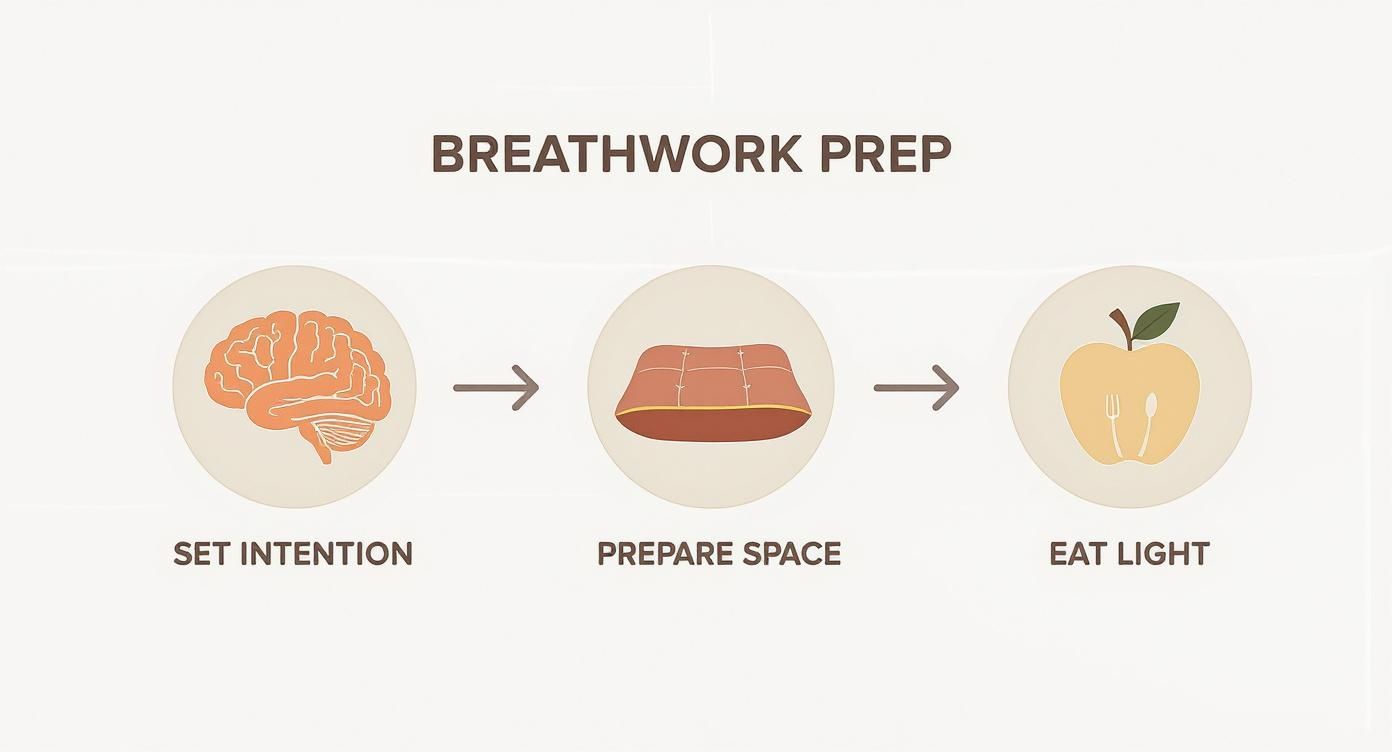
This just goes to show that a successful session starts long before the first breath. It begins with intentional preparation of your mind, your body, and your space.
Facilitated Session Versus Solo Practice
Deciding how to practice is a big deal. While both facilitated group sessions and solo journeys have their merits, understanding the key differences is crucial for your safety and for getting the most out of the experience.
There’s a good reason why working with a trained facilitator is the standard. A peer-reviewed article in the Journal of Transpersonal Psychology pointed out that a facilitator’s presence significantly boosts feelings of safety. This allows people to surrender more deeply to the process. A good facilitator holds a supportive space, manages the music, and can offer a hand if intense emotions or physical blocks come up. For beginners, this is non-negotiable.
On the other hand, a solo journey gives you more privacy and flexibility, but it demands a much higher degree of self-awareness and experience. If you’re just feeling stressed and need an outlet, you might find that simpler breathing exercises to lower your heart rate are a gentler place to start than a full-blown solo holotropic session.
Facilitated vs Solo Holotropic Breathwork Practice
Here’s a quick comparison to help you figure out which path is right for you at this moment.
| Aspect | Facilitated Session | Solo Practice |
|---|---|---|
| Safety and Support | A trained professional provides a secure container and can offer support for intense experiences. | You are entirely responsible for your own safety. A trusted “sitter” is highly recommended, especially early on. |
| Guidance | The facilitator curates the music and guides the session’s flow, letting you fully surrender. | Requires complete self-direction, from creating a playlist to managing your own process. |
| Cost and Accessibility | Typically involves a fee for workshops or private sessions. | Free, but requires a significant investment in self-education and preparation. |
| Ideal For | Beginners, anyone working on deep-seated trauma, or those seeking a professionally held space. | Experienced practitioners who are comfortable navigating their inner world independently. |
Ultimately, starting with a certified facilitator is the most recommended path. It provides the safest container to learn the holotropic breathwork techniques properly and builds the confidence you’ll need if you decide to explore a solo practice down the road.
How to Navigate Your Inner Experience
When you drop into a holotropic breathwork session, your inner world can come alive in ways that might feel completely new. It’s not always a peaceful float down a lazy river; more often, it’s a dynamic journey through a vibrant landscape of powerful emotions, buried memories, and intense physical sensations. The real art of navigating this is learning to get out of your own way—to trust the process and surrender to whatever comes up, rather than trying to analyze or fight it.
You might find yourself laughing uncontrollably one moment and weeping the next, for reasons that make no sense to your conscious mind. It’s also common to feel a tingling in your hands and feet (a harmless effect called tetany), sudden shifts in body temperature, or a palpable sense of energy buzzing through you. Just remember, this is all perfectly normal. These are signs that your body is finally letting go of old energy and ingrained patterns.
Trusting Your Inner Healer
If there’s one piece of advice to hold onto, it’s this: trust your inner healing intelligence. The entire practice is built on the profound idea that your psyche knows exactly what you need to heal. Your job isn’t to steer the ship; it’s simply to allow the currents to guide you.
Practical Action: When a difficult emotion like anger arises, instead of pushing it away, try silently saying to yourself, “I see you. I allow you. You are safe here.” This simple act of acknowledgment can transform resistance into release. Breathe directly into the physical location of the feeling and imagine making space around it.
The core principle here is radical acceptance. Whatever comes up is precisely what needs your attention right now. When you surrender to the experience, you open the door for genuine release and integration.
For many, the process feels like a deep emotional and energetic cleanse. A 2018 study published in Frontiers in Human Neuroscience demonstrated that specific breathing practices can significantly influence autonomic nervous system activity, helping shift the body from a state of stress to one of deep rest and processing. That shift is absolutely essential for healing.
The Role of the Sitter or Facilitator
While the journey is deeply personal, you’re not meant to go it completely alone, especially in the beginning. A trained facilitator, or even a trusted friend acting as a “sitter,” plays a crucial—yet intentionally non-intrusive—role. Their main job is to hold a safe and supportive space for your process to unfold.
A good facilitator provides a container for your experience. Here’s what that looks like:
- They ensure physical safety: A sitter makes sure you’re physically safe and comfortable, maybe adjusting a blanket if you get cold or simply offering a reassuring presence in the room.
- They don’t interfere: A skilled facilitator will never interpret your experience for you or interrupt your process. They are there to support, not to direct.
- They may offer focused bodywork: If you get stuck in a physical or energetic block—like intense tension in your jaw or a tightness in your chest—a facilitator might (with your prior consent) apply gentle, focused pressure to help that energy release.
This supportive presence is what allows you to surrender more deeply, knowing you are in a secure environment. This kind of work is a powerful way to understand how to release stored trauma from the body.
Critical Safety and Health Considerations
Holotropic breathwork is a powerful modality, and for that very reason, it’s not for everyone. The accelerated breathing pattern creates significant physiological changes, so it is absolutely vital to be aware of the contraindications to ensure your safety.
This practice should be avoided if you have any of the following conditions:
- Serious Cardiovascular Issues: This includes a history of heart attack, severe or unstable hypertension, angina, or aneurysms.
- Glaucoma or Retinal Detachment: The practice can temporarily increase pressure in the eyes.
- Recent Surgery or Major Injuries: Your body needs to be fully healed before undergoing such an intense physical and energetic process.
- Severe Psychiatric Conditions: A history of psychosis, bipolar disorder (particularly manic episodes), or other conditions where you might lose touch with reality.
- Epilepsy or a history of seizures.
- Pregnancy.
This isn’t about gatekeeping the practice; it’s about being responsible. The goal is healing, and that starts with making a smart, informed decision about whether this is the right tool for you at this moment. If you have any doubts, always talk to your doctor first.
Despite these necessary precautions, the practice has a strong safety profile when done correctly. In a major clinical report on Holotropic Breathwork involving 11,000 psychiatric inpatients, the practice was found to be generally well-tolerated. Only a small fraction—2%—experienced temporary adverse effects like anxiety, while over 80% reported improved mood and reduced psychological distress. This really highlights its potential as a powerful tool in a controlled, supportive setting.
Integrating Insights Into Your Daily Life

The real work of holotropic breathwork doesn’t stop when the music ends and your breathing settles. In many ways, that’s when it truly begins. This next phase is called integration, and it’s the crucial process of weaving the profound, often non-verbal, insights from your journey into the fabric of your everyday life.
Think of it as building a bridge between your inner world and your outer reality. If you rush right back to your inbox, errands, and to-do lists, the wisdom you gained can evaporate like a dream. Giving yourself the time and space to process isn’t a luxury—it’s an essential part of the practice itself.
Grounding Yourself Immediately After a Session
Right after a session, your first job is to gently come back to earth. Resist the urge to immediately jump into analyzing or trying to logically make sense of what just happened. Your analytical mind wasn’t in the driver’s seat during the journey, so it’s not the best tool for processing the immediate aftermath.
Instead, turn your focus toward simple, sensory activities that bring you back into your body and the present moment. This soft landing allows the insights to settle in a much more organic way.
Practical Grounding Actions:
- Walk in nature: Even a short, ten-minute walk can be incredibly centering. Actionable Step: Leave your phone behind and focus on three things you can see, two things you can hear, and one thing you can feel (the breeze, the ground).
- Creative expression: Don’t think, just create. A popular practice is to draw a mandala, a circular design that can beautifully represent the wholeness of your experience. Get some colored pencils and just let your hand move without a plan.
- Journal freely: Just let the words flow. Write down any images, feelings, or snippets of thought that are present. This is about stream-of-consciousness, not crafting a perfect narrative.
The goal isn’t to interpret the experience, but simply to honor it. By engaging in these non-analytical activities, you create space for the deeper wisdom from the session to surface naturally over the next few days and weeks.
Translating Insights Into Tangible Action
As a little time passes, the messages from your session will start to crystallize. The magic happens when you translate these revelations into small, sustainable changes in your life. This is where real, lasting transformation takes root. A 2015 study in Mindfulness found that practices that increase body awareness (like breathwork) can enhance emotional regulation in daily life, but only if the insights are actively applied.
Let’s look at a real-world scenario. A corporate executive, totally burnt out, has a session where they experience this overwhelming wave of compassion for their younger, more vulnerable self. Their logical mind might try to brush it off. But the integration work is turning that feeling into an action.
- The Insight: A deep-seated need for more self-compassion.
- The Actionable Step: Instead of bulldozing through their stressful workday, they commit to taking a genuine 15-minute break away from their desk. They set a calendar reminder for 2 PM every day to step outside, listen to a calming song, or just sit in silence. That small act becomes a daily practice of honoring the insight.
This is exactly how holotropic breathwork techniques shift from being a powerful experience to a catalyst for genuine change. It’s all about building new habits that align with your newfound awareness.
The Science of Sustaining Change
Of course, making these changes stick is often the hardest part. Research from the National Library of Medicine shows how breathwork can physically shift the body out of a sympathetic (fight-or-flight) state and into a parasympathetic (rest-and-digest) response. Your integration practices are what help solidify this new, calmer baseline.
Another study published in the journal NeuroImage discovered that consistent mindfulness and self-compassion can physically alter neural pathways tied to stress and emotional regulation. So, when you take your breathwork insight—like that need for self-compassion—and turn it into a daily five-minute loving-kindness meditation, you are actively rewiring your brain to support that change.
Integration is an ongoing conversation with yourself. It’s about learning to listen to the subtle whispers of your inner wisdom long after the breathwork session is over, and then finding the courage to act on what you hear. That’s how you truly move toward wholeness.
Got Questions About Holotropic Breathwork?
It’s completely normal to have a few questions before diving into something as profound as Holotropic Breathwork. This isn’t just a simple breathing exercise; it’s a deep journey into your own consciousness. Getting clear on the details is the best way to feel comfortable and safe as you start.
Let’s walk through some of the most common things people ask before their first session.
How Is This Different From Other Breathwork Styles?
This is a big one. You’ve probably heard of other popular methods, and it’s easy to lump them all together. But while practices like the Wim Hof Method or Rebirthing-Breathwork also use conscious breathing, their aims and approaches are worlds apart.
- Holotropic Breathwork: This is the brainchild of Stanislav Grof. The goal here is psychological and spiritual exploration. You use rapid, deep breathing paired with powerful, evocative music to enter non-ordinary states of consciousness. The whole philosophy is built on transpersonal psychology and trusts that your own “inner healer” knows exactly where you need to go.
- Wim Hof Method: Think of this as more of a bio-hacking tool for physical and mental resilience. It’s a very structured system combining specific breathing patterns with cold exposure to boost your immune system and handle stress better.
- Rebirthing-Breathwork: Developed by Leonard Orr, this practice uses a much softer, connected breathing rhythm. Its primary focus is to gently release ingrained emotional patterns and trauma, particularly those stemming from birth.
A 2022 study in Frontiers in Psychiatry compared various breathwork styles and highlighted that while many can improve emotional regulation, the specific container of Holotropic Breathwork—the music, supportive setting, and focus on an unstructured internal journey—makes it a uniquely potent psychotherapeutic tool.
The real difference is the intention. Holotropic Breathwork isn’t about physical performance or hitting a specific target. It’s about letting go and allowing your own psyche to guide an unstructured, deeply personal exploration.
Can I Do Holotropic Breathwork By Myself at Home?
This is probably the most critical safety question we get. While it’s technically possible for someone with a lot of experience to practice alone, the answer for beginners is a firm no. For your first several sessions, it is strongly recommended that you work with a certified facilitator.
A good facilitator is so much more than a playlist DJ. They are trained to create and hold a safe space, which is essential for you to truly let go. They know how to guide you through intense emotional releases or physical sensations and are trained to screen for safety contraindications. A study in the Journal of Humanistic Psychology found that the therapeutic alliance and sense of safety in guided sessions are key predictors of positive outcomes. This expert support is what allows you to surrender fully.
If you do decide to practice solo after gaining significant experience, take this actionable safety step: ensure you have a private, comfortable space where you know you won’t be interrupted. You’ll need a playlist specifically designed for this kind of journey and, ideally, have a trusted friend or “sitter” nearby who understands what you’re doing and can check on you afterward.
How Often Should I Be Doing This?
Finally, what’s the right frequency? How often should you use Holotropic Breathwork techniques to see real results? There’s no single right answer, because this is an intensely personal process.
This isn’t a daily habit like meditation or a few morning deep-belly breaths. Holotropic Breathwork is a major event for your nervous system and psyche, and it requires plenty of time to process afterward. For most people, a session every few months is more than enough to foster deep growth. If you’re going through a period of intense personal work, a monthly session might feel right.
A review of breathwork studies in the International Journal of Yoga concluded that while consistent practice is beneficial, intense sessions require significant integration periods to allow the nervous system to recalibrate. That shift needs time to stick.
The most important rule is to allow for complete integration between sessions. Jumping back in before you’ve processed the insights and shifts from your last journey can be confusing and even counterproductive. Actionable Advice: Keep a journal. When you feel the impulse to do another session, review your notes from the last one. Ask yourself: “Have I taken action on what I learned? Do I feel grounded and stable?” Your honest answers will guide you.
Ready to move from theory to experience? 9D Breathwork offers a full-spectrum journey that combines the power of breath with modern sound technology and guidance to help you rewire patterns from the inside out. Discover how this approach can support your path to wholeness at https://9dbreathwork.com.