At its core, increasing your self-awareness is about paying closer attention. It’s about noticing your thoughts, feelings, and actions to finally understand why you do what you do. This simple shift takes you off autopilot and puts you in the driver’s seat, empowering you to make intentional choices that actually line up with your goals.
Why Self-Awareness Is a Career Superpower

Let’s be real for a minute. The term “self-awareness” can sound like a fluffy, soft skill with no tangible payoff. I’m here to reframe that completely. This isn’t about endless navel-gazing; it’s about sharpening your professional edge. For busy people juggling stress and anxiety, genuine self-awareness is the bedrock of high performance.
Think about the last time a project meeting went off the rails. Or when “constructive” feedback felt more like a personal attack. A lack of self-awareness is what fuels those knee-jerk reactions and paves the road to burnout. Mastering it, on the other hand, leads to better leadership, clearer communication, and a career path that feels deliberate, not accidental.
The Foundation of Professional Growth
Think of self-awareness as your internal compass, guiding your decisions and interactions, especially when the pressure is on. It’s no surprise that a landmark study published in the Journal of Organizational Behavior found that leaders with higher self-awareness led more satisfied and effective teams. They can connect their actions back to their core values, even when things get tough.
Instead of reacting emotionally to a setback, a self-aware professional can hit pause. They can identify the feeling—frustration, disappointment, maybe even embarrassment—and then choose a productive response. This skill is fundamental to building robust emotional regulation strategies, which are absolutely crucial for staying composed and making sound judgments in high-stakes situations.
From Reaction to Intention
Top companies get it. In fact, 78% of Fortune 500 companies have woven self-awareness training into their leadership programs. Why? Because it works. These programs have been shown to boost emotional intelligence by as much as 35% among participants, proving this is a skill with a real, measurable business impact.
A huge part of getting ahead is recognizing that your internal state directly shapes your external results. When you understand your own triggers and thought patterns, you stop being a passenger in your career and start being the driver.
This isn’t a one-and-done skill; it’s a muscle you build over time. A 2010 study in Social Cognitive and Affective Neuroscience even showed that mindfulness practices—a core part of building self-awareness—can physically change the brain structures tied to emotional control. To see just how deep this rabbit hole goes, exploring ways to improve executive function can amplify these capabilities, cementing its role as a true career asset.
Actionable Daily Practices to Build Awareness
You don’t need an hour-long meditation retreat to build self-awareness. Real, lasting growth happens in the small, consistent actions you weave into your busiest days. It’s about creating tiny habits that, over time, peel back the layers and give you powerful insights into who you are and why you do the things you do.
The journey to greater self-awareness starts with simple, effective exercises that actually fit your life—not the other way around. Let’s walk through three foundational practices designed for a packed schedule. These aren’t complicated rituals; they’re quick, practical tools to help you tune into your inner world, even when the outer world is pure chaos.
The Mindful Moment Check-In
Most of us spend our days on autopilot, jumping from one task to the next without a second thought. The Mindful Moment is your chance to deliberately hit pause on that cycle. Think of it as a two-minute reset to ground yourself right here, right now.
Here’s your actionable plan:
- Set two daily alarms: Label one “Mid-Morning Check-In” and the other “Mid-Afternoon Check-In.”
- Stop and breathe: When the alarm goes off, stop typing. Close your eyes and take three slow, deep breaths, inhaling through your nose for four counts and exhaling through your mouth for six.
- Scan your body: Quickly notice any physical sensations. Is your jaw clenched? Are your shoulders creeping up toward your ears? Just observe it without judging.
- Name your emotion: Ask yourself, “What am I feeling right now?” Give that feeling a specific name—anxious, content, frustrated, calm. For example: “I am feeling overwhelmed.”
This simple act interrupts the momentum of unconscious thought and behavior. It’s not just fluff; a study in Psychiatry Research showed that even brief periods of mindfulness can create measurable changes in brain regions linked to memory, sense of self, and stress. It’s a tiny investment with a massive return.
The One-Sentence Journal
Let’s be honest, the idea of daily journaling can feel like a chore. The One-Sentence Journal completely removes that pressure. The goal is simple: capture a single, meaningful insight from your day in just one sentence. This micro-practice helps you connect your actions to your feelings without needing a huge time commitment.
Here is a practical example of an entry:
“I felt a wave of frustration when the project deadline moved up, and I realize now it was tied to my need for control, not the actual task.”
Or maybe it’s a positive realization:
“Felt so energized after delegating that report, which shows I’m finally starting to trust my team more.”
This practice forces you to distill your experience down to its most essential lesson. Over weeks and months, these single sentences create an incredible map of your personal growth, highlighting recurring themes and breakthroughs. A huge part of building this kind of awareness is simply being able to sustain your attention; exploring practical strategies to improve focus and concentration can make these daily observations even sharper.
The Emotional Trigger Log
Our strongest emotional reactions are like breadcrumbs leading back to our deepest-held beliefs and unresolved wounds. An Emotional Trigger Log is a private, non-judgmental space to track these moments. It’s not about blaming anyone—it’s about understanding your own internal landscape.
When you feel a disproportionate emotional response—like intense anger over a minor comment or a sudden spike of anxiety from an email—take a moment to log it in a simple table like this in a notebook or phone app.
| The Situation | My Immediate Feeling | The Underlying Thought |
|---|---|---|
| A colleague interrupted me during the team meeting. | Anger, feeling disrespected. | “My opinion doesn’t matter to them.” |
| I received vague feedback on a major project. | Anxiety, fear of failure. | “I’m going to be seen as incompetent.” |
Simply tracking these triggers is the first step toward dismantling them. Once you spot a pattern, you can start to question the thoughts driving the emotion. This process is essential for learning how to break negative thought patterns and reclaim control over your emotional state. Research from the journal Emotion even confirms that the act of labeling your emotions can dial down their intensity, a phenomenon known as affect labeling.
Your Daily Self-Awareness Toolkit
These three practices form a powerful foundation for your journey. Here’s a quick-reference guide to help you integrate them into your routine.
| Practice | Time Commitment | Primary Benefit |
|---|---|---|
| Mindful Moment Check-In | 2 minutes, 2-3x/day | Grounds you in the present moment, reduces stress. |
| One-Sentence Journal | 2-3 minutes/day | Distills daily experiences into meaningful insights. |
| Emotional Trigger Log | 5 minutes, as needed | Uncovers patterns in emotional reactions. |
By committing to these small, daily actions, you’re not just following a trend—you’re making a strategic investment in your well-being and success.
A Framework for Weekly Reflection and Growth
Your daily observations—those quick Mindful Moments, One-Sentence Journal entries, and Emotional Trigger Logs—are powerful little breadcrumbs. On their own, they offer flashes of insight into what makes you tick. But to really increase self awareness, you need to connect those breadcrumbs to see the path they’re making.
This is where a structured weekly review comes in. It’s what turns all that raw data into actual wisdom you can use.
Without this step, you’re just collecting interesting facts about yourself that never lead to real change. Think of it like tracking your spending but never actually making a budget; you have the information, but it isn’t improving your financial health. A weekly review is your personal board meeting—a dedicated time to look back at the last seven days and strategically plan for a more intentional week ahead.
This process transforms reflection from a passive thought exercise into a strategic tool for real growth. A 2017 study in the Journal of Occupational and Organizational Psychology backs this up, finding that people who used structured self-reflection reported higher levels of learning, goal progress, and self-efficacy. They didn’t just think about their week; they actively learned from it.
Introducing the Insight-Action Review
Forget vague questions like, “So, how did my week go?” The Insight-Action Review is a practical framework to cut through the noise and get to the heart of what’s really driving your behavior. It pushes you beyond simply noticing what happened and into understanding why it happened—and what you’re going to do about it.
All you need is 20-30 minutes once a week with your journal entries and trigger logs. Remember, you’re not looking for flaws or beating yourself up. You’re looking for patterns.
Here’s the simple, actionable breakdown:
- Review Your Data: Just read through your One-Sentence Journal entries and your Emotional Trigger Log from the past week. No judgment.
- Identify a Recurring Theme: Look for a repeated emotion, situation, or reaction. Did a specific meeting consistently tank your energy? Did you feel a burst of motivation after certain conversations?
- Formulate Your “Insight”: This is your “aha!” moment. Articulate the core pattern you’ve uncovered, connecting the dots between individual events.
- Define Your “Action”: Come up with one small, specific, and totally doable action you can take in the coming week to address your insight.
Putting the Framework into Practice
Let’s walk through a real-world scenario. Imagine a project manager named Alex sits down to review their notes for the week.
Alex’s Weekly Data:
- Trigger Log: Felt super defensive in Tuesday’s budget meeting.
- Journal Entry: “Felt that familiar spike of irritation Wednesday when a team member questioned my timeline.”
- Trigger Log: Snapped at a stakeholder on Friday who asked for an ‘unnecessary’ status update.
Looking at these three separate events, Alex starts to see a common thread. The surface-level issue isn’t really about budgets or timelines at all.
Insight: “I noticed I get defensive and reactive whenever my authority or planning is questioned. This seems to be coming from a deep fear of being seen as incompetent.”
Action: “Next week, before my two big project check-ins, I’m going to prepare a one-page summary of key decisions and why I made them. This way, I can shift from being reactive to being proactive and informative.”
See how that works? A vague feeling of being “stressed” just transformed into a clear-cut strategy for improvement. It’s a tangible step toward better emotional regulation and, frankly, better leadership.
This visual shows the simple yet powerful flow of capturing daily awareness that feeds right into your weekly review.
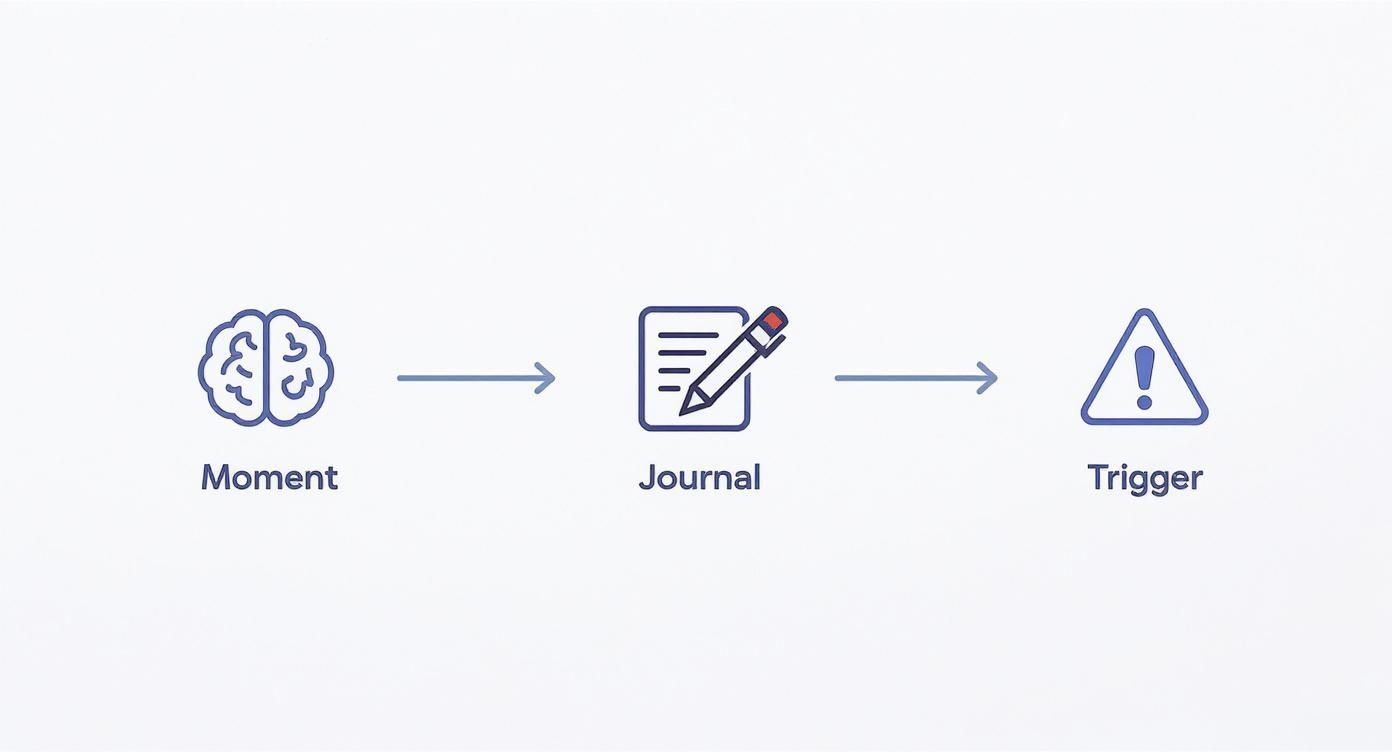
This flow—from in-the-moment experience to quick journaling—is what builds the foundation for a truly data-driven approach to your own personal growth.
Why This Method Actually Works
The Insight-Action Review is so effective because it taps directly into how our brains learn and adapt. Research from the Proceedings of the National Academy of Sciences points to the power of “retrieval practice”—actively recalling and analyzing information—to cement learning. By reviewing your weekly notes, you’re strengthening your self-knowledge and making it easier to access in the heat of the moment.
A study in Perspectives on Psychological Science reinforces this by showing that self-reflection is a crucial component of learning from experience. It’s the process of deliberately reviewing events that consolidates knowledge and improves future performance. This isn’t just a fad; it’s a major cultural shift. If you’re curious, you can explore more about the future of wellness trends and see how self-awareness fits into this bigger picture.
By setting aside just a little bit of time each week for this structured reflection, you create a powerful feedback loop for growth. It ensures your journey to increase self awareness is both intentional and incredibly impactful.
Using 9D Breathwork for Deeper Insights

Daily check-ins and weekly reviews are fantastic for building conscious self-awareness. They help you observe your patterns from the outside in, like a detective gathering clues. But sometimes, the biggest breakthroughs—the deep-seated “why” behind your stress, anxiety, or that feeling of being stuck—are buried just out of reach of your conscious mind.
This is where we need to go a level deeper.
To access these layers, you need a tool specifically designed to quiet the constant chatter of your analytical brain. This is exactly what 9D Breathwork was created for. It’s a powerful method that guides you into a state where profound insights can finally surface on their own.
It’s more than just observing your thoughts; it’s a multi-sensory experience. By blending specific breathing techniques with sound, music, and guided vocal prompts, it opens up a unique pathway to your subconscious mind. This is how you can finally get to the root of those stubborn patterns that conscious reflection alone just can’t seem to crack.
How 9D Breathwork Bypasses the Analytical Mind
Your conscious mind is brilliant at what it does—analyzing, planning, and solving problems. But it’s also a master defender of your ego. It rationalizes behaviors and keeps painful memories or limiting beliefs safely locked away. This internal “gatekeeper” is often the very thing preventing you from seeing what’s truly driving your actions.
9D Breathwork uses a unique combination of elements to gently guide you past this gatekeeper:
- Guided Breathing: Specific, rhythmic breathing patterns shift your physiological state almost immediately, calming your nervous system and changing your brainwave activity. This process naturally quiets the analytical mind, making space for deeper awareness.
- Binaural Beats: These are special auditory tones, played at slightly different frequencies in each ear, that your brain perceives as a single, pulsating beat. A 2018 study in PLoS One found that binaural beats can literally guide your brainwaves into specific states, like the theta state, which is associated with deep meditation, creativity, and subconscious processing.
- NLP and Hypnotic Prompts: We use carefully crafted vocal guidance and principles from Neuro-Linguistic Programming (NLP) to help you reframe old stories and limiting beliefs. These prompts work directly with the subconscious, planting seeds for new, more empowering perspectives.
This powerful combination creates a safe and structured container for introspection. It’s not about forcing insights; it’s about creating the perfect conditions for them to emerge on their own terms.
Uncovering the Why Behind Your Patterns
Let’s imagine a successful professional who, despite her achievements, carries a constant, nagging sense of career dissatisfaction. She journals and does her weekly reviews, noting her feelings of frustration, but she just can’t pinpoint the source. The “why” remains just out of reach.
During a 9D Breathwork session, the structured breathing begins to quiet her relentless inner critic. The music and binaural beats help her mind drift into a more receptive, almost dreamlike state. A guided prompt about self-worth suddenly triggers a long-forgotten memory from her childhood—a moment where she was made to feel that her value was tied directly to her accomplishments.
In that moment, the insight isn’t just an intellectual idea; it’s a felt experience. She connects her current pattern of overworking and dissatisfaction directly to that core belief formed decades ago. This is the kind of breakthrough that can change everything.
This shows how breathwork is so much more than a relaxation technique. Research from a 2017 study in Frontiers in Psychology confirmed that controlled breathing practices can significantly influence our emotional processing and cognitive functions, helping us access and regulate deep-seated emotional responses.
For anyone new to this world, understanding the essentials of guided breathwork can give you a great foundation for what to expect and how to get started.
Integrating 9D Breathwork into Your Routine
You don’t have to ditch your existing self-awareness practices. Think of 9D Breathwork as a powerful amplifier—a deep dive you can take periodically to accelerate your progress and uncover insights that other methods simply can’t touch.
Here’s a simple, practical way to weave it into your life:
- Start Monthly: To begin, dedicate time for one 9D Breathwork session per month. Treat it just like your weekly review—a non-negotiable appointment with yourself for your own growth.
- Set an Intention: Before you start, reflect on a recurring theme from your journal or trigger log. Your intention might be something like, “I want to understand the root of my fear of public speaking,” or “I want to explore what’s behind my feelings of professional unfulfillment.”
- Journal Immediately After: The moment the session ends, grab your journal and spend 10-15 minutes writing down everything that came up—images, feelings, memories, phrases. Don’t analyze it yet. Just get the raw data down on paper.
- Connect to Your Weekly Review: Use the insights from your breathwork session to supercharge your next Insight-Action Review. The “why” you uncovered can lead to a much more targeted and effective “action” for the week ahead.
For example, after our professional uncovered her core belief about achievement, her “Action” for the week might shift from something generic like “Take more breaks” to something truly profound, like “Practice acknowledging one personal quality I value that has nothing to do with my work.”
This approach creates a beautiful synergy between your conscious and subconscious work. Your daily practices build the foundation, and periodic deep dives with 9D Breathwork provide the breakthroughs that propel you forward. This is how you ensure your growth isn’t just incremental, but truly deep and lasting.
Navigating Common Roadblocks on Your Journey
Building self-awareness is a practice, not a perfect science. The journey is less like a straight line and more like a winding path with inevitable bumps. Expecting a flawless process is actually the fastest way to get discouraged.
Real progress in how to increase self awareness means anticipating the common roadblocks and having a strategy ready before they appear.
This is your troubleshooting guide for staying on track when motivation dips or the process just feels hard. We’ll tackle the three most common barriers that can derail your progress and give you practical, actionable ways to navigate each one.
The Fear of Confronting Weaknesses
One of the first and biggest hurdles is the fear of what you might find. It’s completely natural to worry about uncovering weaknesses, insecurities, or past mistakes.
Our brains are wired to protect us from discomfort, and looking at our own flaws is often deeply uncomfortable. This fear can lead to avoidance, where you go through the motions of journaling without ever digging into the really meaningful stuff.
A 2013 study in the Journal of Personality and Social Psychology highlighted that people often dodge self-reflection because it can threaten their self-concept. Confronting a weakness can feel like admitting failure—something many high-achievers are conditioned to avoid at all costs.
To combat this, try a ‘strengths-first’ review. Before you dive into your Emotional Trigger Log or analyze a difficult moment, start by writing down three things you handled well that day. This simple act grounds you in a state of competence and self-respect, making it psychologically safer to then explore areas for growth.
Here’s an actionable example:
Before reviewing a trigger where you felt insecure in a meeting, you might first acknowledge:
- “I communicated my point clearly in the morning brief.”
- “I successfully managed my time to meet a tight deadline.”
- “I offered helpful feedback to a colleague.”
This approach reframes the entire exercise from one of fault-finding to one of balanced self-assessment.
The Trap of Over-Analyzing
The second major roadblock is getting stuck in your head. This happens when you start analyzing your feelings from a distance instead of actually feeling them.
You might spend an hour intellectually dissecting why you felt anxious, turning it into a complex mental puzzle, but completely disconnecting from the physical sensation of the anxiety itself. This is a subtle, sneaky form of avoidance.
Thinking about an emotion is not the same as experiencing it. A study in Social Cognitive and Affective Neuroscience found that simply labeling our emotions (affect labeling) can reduce the activity in the amygdala, the brain’s fear center. This suggests that connecting with the feeling, rather than just theorizing about it, is key to regulation.
The next time you do a check-in, shift your focus from your thoughts to your body. Instead of asking “Why do I feel this way?”, ask “Where do I feel this in my body?”
Is it a tightness in your chest? A knot in your stomach? A buzzing in your hands? By grounding the emotion in a physical sensation, you move out of the analytical mind and into direct experience. This allows you to process the feeling and let it move through you, rather than letting it swirl endlessly in your head.
The Challenge of Inconsistency
Finally, the most common momentum-killer is inconsistency. You start strong, journaling every day and doing your weekly review, but then a busy week hits. You miss a day, and suddenly the whole habit falls apart.
This “all-or-nothing” mindset is a trap that keeps so many people from making long-term progress.
The solution is a powerful behavioral psychology technique called ‘habit stacking’. The concept, popularized by James Clear in Atomic Habits, involves linking your new self-awareness practice to an existing, firmly established habit.
Your brain loves efficiency. Piggybacking a new behavior onto an old one requires less willpower and makes it feel almost automatic.
- Instead of: “I’ll do my One-Sentence Journal sometime tonight.”
- Try This Action: “Right after I pour my first cup of coffee in the morning, I will open my notebook and write my One-Sentence Journal entry.”
The coffee is the trigger for the new habit. The key is to be specific. Link your new practice to something you already do without fail every single day. This makes consistency feel effortless, turning your self-awareness journey from a chore into a seamless part of your daily rhythm.
Got Questions About Self-Awareness? You’re Not Alone.
Whenever you start a journey like this, questions are going to pop up. That’s a good thing. It means you’re engaged and thinking critically about how this all works. Let’s tackle some of the most common ones I hear so you can move forward with confidence.
Probably the biggest question on everyone’s mind is: how long until I actually feel a difference?
The honest answer? Self-awareness isn’t a one-and-done deal with a clear finish line. You’ll likely notice small, subtle shifts almost right away—like catching yourself in a negative thought loop before it completely takes over your afternoon. The bigger, more profound changes, like fundamentally rewiring how you respond to stress instead of just reacting to it, often take a few months of consistent effort.
A fascinating 2018 study in Frontiers in Human Neuroscience found that even short-term mindfulness training can create noticeable changes in the brain’s structure and function, particularly in areas tied to attention and emotional regulation. Think of it like going to the gym. You feel a little stronger after each workout, but the really visible transformation happens over time.
“I’m Way Too Stressed to Do This Right Now”
I get it. It’s the ultimate paradox: the moments you need these tools the most are the exact moments they feel impossible to use. When you’re completely overwhelmed, the goal isn’t a perfect, serene meditation session. The goal is just to be present, even if it’s only for sixty seconds.
Forget the 20-minute reflection when your mind is racing. Take this practical action instead:
- The 60-Second Grounding: Just pause. Name three things you can see (your monitor, a coffee cup, a window). Name two things you can physically feel (the chair under you, your feet on the floor). Name one thing you can hear (the hum of the computer). This simple act yanks your brain out of its anxiety spiral and back into the real world.
- Tune Into Your Body: When you’re stressed, your body is screaming for attention. Where are you holding it? A clenched jaw? Tense shoulders? A knot in your stomach? Just noticing the physical sensation, without judging it or trying to fix it, can immediately dial down its intensity.
The point isn’t to magically erase stress from your life. It’s to change your relationship with it. Self-awareness creates a tiny sliver of space between a trigger and your reaction. In that space, you find the power to choose a better response.
Is Something Like 9D Breathwork Actually Safe?
It’s a fair question. Any practice designed to be powerful, like 9D Breathwork, deserves a healthy dose of respect and curiosity about safety. The short answer is yes, it’s a potent and safe method for most people when practiced correctly. The entire experience uses guided breathing patterns to intentionally shift your physiological state, which can unlock some incredibly profound emotional and physical releases.
A 2019 review published in the Journal of Alternative and Complementary Medicine backed this up, highlighting breathwork’s huge therapeutic potential. But it also stressed the importance of doing it in a guided setting, especially when you’re just starting out. The very structure of 9D Breathwork—with its carefully curated musical journeys and vocal guidance—is designed to create a secure container for your experience, making sure you feel supported from the moment you start to the moment you finish.
Ready to move past just thinking about it and actually experience the deep insights waiting for you? At 9D Breathwork, we guide you past the noise of your analytical mind to uncover the real roots of your patterns.
Explore our guided journeys and discover how you can start rewiring your inner world today.