That constant feeling of dread before a Monday morning meeting? The knot in your stomach that just won’t go away? That’s not just “part of the job.” The first real step to managing work anxiety is admitting that to yourself.
It’s about pinpointing what’s actually causing it—maybe it’s your workload, maybe it’s a specific team dynamic—and then connecting the dots to how it’s showing up in your mind and body. Once you see that connection, you can start building a real, practical strategy to find relief.
What Work Anxiety Really Looks and Feels Like
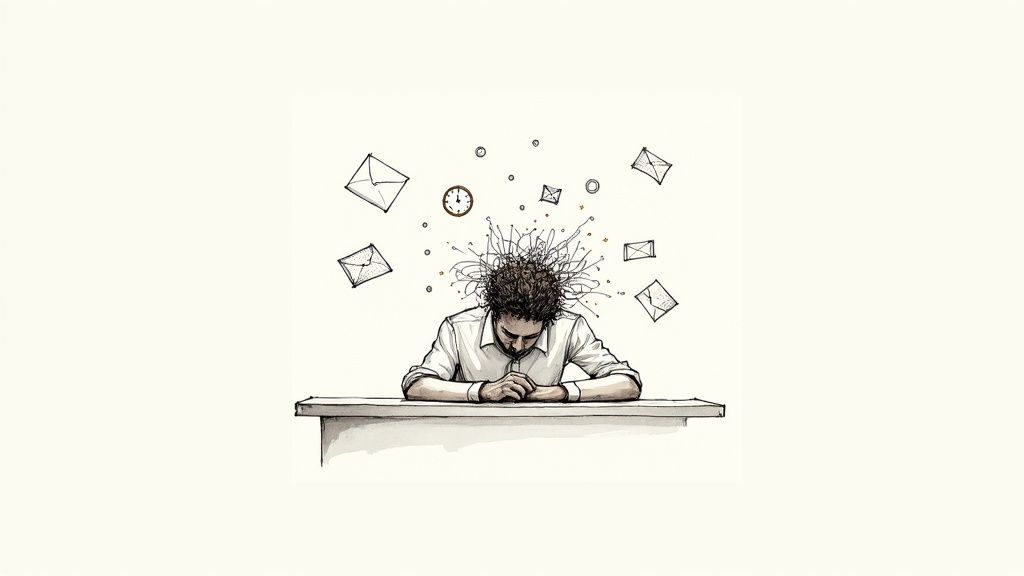
It’s so easy to mistake everyday work stress for something deeper. Stress is usually a short-term reaction to a specific challenge, like a big deadline. You push through, you get it done, and the pressure eases.
Anxiety is different. It sticks around. It’s that persistent sense of unease or fear that lingers, even after the immediate threat is gone. Research published in the Journal of Anxiety Disorders highlights that chronic workplace anxiety can lead to significant impairments in job performance and overall well-being, distinguishing it from transient stress.
And this feeling isn’t just in your head. It has a massive real-world impact. In the UK, mental health-related absences cost the economy an estimated £21.6 billion every single year. Just last year (2022/23), around 875,000 workers were dealing with work-related stress, depression, or anxiety, which led to a jaw-dropping 17.1 million lost working days. If you want to dig into the numbers, you can learn more about the widespread impact of workplace mental health from recent statistics.
Pinpointing Your Anxiety Triggers
The only way to start managing your anxiety is to figure out what is fueling it. Triggers are deeply personal, of course, but they often fall into a few common buckets. Recognizing yours is how you go from feeling completely overwhelmed to taking proactive steps to fix the root cause.
Actionable Step: For one week, keep a simple “Anxiety Log.” At the end of each day, write down any moments you felt anxious. Note what you were doing, who you were with, and what you were thinking. This isn’t for judgment; it’s for data collection. By the end of the week, you’ll have a clear, actionable map of your personal triggers.
Common Work Anxiety Triggers And Their Symptoms
This table can help you quickly connect the sources of your anxiety with the physical or emotional signs you might be experiencing.
| Anxiety Trigger | Common Symptoms |
|---|---|
| Excessive Workload | Chronic fatigue, irritability, trouble sleeping, feeling overwhelmed. |
| Lack of Control | Apathy, low motivation, feeling trapped, increased cynicism. |
| Difficult Interpersonal Dynamics | Social withdrawal, digestive issues, dreading work, constant worrying. |
| Job Insecurity | Headaches, muscle tension, difficulty concentrating, catastrophizing. |
Look for patterns. Does your stomach start churning every time you get an email from a particular manager? Do you get tension headaches at the end of a week filled with impossible deadlines? These are the clues that tell you where to focus your energy.
How Anxiety Shows Up Physically and Emotionally
Work anxiety isn’t just a mental state; it’s a full-body experience. It can have very real, very physical effects that create a feedback loop that’s tough to escape.
Think about a project manager—we’ll call her Sarah. She started getting heart palpitations and shortness of breath right before her weekly team check-ins. For weeks, she just wrote it off as stress. But then she noticed a pattern: the physical symptoms only flared up when she was afraid of being unprepared or getting called out in front of everyone.
Anxious thoughts trigger a very real physical stress response. Your brain doesn’t know the difference between an imagined threat and a real one, leading to things like insomnia, stomach problems, and even panic attacks.
Once Sarah made that connection, she stopped blaming herself for having a physical reaction. Instead, she started looking for ways to handle her performance anxiety—the real root of the problem.
Understanding this link between your thoughts and your body is the first truly actionable step you can take toward getting back in control.
Actionable Techniques to Find Calm Right Now

Your heart is pounding minutes before a big presentation. A harsh email just landed in your inbox, and your thoughts are starting to race. In moments like these, you need something that works right now.
Long-term strategies are crucial, but having a toolkit for the here-and-now can stop anxiety from spiraling out of control.
These techniques are simple, discreet, and effective. You can do them right at your desk to regain a sense of control without anyone even noticing. The whole point is to interrupt the anxiety cycle before it really takes hold.
Ground Yourself with the 5-4-3-2-1 Method
Anxiety loves to pull us into a vortex of what-if worries about the future or cringey replays of the past. The 5-4-3-2-1 grounding technique yanks your focus back to the present moment by forcing you to engage your senses. It’s a beautifully simple, structured practice you can do absolutely anywhere.
Here’s the breakdown:
- See 5 things: Look around and mentally name five objects. Don’t just list them; notice their color, shape, or texture. My blue coffee mug, the wood grain on the desk, the little green plant in the corner.
- Feel 4 things: Shift your awareness to physical sensations. Notice four things you can feel, like the cool, smooth surface of your keyboard, the fabric of the chair against your back, your feet planted firmly on the floor.
- Hear 3 things: Listen intently and pick out three distinct sounds. It might be the low hum of your computer, the distant sound of traffic, the quiet ticking of a clock.
- Smell 2 things: Tune into two scents in your environment. Maybe it’s the faint aroma of coffee or the clean, papery smell of your notebook.
- Taste 1 thing: Focus on one thing you can taste. This could be as subtle as the lingering taste of toothpaste, a sip of water, or the last hint of your lunch.
This sensory scan forces your brain to pivot away from anxious thoughts and reconnect with your immediate, tangible surroundings. A 2021 study published in the journal Mindfulness found that brief mindfulness-based interventions like grounding significantly reduce acute anxiety by improving emotional regulation skills.
Grounding isn’t about pretending your anxiety doesn’t exist. It’s about dropping an anchor in the present moment so the anxiety doesn’t sweep you away.
Regulate Your Nervous System with Box Breathing
Controlling your breath is one of the most direct ways to control your body’s anxiety response. There’s a reason first responders and elite athletes use techniques like box breathing to stay calm under intense pressure—it works directly on the nervous system.
You can do this simple exercise discreetly while sitting at your desk, in the bathroom stall, or even during a meeting (with your camera off, of course). The structure is incredibly easy to remember.
- Start by slowly exhaling all the air from your lungs.
- Inhale gently through your nose for a count of four.
- Hold your breath for a count of four.
- Exhale slowly through your mouth for a count of four.
- Hold at the bottom for another count of four.
Repeat this cycle for a minute or two. The deliberate, even pace helps slow your heart rate and sends a powerful signal to your brain that you’re safe, effectively hitting the brakes on that fight-or-flight response.
There are many other breathing exercises to lower your heart rate you can explore: https://9dbreathwork.com/breathing-exercises-to-lower-heart-rate/
For a more profound sense of calm, especially if you deal with chronic stress, exploring therapeutic approaches like deep pressure therapy for anxiety can also be a game-changer.
Building a Resilient Mindset Day by Day
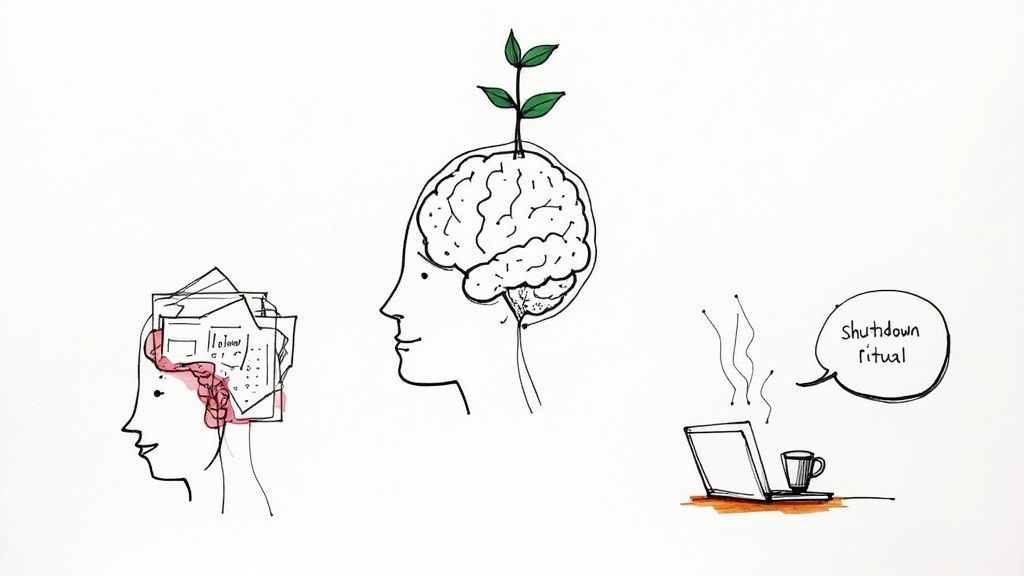
While having techniques to calm down in the moment is crucial, the real game-changer is building long-term resilience. Think of it as preventative maintenance for your mind. It’s about creating small, consistent habits that strengthen your mental foundation, making you far less vulnerable to the daily grind and pressures of work.
This proactive approach is how you get ahead of anxiety. Instead of constantly putting out fires, you’re cultivating a calmer, more stable state of mind from the get-go.
Reframe Your Inner Critic
Let’s be honest, that negative voice in our heads can be a huge driver of work anxiety. Anxious thoughts love to disguise themselves as hard facts: “I’m going to totally bomb this presentation,” or “Everyone on the team thinks I’m incompetent.” The trick is to stop taking them at face value.
This is where cognitive reframing—a cornerstone of cognitive behavioral therapy—comes in. It’s the practice of actively challenging and changing these destructive thought patterns.
Actionable Step: Grab a notebook and create two columns: “Anxious Thought” and “Balanced Reframe.” The next time an anxious thought pops up, write it in the first column. Then, in the second, challenge it by asking:
- What’s a more realistic or compassionate way to see this?
- What actual evidence do I have for this thought?
- What would I say to a friend in this exact situation?
For instance, if your inner critic screams, “I’m going to get fired for that mistake,” a reframe might sound like, “I made a mistake, and I’ll own it. This is actually a chance for me to learn and show I can solve problems.” You’re not ignoring the issue; you’re turning a potential catastrophe into a constructive action.
Create a ‘Shutdown Ritual’ to Set Boundaries
One of the biggest culprits behind work anxiety is the inability to mentally “clock out.” When work bleeds into your personal time, your brain never gets a real break to rest and recharge. A shutdown ritual is a powerful tool to prevent this. It’s a simple, consistent sequence of actions you do at the end of each workday to signal that it’s time to disconnect.
Your ritual doesn’t have to be complicated. It could be something as simple as:
- Plan: Spend 5 minutes reviewing your to-do list and prioritizing your top 3 tasks for the next day. This prevents morning overwhelm.
- Disconnect: Close all work-related tabs, applications, and email on your computer. Turn off notifications on your phone.
- Declare: Say a specific phrase out loud, like “Work is done for the day.”
- Transition: Do one small non-work activity immediately, like changing clothes, making a cup of tea, or listening to one song.
This routine creates a clear psychological line in the sand between your professional and personal life. Studies published in the Journal of Applied Psychology show that mentally detaching from work is absolutely essential for recovering from job stress and preventing burnout. By being consistent, you train your brain to switch off, which helps stop those evening anxiety spirals that keep you mentally chained to your job.
The inability to disconnect is a huge problem. Globally, 12 billion working days are lost each year due to depression and anxiety, and a staggering 60% of employees feel emotionally detached at work. Creating these small boundaries is a powerful way to reclaim your personal time. You can learn more about the scale of workplace mental health challenges from Spill.
Building a resilient mindset also means mastering your reactions in the heat of the moment. For a deeper dive into this, check out these powerful emotional regulation strategies to better manage your responses to workplace stress: https://9dbreathwork.com/emotional-regulation-strategies/
Your physical and digital spaces have a massive, often underrated, impact on your mental state. Think about it: a cluttered desk or an inbox bursting at the seams creates a constant, low-grade hum of anxiety that follows you all day.
The good news? You have more control here than you think. Making a few small, deliberate changes to your environment can genuinely dial down your daily stress. It’s about taking back control where you can, and your workspace is a powerful, tangible place to start.
Tame Your Digital Workspace
That relentless barrage of notifications? An inbox that never seems to empty? It can trigger a full-blown stress response before you’ve even had your morning coffee. There’s even a term for it: “telepressure,” the compulsive need to respond to messages immediately, and it’s a fast track to burnout.
So, let’s build a better system.
Actionable Step: Dedicate 15 minutes today to set up email filters. Create a simple rule in your email client that automatically moves newsletters or non-urgent company-wide updates into a “Read Later” folder. Then, go into your chat apps like Slack or Microsoft Teams and customize your notification settings. Mute all channels except those for your direct team or where you are specifically mentioned. This single action can reclaim hours of your focus.
Master the Art of Assertive Communication
The inability to say “no” is a huge source of anxiety at work. We get so caught up in worrying about looking unhelpful or not being a team player that we overload ourselves. But here’s the thing: setting boundaries isn’t a personal failing—it’s a core professional skill.
It all comes down to clear, respectful communication.
Imagine your manager drops a new project on your desk when you’re already swamped. Instead of a flat “no,” which can feel confrontational, try a more collaborative script:
“Thanks for trusting me with this. Right now, my main priorities are Project X and Y, and I want to make sure I deliver high-quality work on them. To take on this new project, I’d need to shift focus from one of them. Could we talk about which one should be deprioritized?”
See the difference? You’re not refusing the work. You’re simply highlighting the reality of your current workload and turning the conversation into a strategic discussion about resource management. For more on this, check out our guide to workplace stress management strategies.
Declutter Your Physical Desk
The connection between physical clutter and mental clutter is real. A messy desk constantly competes for your brain’s attention, making it harder to focus and fueling that feeling of being overwhelmed.
Actionable Step: Set a recurring calendar reminder for a 5-minute “desk reset” at the end of each day. You don’t need a perfectly sterile, minimalist setup. Just create a simple system:
- Have a dedicated home for your notebook and pens.
- Use a simple file organizer for any stray papers.
- Wipe down your desk surface.
This small habit dramatically reduces visual distractions and allows you to start the next day with a clearer, calmer mind. With 79% of UK employees reportedly experiencing burnout and over half of workers in large companies worried about being seen as underperforming, the pressure is immense. A tidy workspace is one less thing for your brain to process and one small win in a world of overwhelming demands.
Navigating Conversations and Seeking Support
Recognizing you need a hand and actually asking for it is a massive sign of strength. If the tough days are starting to outnumber the good ones, it might be time to start a conversation. The real key is knowing how to approach it without it feeling like a complaint.
This is all about calmly and clearly explaining what’s going on so you can get the support you need. Knowing how to frame this conversation can turn a really stressful situation into a collaborative one.
How to Talk to Your Manager or HR
Bringing up mental health at work can feel incredibly intimidating. The goal here is to walk in prepared, professional, and focused on solutions. You absolutely don’t have to share every single detail, but giving them some context helps them understand how they can actually help you.
Actionable Step: Before scheduling a meeting, create a simple script. Write down 2-3 bullet points covering:
- The Situation: (e.g., “The current project timelines are impacting my ability to focus.”)
- The Impact: (e.g., “This is causing me significant stress and I’m concerned about burnout.”)
- The Proposed Solution: (e.g., “Could we discuss re-prioritizing tasks or adjusting the timeline?”)
Having this prepared helps you stay on track and communicate clearly, even if you feel nervous.
Here are a few ways you could phrase it:
- “I’ve been feeling pretty overwhelmed lately, and it’s starting to mess with my focus. I’m totally committed to my work, so I was hoping we could chat about managing my current workload to make sure I’m still delivering my best.”
- “The tight deadlines on Project X have been a major source of stress for me. Could we maybe look at the timeline together and see if there’s any wiggle room?”
- “I want to be upfront about my capacity right now. I’m dealing with some anxiety that’s hitting my productivity, and I’d really appreciate it if we could explore some of the company’s resources, like the EAP.”
The unfortunate truth is that a stigma still hangs around these conversations. A study from Mind Share Partners revealed that while 76% of U.S. workers had symptoms of a mental health condition, only 42% felt comfortable enough to talk about it at work. Your courage in speaking up is exactly what helps break down that barrier. You can find more insights on the connection between mental health and the workplace in recent reports.
Demystifying Professional Help
If your work anxiety just won’t let up, getting professional support can give you a toolkit of targeted strategies to cope. A lot of companies offer resources you might not even know exist, designed for exactly these kinds of challenges.
This decision tree gives you a simple way to think about what kind of changes might help you start getting a handle on work anxiety.
As the visual shows, tackling anxiety often means dealing with both digital and physical stressors—two key areas where you can start to regain a sense of control.
Here are a few common routes for professional support:
- Employee Assistance Programs (EAPs): Many companies offer these confidential programs. They typically provide short-term counseling, referrals, and other mental health services completely free of charge. Actionable Step: Search your company’s intranet for “EAP” or “Employee Assistance Program” today, just to see what’s available. Knowing the resource exists is the first step.
- Cognitive Behavioral Therapy (CBT): This is one of the most effective therapies for anxiety, hands down. A therapist helps you pinpoint and challenge the negative thought patterns and behaviors that are fueling your anxiety, giving you practical skills that last a lifetime. A 2018 meta-analysis published in JAMA Psychiatry confirmed its high success rate in treating anxiety disorders.
- Specialized Therapists: You can also find therapists who specialize in workplace stress, burnout, and career anxiety. Their focused expertise can provide incredibly relevant and effective guidance for what you’re going through.
Remember, seeking professional help isn’t giving up; it’s a proactive investment in yourself. It gives you the tools not just to get by, but to actually thrive.
Your Questions on Work Anxiety Answered
Let’s be real—even with the best strategies, navigating work anxiety can throw some serious curveballs. You’re not alone in feeling uncertain when a tricky situation pops up.
Here, we’re going to tackle some of the most common questions head-on with direct, no-fluff answers to help you feel more confident and in control.
Can I Get Fired for Having Anxiety?
This is a huge one, and the fear is completely valid. The short answer is, generally, no. You can’t be fired just for having an anxiety disorder.
In many countries, like the U.S. under the Americans with Disabilities Act (ADA), anxiety can be classified as a disability if it significantly impacts major life activities. This isn’t a label to fear; it’s a protection.
It means your employer is legally required to provide “reasonable accommodations” to help you do your job. This could look like:
- A more flexible or modified work schedule.
- Permission to take short breaks for a quick breathing exercise.
- A desk in a quieter part of the office to minimize overwhelm.
The trick is to frame the conversation around your performance needs, not just a diagnosis. It’s about what helps you work best.
How Do I Handle Anxiety About Job Insecurity?
The constant worry about layoffs or company changes is absolutely draining. This kind of “anticipatory anxiety” can feel just as real and threatening as the event itself.
The most powerful thing you can do here is to pull your focus back from what you can’t control (like corporate decisions) to what you absolutely can control.
A resilient mindset shifts from “Why me?” to “Why not me? I’ve found jobs before, and I can do it again.” Losing one job doesn’t define your future career path.
Actionable Step: Instead of getting sucked into a vortex of bad news, take one small, proactive step. Block out just 15 minutes in your calendar this week. Use that time to update a section of your resume, send one message to a contact on LinkedIn, or watch a short tutorial on a new skill. This small action shifts you from a passive worrier to an active agent in your career. A 2017 study in the Journal of Vocational Behavior confirmed that proactive career behaviors, like networking and skill development, significantly reduce the stress associated with job insecurity by increasing one’s sense of control.
What if My Boss Is the Source of My Anxiety?
This is a tough one, and it’s unfortunately all too common. When your direct manager is the primary trigger, a big confrontation is almost never the right first move.
Start by quietly documenting specific instances. Jot down the what, when, and where of the behavior that’s causing you stress. The goal here isn’t to build a legal case—it’s to give yourself clarity on the patterns.
Once you see the patterns, you can start setting subtle but firm boundaries. Does your boss email you at all hours? You don’t have to reply instantly. By consistently waiting until the next morning to respond, you’re training them on your availability without saying a word.
Of course, if the behavior is severe or crosses the line into harassment, it’s time to talk to HR. Walk in with your documented examples and calmly explain the impact it’s having on your work.
For a deeper dive into this topic, you can find more strategies to deal with workplace anxiety.
At 9D Breathwork, we believe in getting to the root of these patterns. Our immersive journeys are designed to help you release stored stress and rewire your response to anxiety triggers, providing a powerful tool for building lasting resilience in your professional life. Explore our experiences and start your journey today.