Holotropic Breathwork is a practice where you use accelerated, deep breathing while lying down, usually set to evocative music. The whole point is to enter a non-ordinary state of consciousness for some incredibly deep self-exploration and healing, all within a safe, supportive setting.
What Is Holotropic Breathwork
This isn’t just a simple breathing exercise; it’s a powerful method for psychological healing and personal discovery. The practice itself was developed back in the early 1970s by Dr. Stanislav Grof and his wife, Christina Grof. Their work was born from extensive research into altered states of consciousness, which initially involved LSD-assisted psychotherapy.
When LSD was banned, they needed a non-pharmacological way to help people access those same deep states of the psyche. That search is what led them to create this unique breathwork modality. You can dive deeper into the origins of this powerful technique on BreathlessExpeditions.com.
The name itself tells you a lot about its purpose. “Holotropic” is derived from Greek roots that mean “moving toward wholeness.” And that’s exactly the goal—to integrate the fragmented parts of your inner world and connect with a profound sense of completeness.
The Core Components of a Session
A typical session is a carefully structured experience, not just random deep breathing. The environment is deliberately curated to support a deep inner journey, giving you both the safety and the freedom you need to let go.
Three key elements work in concert to create the experience:
- Accelerated Breathing: The core of the practice is simple: breathe faster and deeper than you normally would, but without straining. Actionable tip: Imagine you are blowing up a balloon with each inhale, filling your belly and chest completely, and then just letting the air fall out on the exhale without pushing.
- Evocative Music: A specially curated musical arc is your guide. The music usually starts gently, builds to an intense, powerful peak, and then gradually tapers off into a calm, meditative state. It acts as a powerful, non-verbal guide that helps shape the emotional terrain of your journey.
- A Safe Setting: This is absolutely non-negotiable. Sessions are held in a supportive environment. Traditionally, participants work in pairs, with one person as the “Breather” (the one doing the breathwork) and the other as the “Sitter” (the one holding space for them).
The whole philosophy is built on trusting the process. Your own “inner healer” is believed to guide the experience, bringing to the surface whatever is most important for your growth and healing at that specific moment in time.
Key Elements of a Holotropic Breathwork Session
To give you a clearer picture, let’s break down the essential roles and components you’ll find in a formal Holotropic Breathwork session.
| Element | Purpose and Description |
|---|---|
| The Breather | This is the person actively doing the breathwork. Their job is to surrender to the process, keep the breath flowing, and allow whatever comes up to unfold without judgment or analysis. |
| The Sitter | A supportive partner whose entire focus is on the Breather’s physical safety and comfort. The Sitter offers a compassionate presence, only helping if asked and never interfering with the Breather’s journey. |
| The Music | A powerful catalyst that helps drive the experience. The playlist is often a dynamic mix of tribal rhythms, classical pieces, film scores, and ambient sounds designed to evoke a full spectrum of emotions. |
| Integration | This is the crucial post-session phase. It often involves creative expression, like drawing a mandala, and sharing with the group to help process and make sense of what you experienced. |
Each of these pieces plays a vital role in creating a container where profound personal work can happen safely and effectively.
Preparing Your Mind, Body, and Space for the Journey
A truly profound Holotropic Breathwork journey hinges on thoughtful preparation. This isn’t just about showing up; it’s about consciously creating the perfect conditions for deep inner work to unfold. The concepts of ‘set’ (your internal mindset) and ‘setting’ (your external environment) are the absolute foundation of the entire experience.
Your preparation starts long before you ever lie down to breathe. It’s a series of intentional choices that signal to your body and mind that you’re creating a safe, dedicated container for whatever needs to arise. By focusing on these elements, you’re essentially building a secure launchpad for your inner exploration.
Cultivating the Right Mindset
How you walk into a session mentally has a massive impact on where you’ll go. The trick is to shift from a mindset of control and expectation to one of open curiosity and deep trust.
A common pitfall I see is people setting rigid, goal-oriented intentions, like “I’m going to fix my anxiety today.” While the desire for healing is completely valid, framing it this way can create resistance if your inner wisdom has a different plan for you. A much more powerful approach is to shape a more open-ended intention.
Here’s how you can reframe your goals for a better journey:
- Instead of: “I need to solve my relationship problems.”
- Try: “I am open to understanding the patterns in my relationships.”
- Instead of: “I want to get rid of this creative block.”
- Try: “I invite my inner healer to show me what is ready to be expressed.”
Action Step: The night before your session, take 5 minutes to write down your intention. Phrase it as an invitation, like “I am open to receiving whatever my inner wisdom has for me.” Keep it simple and place it somewhere you’ll see it in the morning.
Setting an intention is one of the most important parts of the experience. For those looking to learn more about the foundations of this practice, exploring the essentials of guided breathwork can provide valuable context for your journey.
Preparing Your Physical Body
Your body is the vessel for this experience, and getting it ready allows for greater sensitivity and fewer physical distractions. The goal here is to make your body as comfortable and receptive as possible.
Think of it like preparing soil before planting a seed. You want to clear out the weeds and enrich the ground so growth can happen without anything in its way. This means making conscious choices in the 24 hours leading up to your session.
Actionable Body Prep Checklist:
- Eat Lightly: Steer clear of heavy, greasy, or hard-to-digest foods. A full stomach can cause real discomfort and pulls your energy toward digestion instead of your inner process. Try this: A simple salad, a light soup, or a piece of fruit a few hours before the session is ideal.
- Hydrate Well: Drink plenty of water the day before, but don’t chug a huge bottle right before you start.
- Abstain from Stimulants: Stay away from caffeine, nicotine, and other stimulants for at least 24 hours. These can really interfere with your nervous system’s ability to relax and open up.
- Avoid Depressants: It’s just as important to avoid alcohol or other central nervous system depressants. You want to go into this with a clear mind and body.
- Wear Comfortable Clothing: Choose loose, non-restrictive clothing made from soft fabrics. Practical choice: Think yoga pants, sweatpants, and a soft t-shirt—nothing with tight waistbands or zippers.
Creating a Safe and Sacred Space
Your physical environment, your ‘setting,’ should feel like a sanctuary—a place where you can feel completely safe to let go. This space literally holds you while you journey inward, so setting it up is a critical act of self-care.
First and foremost, ensure you will not be disturbed. Turn off your phone, let housemates know you need uninterrupted time, and take care of any potential distractions beforehand. Before diving deep, it’s crucial to prepare your physical space; you might even consider how to effectively remove negative energy from your house to create a truly clear container for your work.
Here are the essentials for your physical setup:
- Comfortable Foundation: Use a thick mat, a mattress on the floor, or several layered blankets. Comfort is key.
- Support Items: Keep extra pillows and blankets nearby. Actionable step: Place one pillow under your knees to relieve lower back pressure and have a warm blanket ready to grab.
- Eye Covering: An eye mask or a soft cloth helps block out light and encourages your focus to turn completely inward.
- The Musical Arc: Your playlist is your guide. A good one will start gently, build to an intense, cathartic peak, and then gradually soften into a period of calm, meditative music for integration.
Mastering the Holotropic Breathing Technique
At its core, Holotropic Breathwork is built on a deceptively simple instruction: breathe faster and deeper than you normally would, connecting the inhale and exhale without any pause. This isn’t the controlled, mindful breathing you might find in meditation. Instead, it’s about building a current of energy and surrendering to a powerful, natural rhythm.
Think of it as circular breathing. Your breath becomes a continuous loop—the moment an inhale ends, the exhale begins, and as soon as you exhale, you immediately draw in the next breath. There’s no holding, no hesitation. It’s a constant, flowing river of air.
This specific style of breathing is what opens the door to non-ordinary states of consciousness, tapping into what proponents call the psyche’s own innate healing intelligence. The practice itself has fascinating roots, born from the cultural and scientific explorations of the 1960s and 70s. When psychedelic research was largely halted around 1970, the creators of this method sought a way to bridge Western psychology with ancient knowledge of the breath. If you’re curious about the full backstory, HolotropicBohemia.eu offers a great overview of its history and development.
The Mechanics of the Breath
So, what does “breathe faster and deeper” actually feel like? Getting the mechanics right will help you settle into the experience with more confidence.
The ideal breath is full, deep, and comes from the diaphragm.
- The Inhale: Your focus is here. Actively draw a deep breath, starting from your belly. Try this exercise: Lie down and place one hand on your belly and the other on your chest. As you inhale, focus on making the hand on your belly rise first, then the one on your chest.
- The Exhale: This part is completely passive. Just relax and let go. Don’t push the air out; simply release it with a sigh and let it fall out of you naturally.
The rhythm will be faster than your everyday breathing, but you should find a pace that feels sustainable. Keep your attention on that full inhale, followed by a totally relaxed exhale, and you’ll find that continuous, circular flow.
Navigating the Phases of a Session
A Holotropic Breathwork session is a journey with a clear beginning, middle, and end, usually guided by a powerful, evocative musical score. Understanding this natural arc can make it easier to surrender to whatever comes up.
This infographic gives a great visual of the foundational steps for getting your mind, body, and space ready for the work ahead.
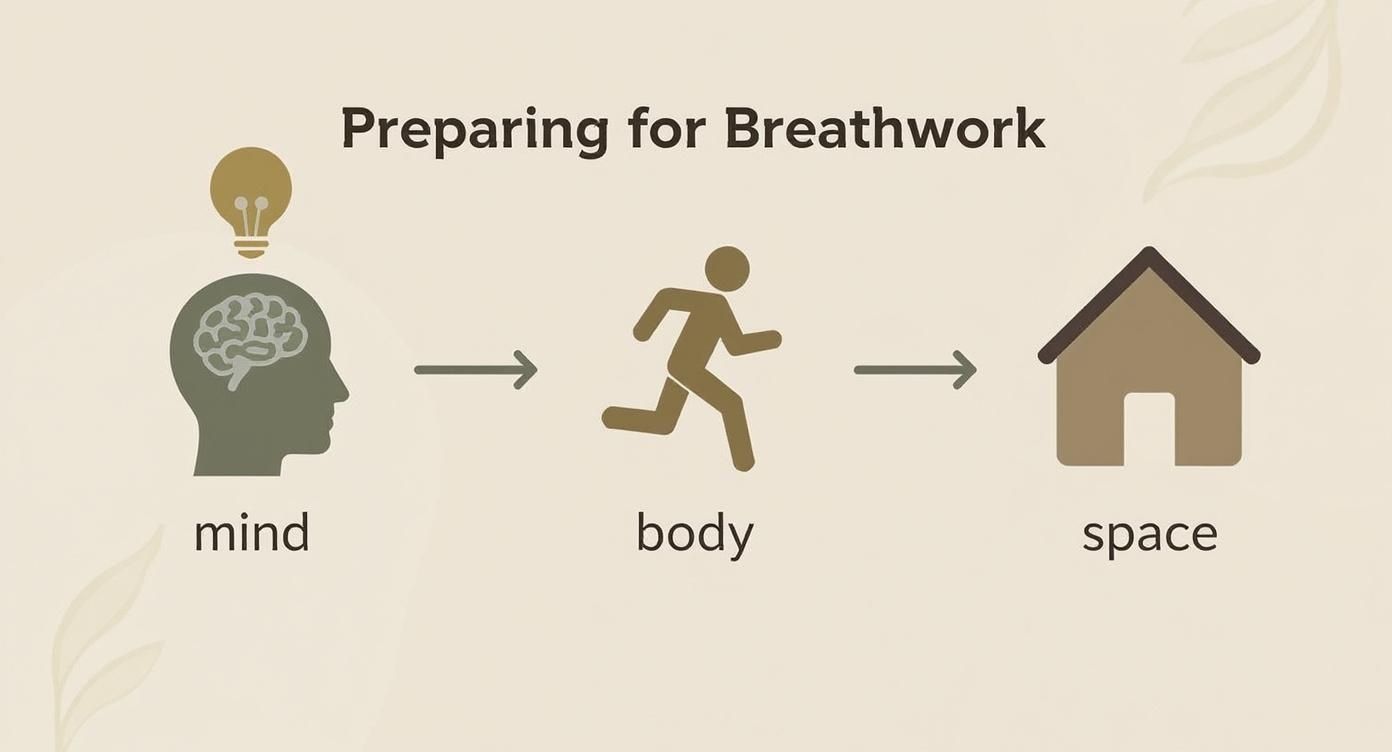
As you can see, preparing your internal state and your physical environment is just as important as the breathing itself.
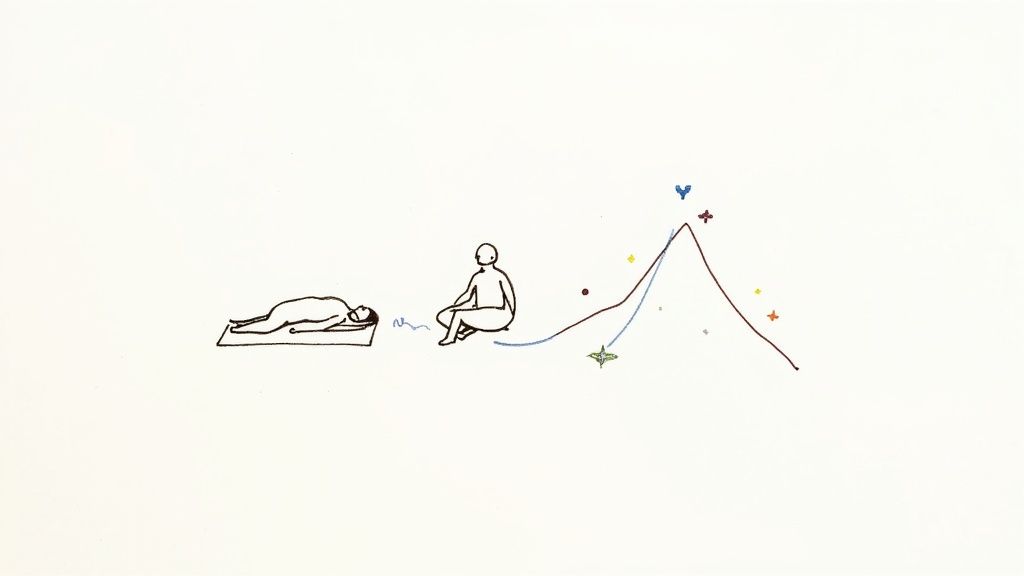
Once the music starts, the session typically unfolds like this:
- Acceleration: As the music begins, you’ll consciously ramp up your breathing, finding that circular rhythm. This initial phase is all about building energy in the body and helping the chattering, analytical mind take a backseat.
- The Peak Experience: The music intensifies, and so does the inner journey. This is often where you might encounter strong emotions, forgotten memories, powerful physical releases, or symbolic, archetypal visions. The work here is simple but not always easy: just keep breathing through whatever arises.
- Gentle Return: After the peak, the music shifts to a much softer, more meditative tone. Your breathing will naturally slow down, guiding you into a state of deep relaxation. This is a critical time for integration, a quiet space where insights can settle and your body can rest.
The most important thing to remember is to trust the process. There is no “right” or “wrong” way for a session to unfold. Actionable mantra: If your mind starts analyzing, gently repeat to yourself, “Just breathe. Trust the process.”
Understanding Common Physical Sensations
As you breathe, your body will respond. The accelerated breathing changes the chemistry in your blood, which can lead to a wide range of physical sensations. Knowing these are normal can help you meet them with curiosity rather than fear.
Many people experience:
- Tingling or Vibrations: A very common feeling, often in the hands, feet, or face. It’s a harmless side effect of the shifting CO2 levels in your body.
- Temperature Fluctuations: You might suddenly feel very hot or intensely cold. This is why having blankets nearby is always recommended.
- Tetany (Clawing of Hands): Sometimes, muscles in the hands, feet, or even around the mouth can cramp up and feel stiff. It might feel strange, but it’s a temporary physiological reaction. In a facilitated session, bodywork can help, but often just breathing into the sensation allows it to release on its own.
- Emotional and Physical Release: Don’t be surprised if you feel a sudden urge to cry, laugh uncontrollably, shout, or move your body in a spontaneous way. These are all welcome expressions and are considered part of the healing.
When you know what to expect, you can reframe these sensations. They aren’t problems to be fixed; they’re signs that the process is working. Your body is simply releasing stored energy, and your only job is to allow it to happen.
How to Navigate Your Inner Journey Safely
When you’re preparing to explore the deep, powerful states Holotropic Breathwork can open up, your safety is the absolute priority. This isn’t just a deep relaxation exercise; it’s an intense journey into your psyche that demands a stable physical and psychological foundation.
Before you even think about the breathing technique, you first have to figure out if this practice is right for you. Understanding and respecting the contraindications is the most critical first step. This isn’t about gatekeeping—it’s about acknowledging the physiological and psychological intensity of the work.
When to Avoid Holotropic Breathwork
Because this practice involves significant changes in your body’s chemistry and can bring powerful, unprocessed emotions to the surface, it is not recommended for everyone. Think of it like preparing for a marathon; you’d want to make sure your body is truly up for the challenge.
Key Contraindications to Consider:
- Cardiovascular Issues: A history of heart attack, severe or uncontrolled hypertension, angina, or other serious heart conditions. The accelerated breathing puts a real strain on the cardiovascular system.
- Glaucoma or Retinal Detachment: The practice can increase pressure inside the eyes, which poses a risk.
- Recent Surgery or Injury: If your body is still in a fragile healing state, the intense physical and emotional releases can be too much.
- Severe Mental Illness: Conditions like a history of psychosis, bipolar disorder, or schizophrenia can be destabilized by plunging into non-ordinary states of consciousness.
- Epilepsy or Seizure Disorders: The physiological shifts from this style of breathing could potentially trigger seizures.
- Pregnancy: Due to the physical intensity and powerful emotional shifts, this practice is not advised for pregnant women.
Action Step: Review this list honestly. If you have any of these conditions, your next action is to consult with your physician and discuss this specific practice with them before proceeding. This is a non-negotiable step for your safety.
Facilitated Group Session vs Solo Practice
Once you’ve determined you’re a good candidate, the next major safety consideration is how you practice. The environment you choose will profoundly shape your experience, especially when you’re just starting out. Our firm recommendation? Always begin with a trained professional.
Learning how to do Holotropic Breathwork is so much safer and more effective within a professionally held space. A trained guide knows exactly how to create a secure container, manage any challenges that come up, and help you make sense of it all afterward. You can search for qualified breathwork facilitators near you to find a safe starting point.
To really see the difference, let’s compare the two main approaches.
Facilitated Group Session vs Solo Practice
This table breaks down the key differences in support and safety between a professionally guided session and a solo journey at home.
| Feature | Facilitated Group Session | Solo Practice (with a Sitter) |
|---|---|---|
| Expert Guidance | A trained professional provides structure, holds the space, and offers support or bodywork if needed. | Relies entirely on the knowledge of you and your sitter, who may lack professional training. |
| Safety Container | The facilitator is experienced in handling a wide range of intense emotional and physical releases safely. | Safety depends on the sitter’s ability to remain calm and non-intrusive while ensuring physical security. |
| Group Energy | The collective energy of the group can often amplify the experience and provide a sense of shared journeying. | A more private and individualized journey, which some may prefer but lacks collective support. |
| Integration Support | Sessions typically include structured time for integration, such as mandala drawing and group sharing. | Integration is entirely self-directed and may feel isolating without experienced guidance. |
As you can see, the support system in a facilitated session is designed for both safety and depth. A solo practice, even with a sitter, places the full responsibility on you.
Harm Reduction for Solo Journeys
While we don’t recommend it for newcomers, if you’re an experienced breather and choose to practice outside a formal workshop, a harm-reduction framework is non-negotiable.
Your Solo Safety Checklist:
- Always have a trusted sitter. This person’s role is purely to ensure your physical safety, not to guide your journey. Actionable step: Give them clear instructions beforehand, e.g., “Only intervene if I am about to hit something. Otherwise, just be present. Please do not talk to me unless I speak first.”
- Meticulously prepare your space. Remove any sharp or hard objects. Make sure you have plenty of soft padding and that the room is secure from any interruptions. No pets, no phones, no unexpected visitors.
- Know how to self-regulate. If the experience ever becomes too overwhelming, you can always dial it back. Simply slow your breath and return to a normal rhythm. Your breath is your control dial.
Integrating Your Experience for Lasting Change
The journey doesn’t just stop when the music fades and your breath returns to its normal rhythm. In many ways, that’s when the real work begins. The days and weeks after a session are a critical window for integration—the often subtle process of weaving the insights, emotions, and raw energy from your inner journey into the fabric of your daily life.
Without this conscious effort, even the most profound experience can feel like a distant dream within a few days. Integration is what turns a powerful session into lasting, meaningful change. It’s how you honor the wisdom that surfaced and give it room to reshape your perspective.
Practical Tools for Immediate Integration
Right after your session, your mind might feel too full—or too blissfully empty—for words. This is the perfect time to reach for non-verbal ways of expressing what you’ve just been through. These methods help you capture the essence of your journey without getting tangled up in the limits of language.
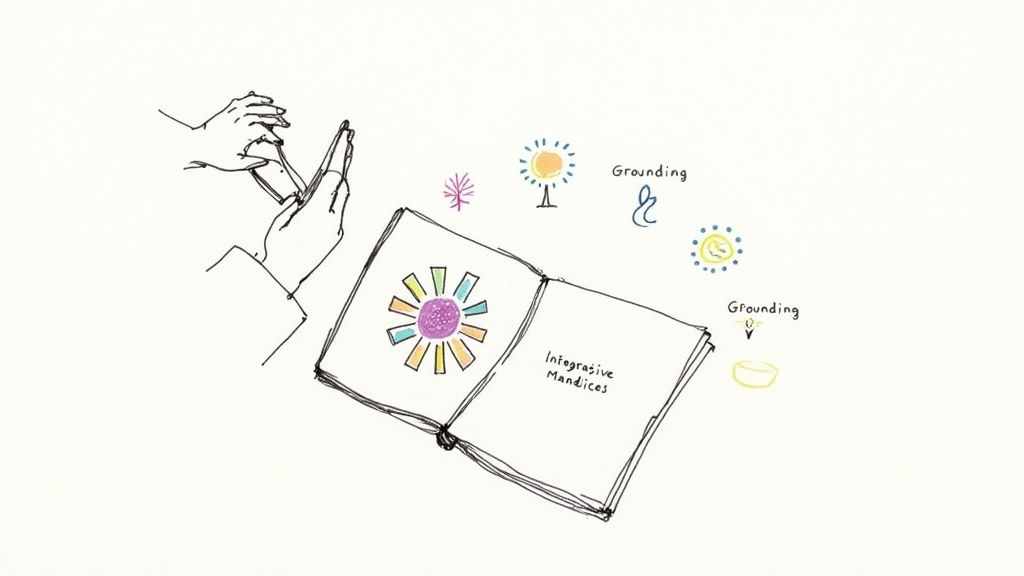
One of the most classic and effective methods is mandala drawing. You don’t need any artistic skill. Just grab a piece of paper, and using crayons or pastels, create a drawing inside a circle that represents what you experienced. Let your hand move freely. Pick colors and shapes that feel right, without any judgment about what you’re creating.
Here are a few other things you can do right away:
- Mindful Journaling: Don’t try to write a neat, linear story. Actionable prompt: Start your journaling with these phrases: “Images I remember…”, “Feelings that came up…”, “Sensations in my body…”.
- Embodied Movement: Gently and intuitively move your body. Maybe you stretch, sway, or even dance to a song that reflects the feeling of your journey. This helps ground the experience in your physical self.
- Connecting with Nature: Spend some quiet time outside. Walk barefoot on the grass, lean against a tree, or just look up at the sky. Nature has an incredible ability to help us ground and process deep experiences.
Navigating the Emotional Echoes
In the days that follow your breathwork, don’t be surprised if you notice some emotional ripples. Feelings that came up during the session—whether joy, grief, or anger—might resurface at unexpected times. The key is not to push them away or over-analyze them, but to simply witness them with compassion.
Think of these emotions as visitors. When they show up, just acknowledge them without needing to figure out exactly why they’re there. This simple act of witnessing is a powerful form of integration all on its own.
Action Step: When a strong emotion comes up, pause for 30 seconds. Place a hand on your heart, take one deep breath, and say to yourself, “It’s okay to feel this.” This simple act helps you practice acceptance instead of resistance.
Sharing Your Experience Thoughtfully
Talking about your journey is a vital part of integration, but it’s important to choose who you share it with. A non-ordinary state experience can be tough to explain to someone who isn’t familiar with this kind of inner work. Sharing with the wrong person can leave you feeling misunderstood or even invalidated.
Who to talk to:
- Your Facilitator or Group: If you were in a workshop, the group sharing circle is the ideal place. The facilitator and other participants understand the context of what you’ve been through.
- A Trained Therapist: A therapist with experience in transpersonal psychology or somatic therapies can be an invaluable partner in unpacking your insights.
- A Trusted Friend: Choose a friend who is open-minded and a great listener. Practical test: Ask yourself, “Can this person listen to my story without trying to ‘fix’ it or explain it away?” If the answer is yes, they’re a good candidate.
The deep self-exploration in holotropic breathwork often unearths profound insights, which can be a huge part of understanding and how to find your life purpose. These conversations are a key part of that discovery. This whole process shows how breathwork supports not just healing but deep personal growth. You can explore more about https://9dbreathwork.com/resources/transforming-life-through-breath-control/ to understand the deeper mechanisms at play.
Ultimately, Holotropic Breathwork is a practice that uses accelerated breathing to access deeply held material, often in sessions lasting 2–3 hours with trained facilitators. The goal is to work through emotional and psychological blocks that other methods might not reach. Integration is the bridge that carries that healing from the mat into the rest of your life.
Common Questions About Holotropic Breathwork
Stepping into a practice as powerful as Holotropic Breathwork naturally brings up questions. It’s totally normal to feel a mix of excitement and maybe a little apprehension. Getting clear on what to expect isn’t just about the breathing technique itself—it’s about feeling ready, mentally and emotionally, for whatever your journey holds.
Let’s walk through some of the most common things people wonder about. My hope is that by tackling these head-on, you’ll feel more confident and can approach your first session with a sense of open curiosity rather than worry.
What if Nothing “Big” Happens?
I see this concern all the time. There’s a common misconception that every session has to be a fireworks show of dramatic emotional releases or cinematic visions. That kind of pressure can actually get in the way of the real work.
The truth is, there’s no such thing as a “correct” experience. Your psyche is incredibly intelligent; it will bring forward precisely what you need in that moment, which isn’t always what your conscious mind thinks it wants.
Some of the most profound journeys I’ve witnessed (and experienced myself) have been quiet and deeply restful. They might be focused on subtle physical sensations or a simple, overwhelming feeling of peace. Other times, the real insights don’t land like a thunderclap during the session. They arrive as quiet whispers, gently unfolding in the days and weeks that follow.
Actionable reframe: Instead of asking “Did something big happen?” ask “What did I notice?” This shifts your focus from judgment to curiosity, which is the true goal of the practice.
Can I Just Do This by Myself at Home?
This is a critical question, and I have to be direct: especially for anyone new to this work, the answer is a firm no. Holotropic Breathwork is an incredibly potent practice. It can open you up to the full spectrum of human experience, from states of pure bliss to the surfacing of deep, unresolved trauma.
There’s a reason certified facilitators go through a demanding, multi-year training program. They are taught specifically how to create and hold a safe space for this kind of deep exploration. They know how to offer supportive bodywork, help you navigate challenging psychological material when it arises, and guide you through the crucial integration process afterward. These aren’t just nice-to-have skills; they are essential for a safe and effective journey.
If you decide to practice without a professional down the line, having a knowledgeable and grounded “sitter” is non-negotiable. But for anyone just starting out, the safest and most effective way to build a solid foundation is to find a workshop led by someone who is properly certified.
Isn’t This Just Like Other Kinds of Breathwork?
While many practices use the breath as a primary tool, they often have very different intentions and methods. It’s useful to see where Holotropic Breathwork stands in relation to a few others you might have heard of.
- Wim Hof Method: This is primarily about building physical and mental resilience. It uses very specific, controlled breathing patterns followed by breath holds, often combined with cold exposure, to consciously influence the autonomic nervous system and immune response.
- Rebirthing Breathwork: As the name suggests, this technique is often focused on healing trauma related to birth and early childhood. It typically involves a gentler, connected circular breath in a therapeutic setting to release suppressed emotional patterns.
- Holotropic Breathwork: Coming from the world of transpersonal psychology, this method uses a faster, deeper breath combined with powerful, evocative music. The goal is much broader: to access the entire spectrum of human consciousness—from personal memories to archetypal, perinatal, and spiritual realms—all in service of the psyche’s natural movement toward wholeness.
How Do I Find a Certified Facilitator?
Finding a well-trained, certified facilitator is the single most important step you can take to protect your well-being and ensure the integrity of your experience. The official organization that oversees this is Grof® Transpersonal Training, founded by the creators themselves, Stanislav and Christina Grof.
Their website is the best resource, as it has a global directory of people who have completed the full, extensive training program. Be wary of anyone offering “holotropic-style” breathwork without legitimate certification. A certified facilitator has proven they have the skills needed to hold a professional, safe container for your deep inner work. Taking the time to find one is an investment in yourself.
At 9D Breathwork, we’re inspired by the power of the breath to create profound shifts from the inside out. Our approach marries the ancient wisdom of breathwork with modern science, weaving together hypnotic guidance, binaural beats, and subliminal messaging to help you disrupt old patterns right at their source.
If you’re ready to explore your potential and rewire your inner world, we invite you to discover our immersive journeys today.